



















































Understanding Accredited Meaning Before Choosing a Certification Program
Understand accredited meaning before choosing a certification program in 2026. Learn how accreditation supports quality, credibility, and industry recognition.


Accredited meaning, in the context of certification programs, refers to formal recognition that a training body, course, or credential has been independently evaluated against defined quality, content, and assessment standards — and passed. It is not a synonym for official-sounding or widely used. A program can be popular and still carry zero accreditation. True accreditation involves a named accrediting body, published criteria, periodic re-evaluation, and a public register you can check. In 2026, with AI-generated course marketplaces flooding the market, understanding this distinction is the single most useful skill a learner can have before spending money on a certificate.
Key Takeaways
- Accredited is a specific, checkable claim — not marketing language. If a provider can't name who accredited them and point to a public listing, treat the claim as unverified.
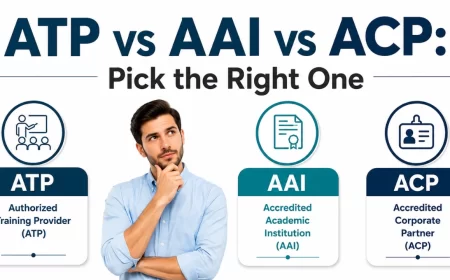
- There's a difference between an Accredited Academic Institution (degree-granting, regionally/nationally recognized), an Authorized Training Provider (ATP) (licensed to deliver a specific accredited curriculum), and an Accredited Corporate Partner (an organization whose internal training has been benchmarked against an external standard).
- Accreditation protects three things at once: the learner's money, the employer's hiring decision, and the credential's long-term value.
- The certification industry has quietly become a multi-billion-dollar market, and with that growth has come a parallel rise in diploma-mill-style accreditation that mimics the real thing.
- A working framework — verify, cross-check, question — takes under 15 minutes and eliminates most bad decisions before you enroll.
- Employers increasingly run their own quiet verification checks; a credential that can't survive that check is a liability on a resume, not an asset.
The Word Everyone Uses and Almost No One Defines
Type best data analytics certification into any search engine and you'll get eleven results in the first screen claiming to be internationally accredited, globally recognized, or industry-accredited. Read the fine print on most of them and you'll find nothing — no accrediting body named, no registration number, no way to verify the claim independently. It's not necessarily fraud. Often it's just marketing shorthand that has drifted so far from its original meaning that the word has become almost decorative. That drift has a cost. A 2023 LinkedIn Learning report found that 76% of professionals said a certification influenced a hiring or promotion decision at some point in their career — yet a separate HR survey by the Society for Human Resource Management found that nearly 4 in 10 hiring managers had encountered a candidate whose certification turned out to be unverifiable or issued by a defunct or non-existent accrediting body. Those two numbers sitting next to each other tell the real story: certifications matter enormously, and a meaningful share of them don't hold up to scrutiny.
This article exists to fix that gap. Not with vague reassurance, but with a working definition of accredited meaning, a practical way to test any provider's claims, and a full map of how the accreditation ecosystem actually functions — from academic institutions down to individual course providers and corporate training partners. By the end, you'll be able to look at any certification page and know, within minutes, whether the accreditation claim is real, partial, or decorative.
The Fundamentals — What Accredited Really Means
At its core, accreditation is a third-party quality judgment. Someone other than the organization selling you the course has looked at its curriculum, its assessment methods, its instructor qualifications, and its outcomes data, and formally certified that it meets a defined bar.
Three elements have to be present for the word to mean anything:
1. An independent accrediting body. This cannot be the training provider itself, a sister company, or an internal quality board invented for the purpose. It needs to be a separate organization with its own standards, history, and reputation to protect.
2. Published, checkable criteria. Real accrediting bodies publish what they evaluate — curriculum hours, assessment rigor, instructor credentials, learner outcomes, renewal cycles. If a provider says we're accredited but can't tell you against what standard, the claim is empty.
3. A public registry or verification path. This is the part almost everyone skips. Genuine accreditation almost always comes with a way to verify it independently — a searchable database, a certificate number, or a directory entry maintained by the accrediting body, not the training provider.
Miss any one of these three and what you're looking at is a claim, not an accreditation. That distinction is where most bad decisions are made.
A Quick Mental Model
Think of accreditation like a restaurant health inspection certificate. The restaurant didn't write its own grade. A city health department — an external, standards-based, periodically-renewing authority — did the inspection and posted the grade publicly. If a restaurant just printed A+ Clean Kitchen on a laminated sign it made itself, you'd rightly be suspicious. Certification programs work the same way. The grade needs to come from somewhere other than the entity being graded.
How Accreditation Actually Works — The Mechanics Behind the Word
Understanding the process makes the meaning stick far better than any definition alone.
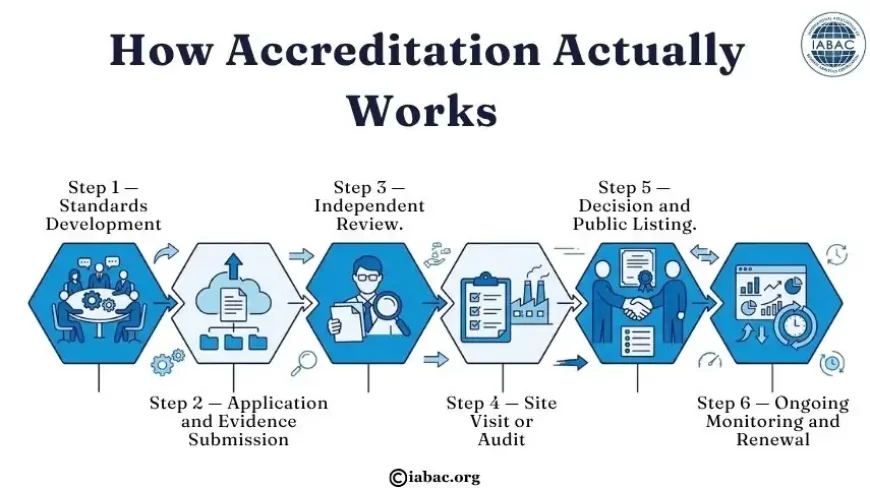
Step 1 — Standards Development. An accrediting body first defines what good looks like in a given field: minimum instructional hours, competency frameworks, assessment methodology, instructor qualification thresholds, and renewal requirements.
Step 2 — Application and Evidence Submission. A training provider or institution applies, submitting curriculum documents, instructor CVs, sample assessments, and learner outcome data.
Step 3 — Independent Review. Reviewers — often practitioners in the field, not marketing staff — assess the submission against the published standard. This can take weeks or months, not days.
Step 4 — Site Visit or Audit (where applicable). For academic institutions and larger training bodies, this often includes an on-site or virtual audit of actual delivery, not just paperwork.
Step 5 — Decision and Public Listing. If approved, the provider is added to a public registry, usually with a unique identifier, an approval date, and an expiry or renewal date.
Step 6 — Ongoing Monitoring and Renewal. Accreditation isn't permanent. Reputable bodies require re-certification every 1–5 years, with continued compliance checks in between.
This is precisely why accredited should feel like a process word, not a label word. It describes something that happened over time and continues to be checked — not a sticker that was purchased once and never revisited.
The Three Types of Accreditation You'll Actually Encounter
Most confusion in this space comes from people assuming all accredited claims are the same type. They aren't. Here's the breakdown that matters most for anyone evaluating a certification program.
Accredited Academic Institution
This is the type most people are already familiar with — universities and colleges recognized by a national or regional accrediting authority (in the U.S., bodies recognized by the Department of Education; in the EU, national quality assurance agencies; and so on). Their degrees, diplomas, and academic certificates carry weight because the institution itself has been vetted, not just a single course.
Authorized Training Provider (ATP)
This is a distinct and often misunderstood category. An ATP is an organization that has been licensed or authorized by a certifying or accrediting body to deliver that body's specific curriculum and prepare learners for its certification exam. The ATP doesn't invent the certification — it delivers a standardized one under a formal agreement, often with requirements around instructor qualification, materials fidelity, and reporting.
This model is common in professional and technical certification (project management, data science, quality management, HR, cybersecurity, and similar fields). The value of the ATP model is consistency: whether you take the course through one authorized provider or another, the underlying certification standard is identical, because both are bound by the same licensing agreement with the accrediting body.
IABAC (International Association of Business Analytics Certifications) is a widely referenced example of a body that operates this exact ATP structure — training providers apply to become Authorized Training Providers, deliver IABAC-aligned curricula, and learners receive a certification tied back to IABAC's own standards and verification registry, rather than a credential invented solely by the training company.
This category applies when a company's internal training function — the department that trains its own employees or clients — has been benchmarked against an external standard. It's less about a public-facing course and more about organizational capability: proof that a company's L&D (learning and development) function meets a recognized bar for instructional design, delivery quality, or competency measurement. This matters increasingly in B2B contexts, where a client wants assurance that a vendor's certified staff were actually trained to a real standard, not an internal one made up for a sales deck.
Comparison at a Glance
|
Type |
Who Is Being Evaluated |
What It Guarantees |
How to Verify |
|
The institution as a whole |
Degree/diploma meets national or |
National accreditation |
|
|
Authorized |
The training provider's right to |
Course content and exam are |
Accrediting body's official |
|
Accredited |
An organization's internal |
Internal training/competency |
Accrediting body's |
Why This Distinction Actually Matters — The Real Stakes
It's tempting to treat this as pedantic word-parsing. It isn't. Three groups of people carry real risk when accreditation claims go unchecked.
- For the learner: Certification programs range anywhere from a few hundred to several thousand dollars, plus the opportunity cost of the hours spent studying. A credential from an unaccredited or self-accredited provider can leave someone with a certificate that means nothing to the next employer — a sunk cost dressed up as an achievement.
- For the employer: Hiring managers increasingly treat certifications as a proxy for competency, especially in technical and analytical fields where skills are hard to assess in a single interview. If that proxy is unreliable, a company risks hiring based on false signal — a cost that shows up months later in performance gaps, not at the interview stage.
- For the field itself: When accredited gets diluted by widespread misuse, it erodes trust in legitimate credentials too. Genuine Authorized Training Providers and accredited institutions end up competing on a level playing field with providers who simply printed the word on their homepage — until someone actually checks.
A 2024 industry survey by the Institute for Credentialing Excellence found that over 60% of employers said they had, at some point, discovered that a candidate's listed certification could not be verified through any public or official channel. That's not a fringe problem. That's a majority-adjacent trend.
Benefits of Choosing a Genuinely Accredited Program
- Portability. A credential tied to a recognized accrediting body tends to be recognized across employers, industries, and even countries, rather than being meaningful only to the single company that issued it.
- Structured, benchmarked learning. Accredited curricula are built against defined competency standards, not assembled ad hoc, which tends to produce more consistent skill outcomes.
- Verifiable proof. A public registry entry means you (and any future employer) can prove the credential is real in seconds, rather than relying on a PDF certificate that could have been generated by anyone.
- Renewal discipline. Because accredited programs require periodic re-certification, the underlying standard tends to stay current rather than freezing at whatever was true the year it launched.
- Career signaling in competitive markets. In fields flooded with self-taught and bootcamp-trained candidates, a verifiably accredited certification is one of the few objective differentiators left on a resume.
Challenges and Risks
The accreditation ecosystem isn't without friction, and it's worth being honest about where it gets messy.
Accreditation mills. Just as diploma mills issue fake degrees, a parallel practice has emerged where organizations create their own accreditation council — often with an official-sounding name — solely to accredit their own courses or a small circle of partner providers. This is the single most common trap learners fall into, because the language looks identical to genuine third-party accreditation.
Regional recognition gaps. A certification accredited in one country or region may not automatically carry the same weight elsewhere, particularly for regulated professions. Always check whether recognition is regional or international in scope.
Accreditation without relevance. A program can be genuinely accredited by a real body and still be a poor fit if that body's standards don't align with what the target industry actually values. Accreditation answers is this legitimate, not is this the right skill for my career.
Speed of industry change vs. renewal cycles. In fast-moving fields (AI, cybersecurity, data analytics), a 3–5 year renewal cycle can mean curricula lag behind real-world practice unless the accrediting body has a strong mid-cycle update mechanism.
AI-generated course proliferation (2026-specific risk). The rise of AI tools capable of generating polished-looking course content and certificates at scale has made it easier than ever to produce something that looks accredited without any of the underlying process. Visual polish is no longer a reliable signal of legitimacy — if it ever was.
An ATP Practical Verification Framework — Verify, Cross-Check, Question
This is the part meant to be used, not just read.
1. Verify. Search for the accrediting body by name — separately from the training provider's website. Does it have its own independent web presence, history, and other accredited partners listed? Does the training provider appear in the accrediting body's own public directory, not just claim membership on its own homepage?
2. Cross-check. Look for the certification in independent professional communities, forums, or industry associations. Is it recognized by name in job postings or professional discussions, or does it only appear in the marketing of the single company selling it?
3. Question. Ask the provider directly: Who accredited you? When was your last renewal? Can you share your registration or authorization number? A legitimate Authorized Training Provider will answer these instantly and often display the number publicly. Hesitation, vagueness, or redirection is itself useful information.
Real-World Scenarios
Scenario A — The Bootcamp Certificate That Went Nowhere. A learner completes a 6-week certified data analytics bootcamp that heavily used the word accredited throughout its marketing. When applying for a role requiring a recognized analytics credential, the hiring manager searches the certifying body's name and finds no registry, no other partners, and a website registered the same month the bootcamp launched. The credential added no weight to the application — not because the skills weren't real, but because the accreditation claim couldn't survive a two-minute check.
Scenario B — The ATP Route Done Right. A working professional researching business analytics certifications finds a training provider listed on IABAC's public Authorized Training Provider directory. Because the ATP status is verifiable directly through IABAC rather than only through the training company's own claims, the learner enrolls with confidence that the certification will be recognized under IABAC's standard regardless of which authorized provider delivered the course.
Scenario C — The Corporate Partner Angle. A mid-sized consulting firm wants to reassure enterprise clients that its internal analytics training program meets external quality standards, not just an internally designed curriculum. By pursuing recognition as an Accredited Corporate Partner under a recognized certifying body, the firm can point clients to third-party validation rather than asking them to simply trust an internal claim.
Tools and Technologies Shaping Verification in 2026
- Digital credential verification platforms — blockchain-backed or API-based badge systems (e.g., Open Badges-compliant platforms) that let anyone verify a certificate's authenticity and issuing body in seconds, rather than relying on a static PDF.
- Accrediting body public registries — searchable databases of authorized providers, partners, and certified individuals, increasingly standard practice among legitimate accrediting organizations.
- LinkedIn certification verification integrations — direct links from a profile's certification section to the issuing body's verification page, making fabricated credentials easier to spot at a glance.
- AI-assisted due diligence tools — emerging tools that cross-reference a claimed accrediting body against known registries, domain age, and organizational history to flag likely accreditation-mill patterns.
Implementation Roadmap — Choosing a Program Step by Step
- Define the outcome first. Decide what the certification needs to prove (a specific skill, a role-readiness signal, a compliance requirement) before searching for programs.
- Shortlist 3–5 programs based on relevance to that outcome, not just search ranking or ad placement.
- Run the verify–cross-check–question framework on each shortlisted program.
- Compare renewal and update cadence — how often is the curriculum revised, and what's required to maintain the credential?
- Check delivery format fit — self-paced, cohort-based, instructor-led, or hybrid — against your actual schedule and learning style.
- Confirm cost transparency — total cost including exam fees, retake fees, and renewal fees, not just the advertised course price.
- Enroll, and document your own proof — save the registration number, accreditation reference, and verification link the moment you enroll, rather than searching for them later.
- Plan the renewal date into your calendar the same day you receive the credential.
Common Failure Points (And How to Avoid Them)
- Relying only on the provider's own homepage for accreditation claims. Always verify externally.
- Assuming visual polish equals legitimacy. A well-designed certificate PDF proves design skill, not accreditation.
- Ignoring the renewal clause. A credential earned under an accreditation that has since lapsed may no longer carry the weight it once did.
- Choosing based on price alone. Unusually cheap accredited certifications relative to the rest of the market are worth extra scrutiny, not automatic suspicion, but scrutiny.
- Skipping the who accredited you question. This single question, asked directly, eliminates a large share of bad choices before enrollment.
Future Trends in Accreditation (2026 and Beyond)
- Micro-credential stacking. Expect accrediting bodies to increasingly support smaller, stackable credentials that combine into a larger recognized qualification over time, rather than one large all-or-nothing certification.
- Real-time verification is becoming the default, not the exception — static PDF certificates without a live verification link are likely to be viewed with growing skepticism by employers.
- Tighter scrutiny of AI-content-based courses. As course creation becomes trivially fast with AI tools, expect accrediting bodies to add specific criteria around human-reviewed instructional design and assessment integrity.
- Growth of the ATP model globally, as accrediting bodies scale reach through authorized partners rather than direct delivery, making the who your ATP relationship is increasingly relevant across regions.
- Employer-side verification automation, where HR systems automatically cross-check listed certifications against public registries during the hiring process rather than trusting resume claims.
Career Opportunities Tied to Verified Accreditation
Professionals who understand and can navigate accreditation correctly often find advantages beyond the certification itself:
- Faster resume screening. Verifiable credentials reduce friction in applicant tracking systems and human review alike.
- Access to roles with compliance or client-facing trust requirements, where an unverifiable credential is a disqualifier regardless of actual skill.
- Consulting and training delivery roles, since understanding the ATP model is itself valuable if you ever want to deliver training under an accrediting body's authorization.
- Internal L&D and quality roles, where knowledge of accreditation standards is directly applicable to building or auditing a company's own training programs.
A Suggested Learning Path
- Start with foundational literacy — understand accreditation, ATP status, and verification basics (this article covers that ground).
- Identify your target competency area — the actual skill or domain the certification should validate.
- Shortlist accrediting bodies relevant to that domain, then look at their Authorized Training Provider networks rather than starting from a single course listing.
- Choose a delivery format and provider verified through that accrediting body's own registry.
- Complete the program with intention — treat the assessment as a genuine skill checkpoint, not a formality.
- Maintain the credential — track renewal dates and continued education requirements as part of ongoing professional development, not a one-time task.
Treat Accredited as a Question, Not a Guarantee
The word accredited carries real weight — but only when it's backed by an actual external body, published standards, and a verifiable public record. Everything else is marketing language borrowing the credibility of a word it hasn't earned. The good news is that verifying the real thing takes minutes, not hours: name the accrediting body, check its independent registry, and ask the provider directly for their authorization details.
Whether you're evaluating an Accredited Academic Institution, considering a course through an Authorized Training Provider, or assessing whether a company qualifies as an Accredited Corporate Partner, the same three-step discipline applies every time. Organizations like IABAC, which operate a transparent Authorized Training Provider structure with a public verification path, illustrate what the legitimate version of this system looks like in practice — a useful benchmark to compare any provider against before you enroll.
Actionable Next Steps
- Before enrolling in any certification program, search the accrediting body's name independently of the provider's website.
- Ask the provider directly for their authorization or registration number — and expect an immediate, specific answer.
- Bookmark the accrediting body's public registry entry for your own future reference and resume verification.
- Set a calendar reminder for your credential's renewal date the day you receive it.
- Share this verification framework with colleagues before they enroll in a program, not after.
Sources Referenced
- LinkedIn Learning, Workplace Learning Report (industry survey on certification impact on hiring and promotion decisions)
- Society for Human Resource Management (SHRM), research on credential verification challenges among hiring managers
- Institute for Credentialing Excellence (ICE), industry survey on employer verification practices
- HolonIQ, global education and workforce training market analysis
- International Association of Business Analytics Certifications (IABAC) — Authorized Training Provider framework and public verification registry (iabac.org)
- Open Badges standard documentation on digital credential verification infrastructure