





















































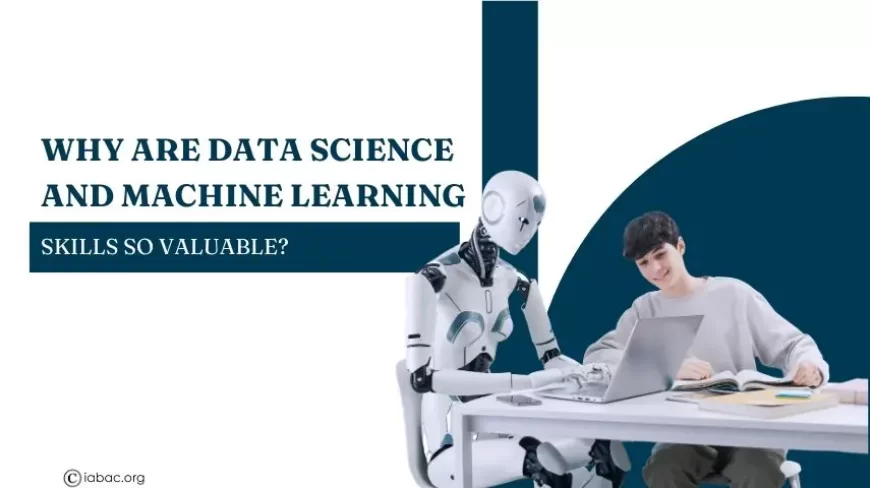
Why Are Data Science and Machine Learning Skills So Valuable?
Data Science and Machine Learning skills are in high demand as employers seek professionals to build AI solutions, analyze data, and support growth in 2026.

A newly released global report confirms what many organizations are already feeling firsthand: demand for professionals skilled in data science and machine learning is climbing fast, and the talent pool simply isn't keeping pace. Companies everywhere are sitting on mountains of data — yet turning that data into real business value remains a persistent challenge. From hospitals and banks to retailers and logistics providers, organizations have never had more information at their fingertips. What they lack is enough skilled people who can analyze it, build machine learning models from it, and translate the results into smarter decisions.
The 2026 report finds that demand for data science and machine learning expertise is outpacing the available supply of qualified professionals by a wide margin. Companies across nearly every country are now competing for the same limited pool of talent. According to the report, the bottleneck isn't technology — it's people. Organizations have the tools; what they're missing are professionals who can put those tools to work effectively.
Key Findings From the 2026 Report
The report's headline numbers paint a clear picture of the current market:
- Data science and machine learning roles are projected to grow 40% globally by 2030.
- Worldwide, more than 4 million data science and machine learning positions remain unfilled in 2026.
- Senior professionals in the United States earn an average of roughly $145,000 per year.
- 82% of Fortune 500 companies rank machine learning talent as their top technical hiring priority.
Together, these figures confirm an industry in the middle of an aggressive, sustained hiring push.
What the Report Reveals
The report, compiled with input from industry organizations and academic institutions, found that job postings requiring combined data science and machine learning skills rose 67% globally between 2023 and 2026. Employers have moved past hiring for narrow specialties. They no longer want candidates who understand only data analysis, or only model-building — they want professionals who can own the entire pipeline, from raw data collection through model deployment and stakeholder reporting.
Three forces are fueling this shift:
1. Rapid Adoption of AI Tools: Businesses raced to adopt AI-powered tools between 2022 and 2025. Automation alone wasn't enough — these systems still need skilled people to monitor, refine, and evaluate them. Buying the technology turned out to be the easy part; understanding and operating it is where the real demand emerged.
2. New AI Regulations: Governments in the European Union, the United Kingdom, Singapore, Brazil, Canada, and elsewhere have introduced formal rules governing AI use. This regulatory wave has created fresh demand for professionals who can interpret model behavior, support audits, and ensure compliance — pushing AI governance and ethics skills higher up the hiring checklist.
3. Explosive Data Growth: Global data volumes keep climbing as businesses pull information from customers, websites, apps, sensors, and internal operations. Traditional business intelligence and reporting tools increasingly struggle to keep up. Machine learning offers a way to process that scale efficiently — and that capability requires specialized talent to build and maintain.
A Global Shortage, Region by Region
The report shows that no region is immune to the talent gap:
|
Region |
Estimated Shortfall (2026) |
|
Asia-Pacific |
2.4 million |
|
North America |
320,000 |
|
Europe |
290,000 |
|
Middle East & Africa |
180,000 |
|
Latin America |
140,000 |
|
Rest of World |
110,000 |
India accounts for a large share of the Asia-Pacific gap. NASSCOM projects the country will need more than 1.8 million data science and machine learning professionals by 2027 — far beyond current supply. Comparable shortfalls show up in the United States, Canada, Germany, and Australia, underscoring that this is a global hiring emergency, not a regional one. Companies need this talent now — not years down the road.
What Data Science and Machine Learning Mean Together
Data science is the discipline of collecting, cleaning, analyzing, and interpreting data. Machine learning is the discipline of building systems that learn patterns from that data and generate predictions. Combined, they let a single professional manage the full journey from raw data to business impact.
Take a retail company trying to spot customers at risk of churning. A combined data science and machine learning professional would:
Gather customer data from multiple sources.
- Clean and structure the dataset.
- Identify the strongest predictive features.
- Build and train a machine learning model.
- Validate the model's accuracy.
- Present findings to business stakeholders.
- Deploy the model into ongoing use.
That end-to-end fluency — technical depth paired with business context — is exactly what today's employers are hiring for.
The Skills Employers Are Screening For in 2026
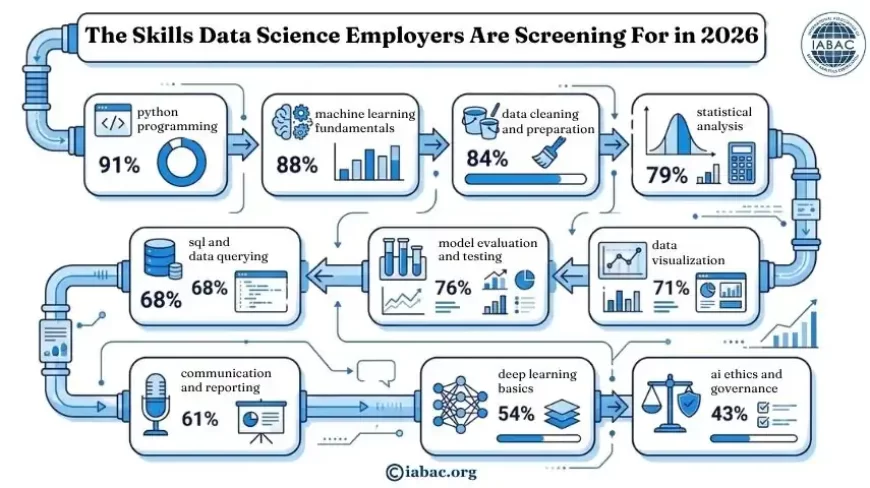
Analysis of job postings shows these skills appearing most frequently:
- Python Programming – 91%
- Machine Learning Fundamentals – 88%
- Data Cleaning and Preparation – 84%
- Statistical Analysis – 79%
- Model Evaluation and Testing – 76%
- Data Visualization – 71%
- SQL and Data Querying – 68%
- Communication and Reporting – 61%
- Deep Learning Basics – 54%
- AI Ethics and Governance – 43%
Communication stands out as a differentiator. Employers consistently say they want professionals who can translate technical results into plain language that non-technical teams can act on.
Why the Talent Gap Continues to Grow
The math behind the shortage is straightforward. Demand for data science and machine learning professionals is growing at roughly 22% per year, while the supply of qualified graduates is growing at only about 8% per year. That gap compounds annually, which is why the backlog of unfilled roles keeps climbing across industries and regions.
Why Traditional Education Alone Is Not Enough
University programs still deliver strong theoretical grounding, but many graduates arrive short on the practical, hands-on experience employers expect. Some know how to code but haven't worked on real machine learning projects. Others understand the underlying math but lack fluency with tools like Python, SQL, and modern ML frameworks.
This gap has driven up the value of industry-recognized certification programs that focus on job-ready, practical skills — and employers increasingly treat certification as proof that a candidate's skills are current and applicable.
How IABAC Helps Close the Skills Gap
The International Association of Business Analytics Certifications (IABAC) designed its Data Science Certifications specifically to build the skills employers are hiring for right now. The curriculum covers:
- Statistics
- Machine Learning
- Data Analysis
- Applied Projects
- Business Communication
Recognized in more than 170 countries, IABAC certifications give professionals a credential that travels across global job markets. The certification tracks support both newcomers to the field and experienced practitioners looking to sharpen their skills — and for recent graduates or career changers, certification adds a layer of credibility that resumes alone often can't provide.
Where the Hiring Is Happening
Several industries are ramping up hiring for data science and machine learning talent:
- Healthcare and Life Sciences — diagnosis support, patient care optimization, resource planning, medical research.
- Financial Services — fraud detection, risk assessment, customer analytics.
- Manufacturing and Supply Chain — predictive maintenance, quality control, demand forecasting.
- Government and Public Services — infrastructure planning, public health monitoring, service delivery.
- Retail and E-Commerce — recommendation engines, inventory management, dynamic pricing, customer behavior analysis.
Demand spans entry-level to senior roles across every one of these sectors.
Building a Career-Ready Foundation
- Professionals aiming to break into or advance in data science and machine learning should focus on:
- Mathematics — probability, statistics, and optimization concepts underpin how models actually work.
- Python Programming — still the most in-demand technical skill in job postings.
- Practical Projects — hands-on work demonstrates applied skill far better than coursework alone.
- Professional Certification — validates skills and signals ongoing commitment to the field.
- Communication Skills — the ability to explain technical findings clearly often separates top candidates from the rest.
The 2026 report sends a clear signal: organizations worldwide need more professionals fluent in both data science and machine learning. Demand keeps rising across healthcare, finance, manufacturing, government, and retail, while the qualified talent pool continues to lag behind. For anyone building a career in this space, the opportunity is substantial — companies are hiring aggressively, salaries remain strong, and the range of industries creating new roles keeps expanding. Professionals who combine practical experience, real project work, and recognized credentials are best positioned to take advantage of this demand. IABAC Data Science Certifications are built to help close that gap, covering the statistics, machine learning, applied project work, and communication skills employers continue to value across global markets.