
























































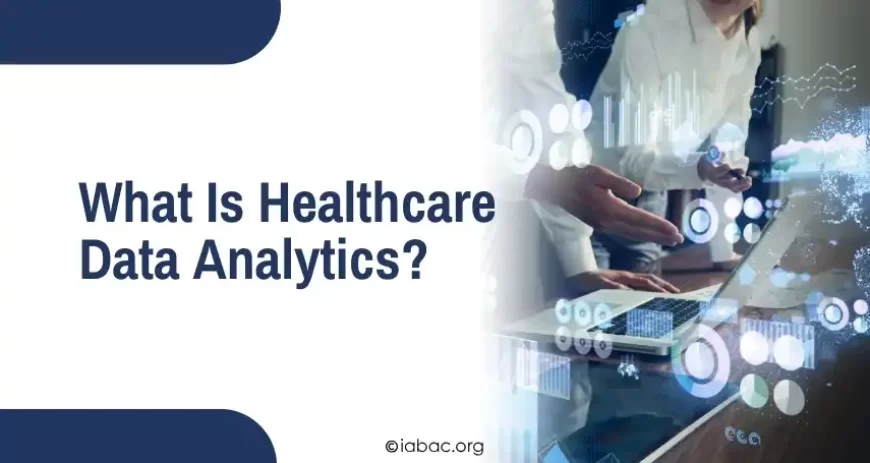
What Is Healthcare Data Analytics & How Does It Work?
What if your doctor could predict your illness before you even felt sick? That is exactly what healthcare data analytics is making possible today.

Think about the last time you visited a doctor. You described your symptoms, answered some questions, and waited for a verdict. Simple enough on the surface.
But what if your doctor already knew your risk factors before you even walked in?
That is no longer a far-fetched idea. Hospitals today are sitting on mountains of patient data, and the smart ones are finally learning how to use it.
Healthcare data analytics is what makes that possible. It helps doctors spot problems earlier, hospitals run more efficiently, and patients receive care that actually fits their individual needs.
What Is Healthcare Data Analytics?
Healthcare data analytics is the process of collecting health-related information from multiple sources, making sense of it, and using those insights to improve how care is delivered.
Think of it like running a busy restaurant. Every day, you track which dishes sell, when customers arrive, how long tables stay occupied, and what gets sent back to the kitchen. Over time, that data helps you make better decisions, what to cook more of, when to add staff, and which menu items to drop.
Hospitals work the same way. Instead of dishes and tables, the data involves patient health, treatment outcomes, staff schedules, and hospital budgets. And the stakes are much higher.
Healthcare data analytics sits right at the intersection of medicine, technology, and decision-making. Done well, it does not just save money, it saves lives.
Where Does All This Health Data Come From?
This is where most people are surprised. Healthcare data does not flow from one neat, organized place. It comes from dozens of sources, often in completely different formats.
Here is a quick look at the main ones:
-
Electronic Health Records (EHRs): Patient history, diagnoses, treatment notes, lab results, and medications.
-
Insurance and claims data: Billing records, procedure codes, and what treatments were covered.
-
Lab and pharmacy records: Blood work results, prescription history, and dosage changes.
-
Wearable devices: Fitness trackers, smartwatches, glucose monitors, and heart rate sensors.
-
Medical imaging: CT scans, MRIs, and X-rays are usually stored in separate systems.
-
Genomic databases: DNA-level data used for personalized medicine.
-
Public health registries: Disease tracking, vaccination records, and outbreak reports.
Here is the uncomfortable truth, though. Despite all of this data being generated every single day, the majority of it just sits there, across different systems, in different formats, largely untouched and never analyzed.
Healthcare analytics exists specifically to change that.
The 5 Types of Healthcare Data Analytics
Not all analytics is the same. There are five distinct types, and each one answers a different question. Think of them as a ladder; each step builds on the one below it.
1. Descriptive Analytics: "What happened?"
This is the foundation. Descriptive analytics looks at historical data to understand past events. How many patients came in last month? What was the average hospital stay? Which ward had the highest infection rate last quarter?
It is essentially a rearview mirror, useful for reporting, tracking performance, and setting baselines. Most hospitals already use this type, even if they do not formally call it analytics.
2. Diagnostic Analytics: "Why did it happen?"
Once you know what happened, the logical next question is why. Diagnostic analytics digs into the data to uncover root causes.
For example, why did patient readmissions spike in March? Was it a specific department, a particular diagnosis group, or a gap in the discharge process? This type of analysis helps teams stop guessing and start finding real answers.
3. Predictive Analytics: "What is likely to happen next?"
This is where things get genuinely powerful. Predictive analytics uses historical patterns and real-time data to forecast future outcomes.
Which patients are most likely to be readmitted within 30 days? Who is at risk of developing a chronic condition in the next two years? Which department is most likely to face a staffing gap next week? These are questions that predictive analytics can answer before the problem actually happens.
4. Prescriptive Analytics: "What should we do about it?"
Prescriptive analytics takes prediction one step further. It does not just tell you what will happen — it recommends what action to take.
Should this high-risk patient be called in for an earlier follow-up? Should the ICU add an extra nurse on Thursday night based on current admission trends? These recommendations come directly from the data — not from gut instinct.
5. Cognitive Analytics: "What can we keep learning?"
The most advanced type. Cognitive analytics uses machine learning to continuously improve its own understanding as new data comes in. It looks for patterns across medical records, genomic databases, and real-time feeds — and refines its recommendations over time.
It is less like a calculator and more like a system that gets smarter the more it is used.
How Does Healthcare Data Analytics Actually Work? Step by Step
Here is how the full process looks inside a real hospital or health system:
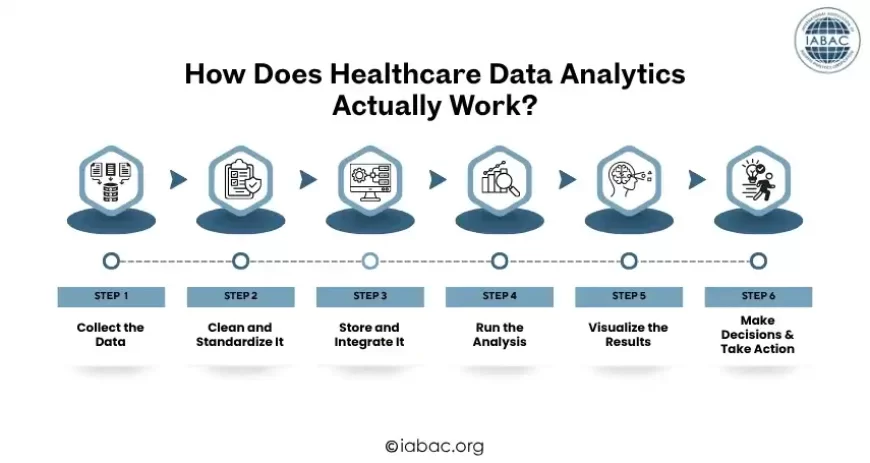
Step 1: Collect the Data
Data flows in continuously from EHRs, wearables, lab systems, billing platforms, and more. This happens largely in the background, without anyone manually entering anything.
Step 2: Clean and Standardize It
Raw health data is messy. Duplicate patient records, missing fields, inconsistent formats across departments — all of this needs to be cleaned and standardized before it is useful. This step is often the most time-consuming part of the entire process.
Step 3: Store and Integrate It
Cleaned data is brought together in a central location, usually a data warehouse or a cloud platform, where it can all be accessed and analyzed together, regardless of which system it originally came from.
Step 4: Run the Analysis
This is where the five types of analytics come into play. Analysts and automated tools look for patterns, build models, and generate insights from the combined dataset.
Step 5: Visualize the Results
Raw numbers mean nothing to a surgeon or a ward manager. Results are turned into dashboards, charts, and simple reports that non-technical staff can actually read and act on in real time.
Step 6: Make Decisions and Take Action
Finally and most importantly, those insights drive real decisions. A flagged high-risk patient gets a call. A staffing gap gets filled before it becomes a crisis. A treatment protocol gets updated based on what the data actually shows works.
This creates a continuous feedback loop. Better decisions lead to better outcomes. Better outcomes generate better data. And better data produces smarter decisions the next time around.
Real-World Applications That Are Already Working
This is not a theory or a future possibility. Healthcare data analytics is already running inside hospitals and clinics around the world, doing things that were not possible even a decade ago.
-
Catching deteriorating patients early: Predictive models track vital signs and flag patients whose numbers suggest they may crash hours before any visible warning sign appears at the bedside
-
Reducing hospital readmissions: Analytics identifies which discharged patients are most likely to return within 30 days, so care teams can follow up proactively rather than waiting for the crisis
-
Cutting medication errors: When patient data, allergy records, and drug interaction information are all connected, the chance of a dangerous prescribing mistake drops significantly
-
Smarter staff scheduling: Instead of relying on experience and guesswork, hospitals use data to predict patient volumes and match staffing levels to actual demand
-
Disease outbreak tracking: During COVID-19, analytics tools tracked infection rates, hospital admissions, and vaccination data across entire populations in real time, helping authorities respond faster
-
Personalized treatment plans: By analyzing patient history, genetics, and lifestyle data together, doctors can move away from one-size-fits-all treatment toward care that is genuinely tailored to the individual in front of them
-
Managing hospital finances: Analytics helps track billing inefficiencies, reduce claim denials, and keep the financial side of healthcare running without unnecessary waste
Why Healthcare Data Analytics Matters More Than Ever Right Now
Healthcare in 2025 is under real pressure. Costs are rising. Staff shortages are getting harder to ignore. Patients expect faster and more personalized care. And health systems are being pushed to prove outcomes, not just deliver services.
The scale of this shift is significant. The global healthcare analytics market was valued at $52.98 billion in 2024 and is projected to reach $198.79 billion by 2033, a clear sign that the entire industry is moving in one direction.
Analytics directly addresses all of this. Instead of reacting to problems after they happen, health systems can anticipate them. Instead of reviewing last quarter's numbers, administrators can monitor what is happening this morning. Instead of treating every patient the same way, clinicians can personalize care based on what the data shows about that specific individual.
The shift from reactive to proactive care is the single biggest promise of healthcare data analytics. And it is already happening in hospitals that have invested seriously in this capability.
The Real Challenges Nobody Talks About Honestly
Here are the challenges that deserve honest attention:
-
Data lives in silos: Different departments, different hospitals, different systems all hold pieces of the same patient's story. Getting them to share data cleanly is still a major technical and organizational challenge
-
Data quality is often poor: Missing fields, duplicate records, and inconsistent coding standards across departments. Poor-quality data leads to poor-quality insights, no matter how sophisticated the analytics tool is
-
Privacy and compliance are non-negotiable: Patient data is among the most sensitive information that exists. HIPAA in the US and GDPR in Europe set strict rules around how it can be collected, stored, and used, and those rules apply to every analytics project
-
Change resistance inside organizations: Doctors and administrators who have worked a certain way for decades do not automatically trust a dashboard over their own experience. Getting genuine buy-in across a hospital is often harder than building the technology itself
-
Uneven readiness for AI: Many organizations have invested in analytics tools but have not yet built the internal skills, governance frameworks, or data foundations needed to use them responsibly and at scale
Who Actually Uses Healthcare Data Analytics?
It is not just data scientists sitting behind computers. The insights from healthcare analytics touch almost every role across the entire ecosystem:
-
Doctors and clinicians: Use data to support diagnosis, choose treatments, and monitor patient progress over time
-
Hospital administrators: Use it to manage budgets, optimize operations, and make smarter resource decisions
-
Public health officials: Track disease patterns, plan vaccination campaigns, and coordinate responses to outbreaks
-
Insurance companies: Assess risk, detect fraud, and manage claims more accurately and efficiently
-
Pharmaceutical companies: Analyze clinical trial data, understand drug effectiveness, and speed up the research process
-
Patients: Benefit indirectly through faster diagnoses, fewer medication errors, and care that is more tailored to their individual needs
Where Is Healthcare Data Analytics Heading Next?
The field is moving fast, and the direction is clear. Here is what is shaping the next few years:
-
Wearables becoming clinical tools: Data from smartwatches and continuous monitors is starting to feed directly into patient records and trigger real clinical alerts.
-
AI reading medical images: Machine learning tools are being trained to detect tumors, fractures, and anomalies in scans, faster and in some cases more consistently than manual review alone.
-
Interoperability becoming standard: FHIR (Fast Healthcare Interoperability Resources) and HL7 (Health Level Seven) are finally pushing different health systems to share data cleanly and consistently across providers.
-
Predictive analytics going mainstream: What was once available only to large hospital networks is becoming accessible to smaller clinics and community health centers.
-
Human and AI working together: The future is not AI replacing doctors. It is AI handling the heavy lifting of pattern recognition while humans retain full authority over the final decision.
Healthcare data analytics is not a trend that will pass. It is the direction the entire industry is moving and for very good reason.
The hospitals and health systems that learn to use their data well are already catching diseases earlier, reducing errors, cutting unnecessary costs, and delivering care that actually fits the patient sitting in front of them.
For anyone working in healthcare today, whether you are a clinician, administrator, analyst, or policymaker, understanding how data analytics works is no longer optional. It is becoming as fundamental as understanding how a hospital itself operates.
If you are looking to build or sharpen your skills in this field, the IABAC Healthcare Analytics Certification is a great place to start