





















































Will AI Actually Deliver ROI?
Will AI actually deliver ROI? how businesses measure AI success, evaluate costs, and achieve real value from AI investments.


You have been in the room. The AI vendor finishes the demo. Everyone claps. The slide says '10x productivity.' And somewhere in your head, quietly, one question surfaces:
Will this actually return what we put into it?
That is the right instinct. The wrong move is what most leaders do next either buy anyway without a framework, or delay indefinitely waiting for certainty that never comes.
This blog will not try to convince you AI is worth it. It will do something more useful: show you exactly why that question 'will AI deliver ROI?' is itself the problem. And what you should be asking instead.
The Real Question Is Not Whether AI Delivers ROI
|
Metric |
Source |
|
95% |
of generative AI pilots produced zero measurable ROI on the P&L — MIT study of 300 enterprise deployments. |
|
2× |
revenue gains for companies getting AI right, vs those that don't — BCG 2025 research. |
|
42% |
of companies abandoned most of their AI projects in 2024, up from 17% the year before — S&P Global. |
It does. And it doesn't. Both are true, simultaneously, right now, across thousands of companies. Same technology. Wildly different outcomes. The variable is not the AI.
The variable is the question you asked before you started.
Companies that failed asked: "Which AI tool should we buy?"
Companies that won asked: "Which specific business problem costs us the most and can AI measurably fix it?"
Why Smart Leaders Still Get This Wrong
It is not a failure of intelligence. It is a failure of framing. The AI conversation has been dominated by two narratives, and both of them are traps.
|
Trap 1: The Hype Frame |
Trap 2: The Sceptic Frame |
|
→ AI will transform everything → Your competitors are already using it → You need to move fast or fall behind → The ROI will come — trust the technology |
→ AI is overhyped and underdelivers → The costs are too high for uncertain return → Wait until it matures before investing → We tried a tool once and it didn't work |
Leaders in the hype frame overspend on technology without a strategy. Leaders in the sceptic frame delay until the competitive gap becomes irretrievable. Neither frame produces ROI.
The leaders seeing real returns operate in a third frame entirely: they treat AI as a business decision, not a technology decision. They start with the cost of a problem, not the promise of a tool.
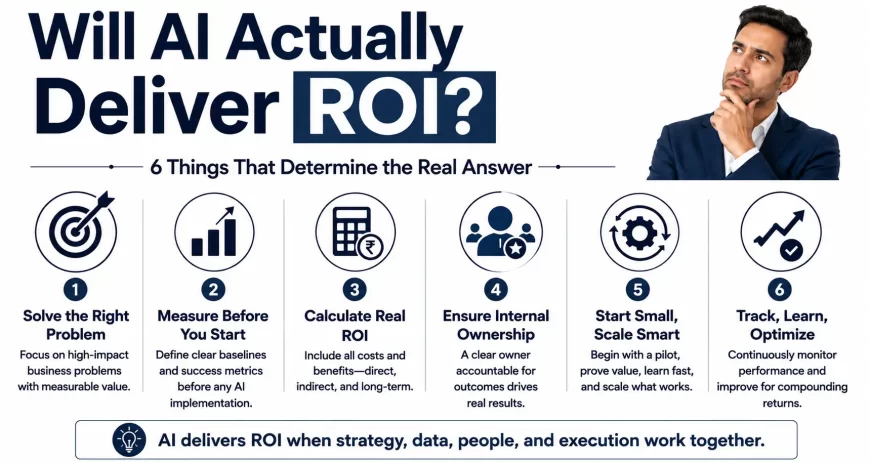
The Three Questions That Actually Determine AI ROI
Before any AI investment any tool, any consultant, any pilot three questions determine whether you will see a return. Most organisations skip all three.
1) What is the exact cost of the problem we are solving?
Not approximate. Not 'our team spends a lot of time on reporting.' Exactly. How many hours per week, at what salary, producing what output, with what error rate, causing what downstream delay. If you cannot answer this, you cannot measure ROI. You will spend money and argue about whether it worked.
The companies that see the fastest AI returns pick problems with a clear, defensible price tag. That price tag becomes the ROI baseline before a single rupee is spent.
2) Are we measuring from before, or just hoping for after?
This is where most AI projects quietly fail. Teams deploy an AI solution, then look for evidence it worked. But without a baseline measurement taken before implementation, any improvement is unprovable and any failure is invisible until it has already cost you.
ROI is not measured after the fact. It is designed before the start.
3) Who inside our organisation owns the outcome, not the tool?
AI tools do not own results. People do. The single strongest predictor of AI ROI is whether there is a named internal owner accountable for the business outcome, not the software vendor, not the consulting partner, not IT. Someone who answers: did this move the number?
Without that person, every AI project eventually becomes a cost line that nobody can defend.
The ROI You Expect vs. The ROI That Actually Arrives First
Most leaders expect AI to show up on the P&L immediately. That expectation is the single biggest cause of premature project cancellation. Here is how AI ROI actually moves through an organisation:
|
ROI Type |
What You Measure |
Realistic Timeline |
|
Hard ROI |
Revenue up, costs down — on the P&L |
12–24 months |
|
Operational ROI |
Speed, fewer errors, less manual work |
3–9 months |
|
Strategic ROI |
Competitive edge, data advantage |
18+ months, compounding |
The sequence matters more than the timeline. Operational ROI comes first and most organisations measure it wrong or not at all, which makes AI look invisible even when it is working.
What 'Wrong Questions' Cost in Practice
This is not abstract. The wrong question, asked at the start of an AI initiative, has a measurable cost:
- Wrong question: "Can we use AI for marketing?" → Result: a content tool that produces more output with no link to pipeline. Cost: tool subscription + team time + 6 months of confusion.
- Wrong question: "Should we build an AI chatbot?" → Result: a bot that handles 12% of queries and frustrates the other 88%. Cost: development, maintenance, customer complaints.
- Wrong question: "Which AI platform should we buy?" → Result: a licence for a powerful tool that the team does not know how to deploy against a real problem. Cost: licence + inertia.
The right question in each case: "What specific outcome do we need to move, by how much, by when and what would it be worth if we got there?"
Every failed AI project has a root cause. In most cases, it is not the technology. It is that nobody asked this question clearly before writing a single check.
Before Any AI Investment: A Five-Point Clarity Check
Run this before signing any contract, any consulting agreement, any software purchase. If you cannot answer all five, you are not ready to invest, you are ready to waste money.
- Name the problem in one sentence with a number in it: Not 'improve efficiency.' Something like: 'Our sales team spends 14 hours a week on manual CRM updates that produce no revenue.' That is a problem with the cost. That is investable.
- Know the baseline: Before AI: how long does the process take, how much does it cost, what is the error rate. Without this, you cannot prove ROI even if you achieve it.
- Define the 90-day proof point: What specific, measurable result in 90 days would tell you this is working? If the answer is vague, the pilot will be too.
- Name the internal owner: One person. Accountable for the outcome. Not the tool. Not the vendor relationship. The business result.
- Set the exit criteria: What does 'not working' look like in measurable terms? What happens if you reach that point? Defining this upfront is not pessimism, it is the discipline that separates serious investment from expensive experiments.
Why Most AI Initiatives Fail at the Strategy Layer, Not the Technology Layer?
The data on this is consistent. The MIT study. The S&P Global abandonment figures. The Gartner projections show 40% of agentic AI projects cancelled by the end of 2027. None of these failures were caused by the AI not working.
They were caused by organisations skipping the strategy layer entirely — going straight from 'AI is exciting' to 'let's deploy' without the structured thinking that connects technology to business outcome.
This is the gap that AI consulting exists to close. Not to sell you tools. Not to write a strategy document that sits in a drawer. But to build the structured bridge between your business problem and a measurable result — and hold accountability through delivery.
If you want to understand exactly where your business stands against these questions — and what a structured AI strategy would actually look like for your specific context — IABAC's AI consulting practice is the starting point. Not a sales conversation. A diagnostic one.
Frequently Asked Questions:
1) How fast can we realistically see ROI from AI?
Operational improvements — speed, fewer errors, reduced manual work — typically appear within 60 to 90 days when AI is applied to the right problem with a structured pilot. Financial ROI on the P&L usually takes 12 to 18 months. Companies that expect P&L impact in quarter one cancel projects that would have been delivered in year two.
2) What is a realistic ROI number to put in a business case?
McKinsey's data points to 13 to 15% revenue growth and 10 to 20% ROI improvement for organisations using AI strategically in sales operations. BCG found 2x revenue gains for top AI performers versus laggards. Neither number is guaranteed — both are the output of disciplined implementation, not technology deployment.
3) Which functions deliver AI ROI fastest?
Any function with high-volume, repetitive, data-rich processes: sales operations, customer support, document processing, finance back-office, marketing analytics. The more volume, the faster the return. Starting in a contained function with measurable output is almost always better than a broad transformation.
4) What separates companies that succeed with AI from those that fail?
One thing, consistently: they started with a specific, costly business problem — not a technology wish list. Every other best practice flows from that.
5) Is AI consulting worth the cost for a mid-size business?
The relevant comparison is not 'cost of consulting vs. no consulting.' It is 'cost of structured implementation vs. cost of unstructured implementation.' The second option is almost always more expensive — failed projects, abandoned licences, and lost months cost more than getting the strategy right upfront.
AI delivers ROI. The organisations seeing it are not smarter than you, better funded than you, or further ahead in technology than you might think. They made one different decision at the start: they defined the problem before they chose the tool.
If you have finished this blog and your honest answer to Question 1 — 'what is the exact cost of the problem we are solving with AI?' — is still vague, that is your actual starting point. Not a software demo. Not a vendor shortlist. A clear problem definition.
That is the question worth getting right.
Ready to move from the wrong questions to the right ones?
IABAC works with business leaders to build structured AI strategies tied to measurable outcomes not impressive demos. Start with a diagnostic conversation at iabac.org