



























































Is Analytics Consulting Necessary for Businesses?
Is analytics consulting necessary for your business? See when tools fall short, how clarity improves decisions, and where consulting drives measurable value.


For many organizations, analytics consulting initially feels like an optional investment rather than a necessity. Businesses already use dashboards, reporting systems, and analytics platforms that promise visibility into performance. With so many tools available, a reasonable question naturally arises:
If analytics technology already exists, is consulting truly required?
This doubt is both common and understandable. Leaders often assume that once analytics tools are implemented, meaningful insights and confident decisions should follow automatically. Yet, real-world experience across industries suggests a more complex reality.
Despite widespread adoption of analytics platforms, many businesses continue to struggle with decision uncertainty, conflicting reports, and difficulty translating data into action. These challenges reveal an important distinction: analytics tools generate information, but clarity requires structure and interpretation.
Understanding whether analytics consulting is necessary requires examining where analytics efforts typically succeed and where they quietly break down.
Why Businesses Often Question the Need for Analytics Consulting
Skepticism toward consulting is not irrational. Organizations invest heavily in internal teams, data infrastructure, and analytics technologies. From a managerial perspective, consulting may appear as an added cost rather than an immediate value driver.
Several assumptions commonly shape this viewpoint:
-
Modern analytics tools should deliver insights automatically
-
Internal teams already understand business operations
-
Dashboards provide sufficient visibility
-
Consulting is only relevant for large enterprises
However, analytics challenges rarely originate from technology limitations alone. More often, they arise from structural inconsistencies, measurement gaps, and interpretive complexity.
The Hidden Complexity Behind Business Analytics
On the surface, analytics environments often appear stable. Reports are generated regularly, dashboards display metrics, and data pipelines seem operational. Yet beneath this apparent order, organizations frequently encounter silent friction points.
Common issues include:
-
Metrics defined differently across departments
-
Data sources lacking integration or consistency
-
Reports measuring activity rather than outcomes
-
Dashboards presenting numbers without context
These challenges rarely trigger system failures, but they significantly affect decision quality. When metrics conflict or insights feel ambiguous, confidence erodes even in data-rich organizations.
Where Analytics Tools Alone Reach Their Limits
Analytics platforms excel at processing and visualizing data. However, they do not inherently resolve questions of measurement logic, interpretive alignment, or decision relevance.
Organizations commonly experience situations where:
✔ Dashboards exist but decisions remain uncertain
✔ Reports are generated but patterns remain unclear
✔ Data is abundant but insights feel inconsistent
Tools process data efficiently, yet they rely on predefined structures. If those structures lack coherence, analytics outputs may describe reality without explaining it.
What Analytics Consulting Actually Contributes
Analytics consulting addresses challenges that extend beyond software usage. Rather than replacing tools, consultants refine how analytics systems are designed, interpreted, and aligned with business objectives.
Consulting engagements typically focus on:
✔ Clarifying measurement frameworks and KPIs
✔ Identifying hidden data inconsistencies
✔ Structuring analytical workflows
✔ Aligning metrics with decision needs
✔ Improving interpretive reliability
Even modest improvements in measurement clarity or data consistency often produce noticeable gains in analytical usefulness.
Situations Where Analytics Consulting Becomes Highly Valuable
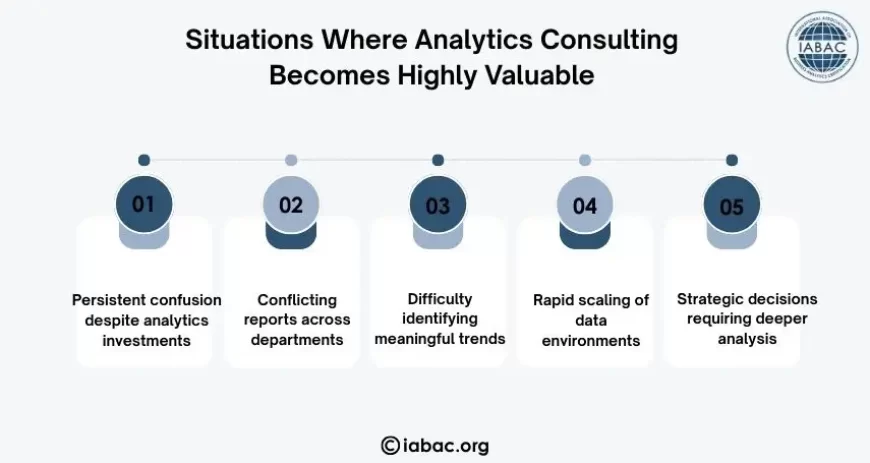
While not every organization requires consulting immediately, certain business conditions strongly benefit from external expertise.
Consulting frequently proves valuable when businesses experience:
-
Persistent confusion despite analytics investments
-
Conflicting reports across departments
-
Difficulty identifying meaningful trends
-
Rapid scaling of data environments
-
Strategic decisions requiring deeper analysis
In such scenarios, consulting helps compress prolonged trial-and-error cycles into structured resolution paths.
Cost vs Value: A Critical Perspective
Consulting is often evaluated purely as an expense. However, unresolved analytics problems frequently produce hidden operational costs. Inconsistent metrics, delayed insights, or misinterpreted data can influence decisions, resource allocation, and strategic planning.
Improved analytical coherence can generate value through:
✔ Reduced decision delays
✔ Greater interpretive confidence
✔ Better alignment across teams
✔ Enhanced performance visibility
The value of consulting lies not only in insights but also in reducing uncertainty and improving decision efficiency.
Does Every Business Truly Need Analytics Consulting?
Not necessarily.
Organizations with mature analytics frameworks, standardized measurement models, and highly stable data ecosystems may operate effectively without continuous consulting involvement. However, many businesses encounter inflection points where complexity, scale, or strategic shifts justify external expertise.
Consulting necessity depends less on organization size and more on analytical maturity and decision complexity.
Why Analytics Challenges Often Surface Over Time
Analytics environments evolve. As businesses scale, integrate new systems, and expand data collection, previously manageable inconsistencies can compound. Metrics that once aligned may diverge, and dashboards that once guided decisions may lose relevance.
Consulting engagements often help organizations adapt analytics frameworks to changing operational realities.
Why Many Organizations Eventually Seek Consulting Support
As data ecosystems become more complex, businesses frequently recognize that analytics effectiveness depends on structure, interpretation, and alignment rather than tool adoption alone.
This explains why organizations increasingly rely on analytics consulting services to refine measurement frameworks, stabilize insights, and enhance decision confidence.
Analytics consulting is not universally mandatory, yet it becomes highly valuable when organizations encounter structural, interpretive, or measurement challenges that limit the usefulness of analytics systems. By improving clarity, coherence, and reliability, consulting transforms analytics from passive reporting into practical decision intelligence.
Businesses evaluating the necessity of consulting often discover that the true question is not whether consulting is required, but whether existing analytics systems consistently support confident decisions.