


















































AI Voice Agents vs Traditional IVR Systems: Key Differences
Compare AI voice agents and traditional IVR systems. Learn the key differences in automation, customer experience, efficiency, and cost.

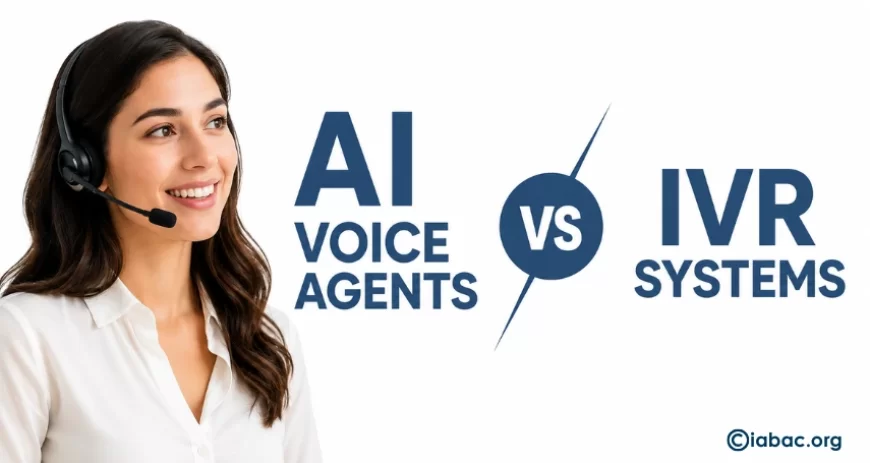
AI Voice Agents are changing that experience entirely. Instead of forcing customers through rigid menus, they listen, understand intent, and respond the way a knowledgeable employee would in plain conversation, not button presses.
This article breaks down exactly how AI Voice Agents differ from traditional IVR systems: the technology behind each, where they genuinely shine, where they fall short, and how to decide which one (or which combination) makes sense for your business in 2026.
What Is a Traditional IVR System?
IVR stands for Interactive Voice Response. It's the automated phone system that greets you with a recorded menu: “For sales, press 1. For support, press 2.”
Under the hood, IVR runs on rule-based logic. Every path is pre-programmed by a human designer. The system doesn't “understand” anything; it simply matches a keypress (or a very limited set of recognized words) to a pre-built branch in a decision tree.
How Traditional IVR Actually Works?
Early IVR systems used Dual-Tone Multi-Frequency (DTMF) to signal the tones generated when you press keys on a touchpad. Later versions added basic speech recognition, but usually limited to single words like “yes,” “no,” or “representative.”
The biggest limitation: IVR has zero conversational context. If you say “I need to check my balance, and also update my address,” it can't process two requests in one breath. It needs one menu choice at a time.
What Are AI Voice Agents?
AI Voice Agents are a completely different category of technology. Instead of a fixed menu, they use conversational AI to understand what a caller actually wants in natural, everyday language.
Say a customer calls and says, “Hey, I got charged twice for my last order and I want a refund.” An AI voice agent processes that full sentence, identifies the intent (billing dispute), pulls relevant account data, and can resolve it or route it intelligently all without a single “press 1” prompt.
The Technology Stack Behind AI Voice Agents
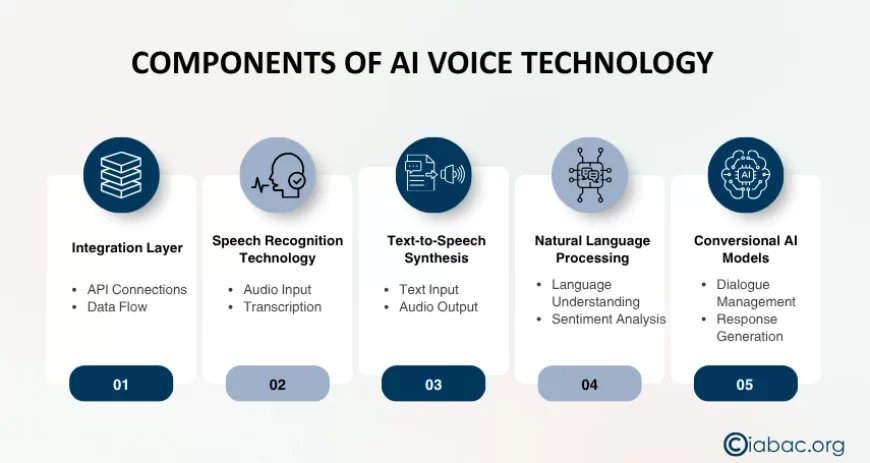
AI-powered voice assistants combine several technologies working together in real time:
- Speech recognition technology: converts the caller's spoken words into text the system can process.
- Natural language processing (NLP) for voice AI: analyzes that text to understand intent, sentiment, and context not just keywords.
- Conversational AI models: generate a relevant, human-like response and maintain context across the entire conversation, not just one turn.
- Text-to-speech synthesis: converts the AI's response back into natural-sounding voice output.
- Integration layer: connects to CRM, order management, and ticketing systems so the agent can actually take action, not just talk.
AI Voice Agents vs Traditional IVR
Here's where the differences become concrete. This comparison covers the dimensions that matter most to business leaders evaluating voice automation: conversational ability, customer experience, automation depth, scalability, and cost.
|
Factor |
Traditional IVR |
AI Voice Agents |
|
Interaction style |
Menu-driven, fixed keypress or simple voice commands |
Natural, free-flowing conversation in plain language |
|
Context handling |
None — each step is isolated, no memory of prior input |
Maintains context across the full call, including topic changes |
|
Problem complexity |
Handles simple, single-step requests only |
Handles multi-step, layered, or ambiguous requests |
|
Personalization |
Generic, scripted responses for everyone |
Tailors responses using account and conversation history |
|
Setup complexity |
Relatively simple to configure menu trees |
Requires AI training, integration, and tuning |
|
Scalability |
Scales call volume but not call complexity |
Scales both volume and complexity simultaneously |
|
Cost over time |
Lower upfront cost, but high escalation-to-human rates |
Higher upfront investment, lower long-term cost per resolved call |
|
Customer experience |
Often frustrating for non-trivial issues |
Closer to speaking with a knowledgeable human agent |
Conversational AI vs Menu-Based Interactions
This is the core philosophical difference. Menu-based IVR asks the customer to translate their problem into the system's language, fitting a messy real-world issue into one of five pre-set categories.
Conversational AI voice agents flip that relationship. The system adapts to the customer's language instead of the other way around. You describe your problem naturally, and the AI does the work of figuring out what you mean.
Think of it like the difference between filling out a rigid paper form with checkboxes versus explaining your situation to a person who actually listens and asks the right follow-up questions.
Quick callout: As businesses continue to adopt AI-powered voice technologies to improve customer engagement and operational efficiency, understanding the fundamentals of conversational AI, natural language processing, and intelligent automation can provide valuable insights into how these systems work. The Certified Artificial Intelligence Expert (CAIE) by IABAC offers structured learning in AI concepts and real-world applications, helping professionals build the knowledge needed to evaluate and implement modern voice AI solutions effectively.
Customer Experience Differences
Customer experience is where the gap between these two technologies is most visible and most costly if you get it wrong.
Where Traditional IVR Falls Short?
The frustration with IVR usually comes down to three things: rigid menus that don't match real problems, no memory between steps, and constant repetition when a call gets transferred to a human.
Anyone who has had to repeat their account number three times in one call once to the IVR, once to the first agent, once to the second agent has felt this pain directly.
Where AI Voice Agents Improve the Experience?
Automated customer support agents built on conversational AI remember what's already been said. If a customer mentions their order number early in the call, the agent doesn't ask for it again three minutes later.
They can also detect tone and urgency to some degree, adjusting pacing or escalating sensitive issues (like a billing dispute or a safety concern) to a human agent faster than a fixed menu ever could.
Automation Capabilities: How Much Can Each System Actually Do?
It helps to think about automation in three tiers.
Tier 1: Information Retrieval
Both systems can handle this —checking an order status, hours of operation, or account balance. This is IVR's comfort zone, and AI voice agents handle it just as easily, but faster and more naturally.
Tier 2: Transactional Tasks
This is where IVR starts to struggle. Rescheduling an appointment, processing a return, or updating billing details usually requires multiple data points and some judgment. Voice AI applications built on conversational AI handle these multi-step tasks far more reliably because they can track context across the whole exchange.
Tier 3: Judgment-Based Resolution
Complex complaints, emotionally charged situations, or anything requiring real discretion still benefit from human involvement. The best AI voice agent deployments don't try to fully replace humans here; they triage intelligently and hand off when needed, with full context already captured.
Scalability and Business Impact
Traditional IVR scales well in terms of raw call volume; it can technically handle a thousand calls at once. But it doesn't scale in terms of capability. A thousand simultaneous calls through IVR still only resolve the simplest issues.
AI Voice Agents scale on both dimensions. They can handle high call volume and complex requests simultaneously, which matters enormously during demand spikes, holiday seasons, product launches, or service outages, for example.
There's also a strategic angle: voice-enabled AI systems generate structured data from every conversation (intents, sentiment, common issues), which gives leadership visibility into customer pain points that a traditional IVR system simply can't capture.
Cost and Operational Considerations
IVR systems are cheaper to deploy initially, the technology is mature, vendors are plentiful, and the logic is straightforward to configure.
But that lower upfront cost often hides a higher operational cost: high escalation rates mean more calls reach human agents anyway, just after a frustrating detour through the menu first.
AI Voice Agents require more upfront investment in setup, integration with existing systems (CRM, ticketing, order management), and ongoing model tuning. The payoff is a lower cost per resolved interaction over time, since fewer calls need human intervention for routine issues.
The right approach for most businesses isn't “rip out IVR entirely” it's often a hybrid: AI voice agents handling the front line of conversation, with clean escalation paths to human teams for the cases that truly need them.
Step-by-Step Roadmap: Evaluating and Implementing AI Voice Agents
If you're considering a move from IVR to AI Voice Agents or layering AI on top of your existing system here's a practical sequence to follow.
- Audit your current call data: Identify the most common call reasons, average handle time, and current escalation rates from IVR to human agents.
- Define clear use cases: Don't aim to “automate everything.” Start with 2–3 high-volume, well-defined use cases like order status, appointment changes, or billing questions.
- Map your integrations: List every system the voice agent needs to talk to CRM, ticketing, payment processing and confirm API access exists.
- Choose your approach: build vs. buy. Evaluate vendor platforms versus custom-built solutions based on your team's technical capacity and timeline.
- Design escalation paths: Decide exactly when and how the AI hands off to a human, and make sure context transfers with the call so customers never repeat themselves.
- Pilot with a single channel or use case: Test with real call volume on one use case before expanding scope.
- Monitor, measure, and refine:Track resolution rate, customer satisfaction, and escalation accuracy, then retrain or adjust the conversational flows based on real call data.
- Scale gradually: Expand to additional use cases and channels (chat, SMS) once the voice agent is consistently performing well.
Building the Skills to Evaluate and Implement Voice AI: Certifications Worth Knowing
Evaluating AI Voice Agents intelligently, not just buying whatever a vendor pitches requires understanding the AI fundamentals underneath: machine learning, NLP, deep learning, and generative AI.
For business leaders and technical decision-makers who want that foundation, IABAC offers a set of recognized certifications covering exactly these areas. Here's how they compare.
|
Certification |
Focus Area |
Best For |
|
Certified Artificial Intelligence Expert (CAIE) |
AI fundamentals, ML, NLP, deep learning, conversational AI, real-world deployment |
Decision-makers evaluating or implementing voice AI, chatbots, and intelligent automation (Top Recommended) |
|
Certified Machine Learning Expert (CMLE) |
ML algorithms, model training, predictive systems |
Teams building or fine-tuning the prediction models behind voice AI |
|
Certified Generative AI Expert |
Generative models, large language models, prompt design |
Teams designing the conversational response generation layer |
|
Certified Deep Learning Expert (CDLE) |
Neural networks, deep learning architectures |
Engineers working on speech recognition and NLP model internals |
|
Certified Data Scientist (CDS) |
Data analysis, statistical modelling, data-driven decisions |
Analysts using voice interaction data to guide business strategy |
Why CAIE Is the Top Recommendation for This Topic?
Of these five, the Certified Artificial Intelligence Expert (CAIE) from IABAC is the strongest starting point specifically for understanding AI Voice Agents vs traditional IVR systems.
That's because AI voice agents aren't built on one isolated skill they're the product of several AI disciplines working together, and CAIE's curriculum maps directly onto that stack:
-
Artificial Intelligence fundamentals
-
Machine Learning concepts and applications
-
Natural Language Processing (NLP)
-
Deep Learning and Neural Networks
-
Conversational AI technologies
-
Real-world AI deployment strategies
Choosing Between AI Voice Agents and Traditional IVR
As AI continues to transform industries and redefine job roles, AI certifications have become a valuable way to validate skills, demonstrate expertise, and stay competitive in the workforce. Whether you are beginning your AI journey or looking to advance your career, certifications provide a structured path to learning the latest tools, techniques, and best practices.
Beyond enhancing technical knowledge, they signal a commitment to continuous learning and professional growth. In an era where organizations increasingly rely on AI-driven solutions, certified professionals are better positioned to seize new opportunities, contribute to innovation, and lead the future of intelligent technology with confidence.