















































Generative AI vs Traditional AI: Key Differences Explained
The key differences between Generative AI and Traditional AI, including how they work, their uses, benefits, and future impact.

The importance of the AI conversation in 2026
Artificial intelligence has moved well beyond the walls of Silicon Valley. It is actively changing healthcare diagnostics, educational design, software engineering, and executive decision-making across industries worldwide.
Yet despite its growing presence, many professionals and learners continue to treat Generative AI as synonymous with AI itself, a misconception that limits how effectively they can engage with the technology. The two are related, but they are not interchangeable. They operate on different principles and serve different functions entirely.
What is Traditional AI?
Traditional AI is artificial intelligence developed to do one specific task through rules or learning patterns from labeled data. It’s like teaching a computer to make decisions the way you would teach someone from a detailed manual.
For example, a spam filter is classic AI. It was trained on thousands of emails, whether spam or not spam. It learns those patterns, and applies them to each new email it sees . It does not generate new emails, it only classifies them.
- Everyday Examples of Traditional AI in Real Life
- automatically sorts out your inbox email spam filters
- Suspicious credit card activity detection using fraud detection systems
- GPS navigation apps that compute the fastest route
Recommendation engines for Netflix or Spotify - X-ray cancer detection medical imaging tools
- Chatbots with static menu based answers
What is Generative AI technology?
Generative AI is a class of AI that can produce totally new content such as text, images, music, video, code, and more from a simple prompt or instruction. It doesn’t just categorize or predict from existing data, it creates something that didn’t exist before.
This is due to large-scale deep learning models, specifically a kind called Large Language Models (LLMs), that are trained on vast quantities of text and data scraped from across the internet. These models learn the underlying structure of language, art and information and can generate human-quality output on demand.
Examples of Commonly Used Generative Artificial Intelligence Applications:
- ChatGPT: Generative AI for content creation, analysis, programming, and research
- DALL-E & Midjourney:Image generating AI applications using text-based descriptions
- GitHub Copilot: AI tool used for coding by software engineers
- Google Gemini: Generative AI application having multi-modal capabilities
- ElevenLabs: Voice generating AI based on written text
- Runway ML: AI based video generation and editing platform
Generative AI vs. Traditional AI: How They Learn
This is one of the major misunderstandings among novices, so allow me to simplify things.
Traditionally AI: Learning with Labels
Traditional AI works through supervised training. This requires labeling many or many more pieces of data by hand. So, a model designed for image classification would require labeling its inputs with cat or dog in order to differentiate between them.
The approach is highly specific and requires considerable effort, as the model can only draw on what it learned from the categories it received. If you want it to recognize a fish, it won't be able to do it since it doesn't know anything about fish.
Generative AI: Learning through Statistics at Scale
Deep learning and neural network models in particular use large amounts of unlabelled data for their training. They don't rely on labeled data but rather learn the statistics of the language or image corpus.
Generative AI vs Traditional AI: Comparative Table
Use this easy-to-understand table for quick comparison:
|
Feature |
Traditional AI |
Generative AI |
|
Primary Purpose |
Recognize, classify, predict |
Create new content (text, images, code) |
|
Learning Method |
Trained on labelled data |
Trained on massive unlabelled datasets |
|
Output Type |
Decision, label, or score |
New text, images, audio, video, or code |
|
Flexibility |
Narrow one task at a time |
Broad adapts across many tasks |
|
Examples |
Spam filters, fraud detection, GPS |
ChatGPT, DALL-E, GitHub Copilot, Gemini |
|
Data Required |
Smaller, structured datasets |
Billions of data points |
|
Key Technology |
Decision trees, SVM, CNNs |
Transformers, LLMs, Diffusion models |
|
User Interaction |
Automated background processing |
Conversational & prompt-based |
|
Industry Impact |
Established across all sectors |
Rapidly disrupting creative & knowledge work |
|
Career Demand |
High (Data Scientist, ML Engineer) |
Exploding (Prompt Engineer, AI Developer) |
Practical Uses of Generative AI in Real-Life Situations to Change Industries:
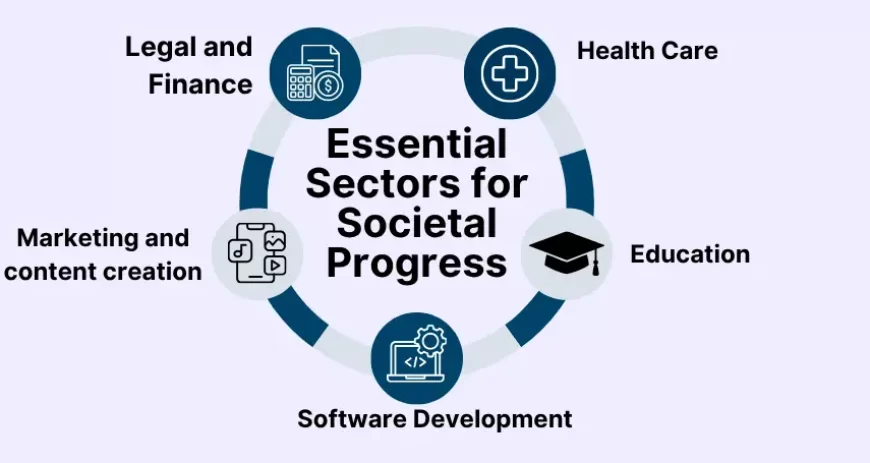
Generative AI isn't a lab technology, it is already implemented in various industries, making a difference in operations. Below are examples of generative AI implementation in particular fields:
1) Healthcare
The application of generative AI technology enables scientists to design new medicine molecules through interaction prediction with proteins. Companies like Insilico Medicine were able to shorten the time required to develop drugs using AI, bringing down the process from years to months. Traditional AI technologies perform excellently at detecting diseases on X-rays while generative AI opens up new opportunities in terms of designing solutions.
2) Education
With the help of generative AI algorithms, teachers can create personalized lessons, quizzes, and explanations in just a few seconds. Online platforms such as Khan Academy and Coursera integrate AI tutors providing real-time personalized responses, impossible to obtain
3) Software Development
The development of software is simplified through AI software generation platforms like GitHub Copilot. They generate code snippets in real-time, saving developers up to 55% of their work time as per GitHub. The process requires them to input the desired code in plain English, which is then generated automatically.
4) Marketing and Content Creation
AI content generation technology is revolutionizing marketing activities such as the creation of ads, social media updates, and even writing blog posts. With AI, businesses can automate the creation of personalized content at a scale that would have required weeks of work from entire teams.
5) Legal and Finance
Law firms are employing Generative AI to develop contract provisions, summarize judicial opinions, and develop first drafts. Generative AI is utilized by banks to produce financial reports and risk analyses. Traditional AI was only capable of detecting fraud, while Generative AI explains results in layman's terms.
Does It Fit Your Needs? Who Should Study Generative AI?
- You do not have to be a coder or a mathematician to learn about Generative AI. If one of the statements below applies to you, this is the perfect field to explore further:
- Aspiring students who want to develop skills in advance before finding a job in the IT sector
- Professionals from such spheres as marketing, HR, finance, and healthcare that wish to learn more about AI tools
- Developers that strive to enter the field of creating applications with the use of artificial intelligence
- Teachers that would like to know how AI is affecting education
- Candidates with no CS education willing to become an expert in AI technology
- Businessmen and entrepreneurs willing to incorporate AI solutions into their companies
How to Begin Learning Generative AI - Step-by-Step Guide
Below are the steps to help you learn generative AI, be it a beginner or someone with technical knowledge:
- Understanding AI and Machine Learning: Begin with free materials such as Google's MLCC, or other YouTube videos on deep learning, neural networks, and the likes.
- Learn Basic Python Programming: Since Python is the programming language mainly used in AI development, enroll in Python courses on platforms such as Codecademy, freeCodeCamp, or DataCamp.
- Learn the AI Frameworks: Start by using TensorFlow and PyTorch, which are the most popular platforms to experiment and learn about different AI models.
- Get Familiar with LLM: Try to familiarize yourself with the APIs provided by OpenAI, Hugging Face, or Langchain to experiment with building simple things like text summarization or chatbots.
- Prompt Engineering: It is important to know how to create a prompt that would yield accurate and quality results.
- Get to Know the Regulations Surrounding AI Development and Usage: Be familiar with the legal requirements, such as GDPR, IEEE framework on AI ethics, or UNESCO's recommendation on AI.
Top Certifications: Generative AI & AI Models
One of the fastest ways to prove your AI proficiency, gain a competitive edge in the job market, and show that you are up-to-date with industry standards is through certifications. The following table compares the most widely known certifications:
|
Certification |
Provider |
Level |
Best For |
|
Certified AI & Generative AI Professional |
IABAC (Recommended) |
Beginner–Advanced |
AI career starters & professionals |
|
Certified Generative AI Expert |
IABAC |
Intermediate |
Developers & data scientists |
|
Certified AI Professional |
IABAC |
Beginner–Advanced |
Cross-industry professionals |
|
Professional ML Engineer |
Google Cloud |
Intermediate |
Cloud & ML engineers |
|
Azure AI Engineer Associate |
Microsoft |
Intermediate |
Azure platform developers |
|
AI Engineering Certificate |
IBM |
Beginner |
Data science learners |
What Makes IABAC Unique?
IABAC provides an organized learning path that is tailored specifically to newcomers and experts alike. IABAC’s AI and Generative AI courses emphasize hands-on skills rather than theoretical concepts and are internationally recognized throughout various industries. If you are a beginner in AI or already have knowledge about the field but wish to formalize your education, IABAC certification may be a great option for you.
It's important to note that Generative AI and Traditional AI don't compete they complement each other by serving entirely different purposes. Traditional AI excels at structured, repetitive tasks like classification, fraud detection, and recommendations, while Generative AI enables creation, personalisation, and human-like interaction. The real question by 2026 won't be whether AI affects your career, but whether you're ready to work alongside it. No matter your background, understanding both technologies opens the door to endless opportunities. Start that journey today with our AI Certification and position yourself among the leaders of tomorrow's AI-driven world.