




























































How does data engineering consulting Improve Data Quality?
Learn how data engineering consulting improves data quality in 2026 through better pipelines, validation, governance, monitoring, and reliable data management.


Data engineering consulting improves data quality by checking your existing pipelines, fixing how data is collected and cleaned, and setting up automatic checks that catch mistakes before they show up in your reports. A consultant brings an outside view and hands-on experience that most internal teams don't have time to build on their own. The payoff is fewer broken reports, matching numbers across departments, faster fixes when something goes wrong, and more trust in the data behind your decisions and any AI tools you use. If you don't have this skill in-house, hiring a qualified consultant — ideally one certified through a trusted group like IABAC — is usually faster and cheaper than trying to fix it yourself through trial and error.
Key Takeaways
- Bad data quietly costs companies money by throwing off reports, analytics, and any AI system that depends on that data.
- Consultants fix data quality through checks, pipeline redesign, automatic testing, and clear rules — not a one-time patch.
- The value of consulting comes from experience and method, not just the software used. The same tools in untrained hands rarely give the same result.
- Common problems include pipelines nobody documented, mismatched formats, manual data entry, and no clear owner for the data.
- When picking a consultant, look at their certifications and past work, not just how fast they promise to finish.
- If you want to build a career in this area, a recognized certification, like those from IABAC, can help prove your skills.
Every company runs on data now, but almost no company fully trusts its own numbers. Ask someone in finance, someone in marketing, and someone in operations for the same figure — say, total active customers — and you'll often get three different answers. This isn't rare. It's what happens when a company grows faster than the systems tracking its data. This is where data engineering consulting comes in. Instead of treating messy data as a one-time cleanup job, a good consultant treats it as something you have to build, watch, and maintain — the same way a factory keeps an eye on quality at every step of the line. In 2026, more companies are feeding their data into AI tools, automated systems, and live dashboards. That means a mistake in the data doesn't just show up as a wrong number in a spreadsheet anymore. It can turn into a wrong decision made by a computer, instantly, across thousands of records.
This guide walks through exactly how data engineering consulting fixes data quality — the steps consultants take, the tools they use, the mistakes to watch for, and how both business owners and people wanting to enter this line of work can move forward with confidence in 2026 and beyond.
1. What Is Data Engineering Consulting?
Data engineering consulting means bringing in outside experts to build, check, or fix the systems that collect, move, store, and prepare your data. It sits between software engineering, data setup, and business strategy.
Unlike general IT consulting, this type of work is focused on the path data takes — from where it starts (an app, a sensor, a customer form, a payment system) to where it ends up (a database, a dashboard, or a machine learning model). Companies usually bring in consultants for reasons like:
- They don't have anyone in-house who knows data engineering
- Their current pipelines are unreliable, slow, or give different answers each time
- The company is growing fast and its data setup can't keep up
- Leaders no longer trust the numbers they're being shown
- A new AI or automation project needs clean, well-organized data first
Data engineering consulting is different from data science consulting in one big way: data science asks, "what does this data tell us?" Data engineering asks, "can we even trust this data enough to ask that question?"
2. Why Data Quality Matters More Than Ever in 2026
Data quality used to be something only the IT team worried about while everyone else focused on results. That has changed for three reasons.
1. AI use has raised the stakes. A machine learning model fed bad data doesn't just get "a little less accurate" — it can give confident, wrong answers that look correct on the surface. Bad training data can bias a hiring tool, misprice a product, or send supply orders to the wrong place, often without anyone noticing until real damage is done.
2. Live decisions leave no time to catch mistakes later. Ten years ago, an error might get caught during a monthly report review. Now dashboards update in real time, and automated systems act on data the second it arrives. Mistakes spread before a person ever sees them.
3. Rules around data have gotten stricter. More industries now require companies to prove not just that they collect data responsibly, but that the data is accurate, traceable, and can be checked later.
Gartner, a well-known research firm, has long estimated that poor data quality costs the average organization around $12.9 million a year. That number has likely grown as companies collect more data and lean on it more heavily for AI. But the bigger, less obvious cost is trust. Once people stop trusting the numbers, decisions slow down, and the whole point of collecting data in the first place starts to fall apart.
3. How Data Engineering Consulting Improves Data Quality: The Main Steps
Consultants don't fix data quality with one quick trick. They work through it in layers. Here's what that usually looks like.
3.1 Checking and Mapping the Data
Before anything gets fixed, someone has to understand what's actually happening. Consultants start by mapping out:
- Where data comes from (apps, forms, sensors, outside data feeds)
- How it moves (automated jobs, manual exports, scheduled transfers)
- Where it's stored (databases, spreadsheets, old systems still in use)
- Who touches it, and how often
This step usually uncovers the real reasons behind "bad data" — duplicate records from systems that don't talk to each other, pipelines that fail quietly, mismatched naming, or manual data entry steps that were only meant to be temporary but never went away.
3.2 Agreeing on What Words and Numbers Mean
One of the most common — and most overlooked — causes of bad data is that different teams define the same word differently. "Active customer" might mean one thing to sales, another to marketing, and a third thing to finance. Consultants work with each team to agree on one shared definition and one shared format everyone will use going forward.
3.3 Building Automatic Checks
Instead of waiting for someone to notice a report "looks off," consultants set up checks that run all the time on their own:
- Format checks — flag data that doesn't match the expected structure
- Missing or impossible value checks — catch blank fields or numbers that can't be true, like a negative age
- Freshness checks — alert someone if a data feed hasn't updated on schedule
- Duplicate checks — find and merge repeated records
- Link checks — make sure related records, like an order and its customer, stay connected correctly
Think of these like smoke detectors. They won't stop every problem, but they make sure nobody gets caught off guard.
3.4 Rebuilding the Pipeline Itself
Sometimes the problem isn't the data — it's the process moving the data around. Consultants often replace shaky, manually-run processes with automated ones that log every run, retry on their own if something fails, and notify the right person when something breaks.
3.5 Setting Up Ownership and Rules
Tools alone don't keep data clean — people do. Consultants usually help set up:
- Data owners — a specific person responsible for each dataset
- Change rules — so someone changing a format doesn't accidentally break another team's report
- Documentation — so new hires and other teams know what the data means and where it comes from
3.6 Teaching the Internal Team
A good consultant doesn't just fix the problem and leave — they leave the team better equipped than before. That usually means documentation, training sessions, and coaching so the company isn't stuck depending on outside help forever.
4. Types of Data Engineering Consulting Work
Not every project looks the same. Here's a simple breakdown:
|
Type of Work |
Main Focus |
Best For |
|
Data Quality Check-Up |
Finding out why numbers don't match |
Companies confused about |
|
Pipeline Rebuild |
Replacing old or manual data processes |
Companies that outgrew |
|
Rules and Ownership |
Definitions, ownership, documentation |
Companies with teams working |
|
AI Readiness Work |
Getting data ready for machine learning use |
Companies starting an AI or |
|
Ongoing Support |
Continuous monitoring and upkeep |
Companies without a |
5. Benefits of Data Engineering Consulting for Data Quality
- Problems get caught faster. Automatic checks find issues in hours, not months.
- Numbers match across teams. Everyone works from the same definitions and the same data.
- Less manual cleanup. Teams spend less time double-checking spreadsheets and more time actually using the data.
- Better base for AI work. Clean, checked data lowers the risk of a biased or unreliable model.
- Easier to pass audits. Documented, traceable pipelines make compliance reviews much less painful.
- A fresh set of eyes. Consultants aren't tied to old decisions or office politics, so they can point out problems staff might avoid mentioning.
- Your team learns something. A good project leaves your staff more capable, not just your pipeline.
6. Challenges and Risks Worth Knowing About
No project is completely risk-free. Common issues include:
- The project keeps growing. Data problems often lead to bigger issues underneath, and a project can run over budget and past deadline if it isn't managed carefully.
- People resist the change. Teams used to old manual habits may push back on new automated steps, especially if they weren't part of designing them.
- Too much reliance on the consultant. Without a plan to teach the internal team, the company can end up needing outside help indefinitely.
- Too many new tools at once. Adding a pile of new software all at once can create a different kind of mess, especially for small teams.
- Mismatched expectations. Leadership sometimes expects a quick fix when the real problem needs months of structural work.
The way to lower these risks is to hire a consultant who's upfront about scope, timelines, and what "finished" actually looks like — and who treats documentation and training as part of the job, not an afterthought.
7. Example: A Mid-Size Retailer Fixes Its Numbers
This is a made-up example that shows a pattern seen often in this kind of work — not a specific, named company.
A mid-size online retailer noticed that its marketing team's "customer value" numbers never matched finance's numbers. Looking into it, they found the two teams were pulling from different systems that updated on different schedules, with no shared customer ID between them.
A consultant fixed this in three steps:
- Mapping — traced every system touching customer records and found three separate ID systems.
- Standardizing — set up one shared customer ID and one agreed definition of "active customer" across teams.
- Automating — built daily automatic checks and a monitoring dashboard, replacing a manual weekly spreadsheet process.
Within a few months, both teams were working from the same numbers, and the hours spent each week on manual reconciliation disappeared. This pattern — map it, standardize it, automate it — shows up again and again in successful projects like this, no matter the industry.
8. Tools Commonly Used in Data Engineering Consulting
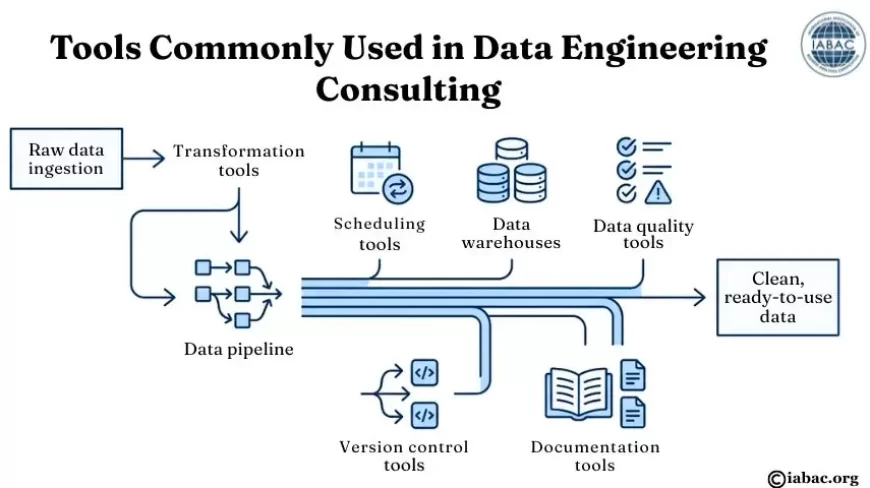
Consultants usually pull from several types of tools, not just one platform:
- Scheduling tools — to run and monitor data jobs
- Data warehouses — the central place structured data gets stored
- Data quality tools — for automatic checks, alerts, and tracing where data came from
- Transformation tools — for turning raw data into clean, ready-to-use tables
- Version control tools — applied to data pipelines the same way they're applied to code
- Documentation tools — so data stays easy to find and understand over time
The exact tools matter less than how well they're set up and kept up. A simpler, well-documented setup consistently beats a fancy one nobody maintains.
9. How the Work Usually Flows
- Check and Map the Data
- Agree on Definitions and Ownership
- Rebuild the Pipeline
- Add Automatic Checks and Alerts
- Test, Document, and Train the Team
- Keep Watching and Improving
This doesn't happen in a straight line in practice — most companies circle back to earlier steps as new data sources, rules, or needs come up.
10. A Realistic Plan for Companies
If you're thinking about hiring a data engineering consultant, here's what a sensible plan looks like:
Step 1 — Figure out the actual problem (2–4 weeks) Get clear on what you're trying to fix. Is it trust in reports? Getting ready for AI? Scaling up? A vague goal leads to a vague project.
Step 2 — Pick the right consultant Look at their relevant experience, references, certifications, and — this matters a lot — whether they're willing to teach your team instead of just doing the work and leaving.
Step 3 — Audit and plan (4–6 weeks) The consultant maps out your current systems and proposes a plan, usually tackling the highest-impact, easiest fixes first.
Step 4 — Do the work Pipeline fixes, standardizing, and automatic checks get built step by step, with regular check-ins against your goals.
Step 5 — Hand it off Documentation, training, and either a switch to your internal team or an ongoing support setup.
Step 6 — Keep watching Data quality isn't a project with an end date. It needs ongoing attention as new tools, sources, and rules show up.
11. Where Data Quality Projects Usually Fail
- Treating it as a one-time fix instead of something you keep up with
- Fixing what shows up on the surface (a wrong dashboard number) without fixing the real cause (an undocumented pipeline)
- Skipping the step where teams agree on definitions before building automatic checks
- Picking tools before actually understanding how the data moves
- Not assigning a clear owner once the consultant leaves
- Skipping documentation, which lets the same problems come back within a year
12. What's Changing in Data Engineering Consulting (2026 and Beyond)
- AI is helping spot bad data. Machine learning is increasingly used to catch odd patterns that simple rule-based checks miss, flagging problems before they cause bigger damage.
- Clearer agreements between teams. Instead of finding out data is broken after the fact, more teams now set formal agreements upfront about what the data should look like.
- Data engineering and AI operations are blending together. As more companies put AI into daily use, the line between "the pipeline feeding the dashboard" and "the pipeline feeding the model" keeps getting blurrier.
- More demand for certified specialists. As this type of consulting matures, companies increasingly want proof of skill — not just a resume claim — when hiring a consultant.
- More focus on clear rules and ownership, pushed by both regulation and the reputational risk of AI systems trained on bad data.
13. Career Opportunities in Data Engineering Consulting
For people building a career, data engineering consulting is one of the fastest-growing areas within data work. It suits people who like solving structural problems, working across teams, and turning messy technical situations into clear answers for the business.
Common ways people get into this line of work:
- Data analysts moving into more technical, pipeline-focused roles
- Software engineers shifting into data-specific work
- IT consultants expanding into data rules and quality work
- Career changers entering through structured certification programs meant for people without a computer science background
Consulting roles in this space often pay more than standard in-house data engineering jobs, since they need a mix of technical skill, clear communication, and project management all at once.
14. How to Become a Data Engineering Consultant
- Build core technical skills — data structure basics, SQL, pipeline tools, and basic cloud data platforms.
- Learn the rules of good data governance — ownership, documentation, and quality checks, not just software.
- Practice on real, messy data — real data teaches lessons that clean tutorial data never will.
- Get a recognized certification — a structured credential proves your skills to clients and employers who can't otherwise judge your technical depth on their own. Groups like IABAC offer certification paths built for people working toward analytics and data-focused careers, and can be a useful way to formalize what you've learned.
- Work on people skills, not just technical skills — talking with clients, scoping a project, and managing expectations matter just as much as the technical work.
- Register as a consultant and build a track record — whether you go independent or join a firm, documenting real projects, even small ones, builds the trust needed to land bigger work.
15. How to Pick the Right Data Engineering Consultant
When you're comparing consultants or firms, look at:
- Relevant experience with your industry's specific data and compliance needs
- Certifications, which give you a baseline signal of proven skill
- A clear, explainable process — can they walk you through how they'll check and fix things?
- Willingness to teach your team — will your staff be able to keep the system running once the consultant leaves?
- References and past results, ideally from companies of similar size
Data quality isn't a small IT concern anymore. It feeds directly into every major decision a company makes, and increasingly, into every automated decision an AI system makes on the company's behalf. Data engineering consulting fixes data quality not through one quick patch, but through a repeatable process: checking what already exists, agreeing on shared definitions, building automatic checks, and setting up the rules and documentation that keep things clean long after the consultant is gone.
If you run a business: start with an honest look at where your trust in the data breaks down, and pick a consultant based on their process and their willingness to teach your team — not just their tool list.
If you're thinking about this as a career: build your technical skills, get hands-on with messy data, and think about a structured certification — like the ones offered through IABAC — to prove your skills as you work toward independent consulting.
Sources Referenced
- Gartner's widely cited estimate on the cost of poor data quality (around $12.9 million a year per organization)
- Common industry practices and methods used in data engineering and data governance work
- IABAC (International Association of Business Analytics Certifications) — iabac.org, for certification path context
- Note: The example in Section 7 is a made-up scenario meant to show a common pattern in this kind of work, not a real, named company.