


















































Top 10 Google I/O 2026 Announcements You Must Know
Discover the biggest Google I/O 2026 announcements, from Gemini innovations and AI agents to smarter search, shopping, creative tools, and apps for users.

Every year, Google I/O gives us a peek into the future. But Google I/O 2026 felt different. Sundar Pichai opened the event by talking about what he called the "agentic Gemini era" of artificial intelligence that does not just answer your questions but actually does things for you.
You set a goal, and the AI plans, acts, and delivers the result. Whether it was buying something online, managing your emails, or building software on its own, everything at I/O 2026 pointed in one direction: AI that works for you, even when you are not looking.
Let's see what announcements Google made on May 19, 2026, at Mountain View, California.
1. Gemini 3.5 Flash — The Everyday Efficiency Engine
Gemini 3.5 Flash is the first model in Google's latest series, and it is much more than just a fast helper. This is a full frontier-level model that competes with bigger, more expensive AI models while running at an impressive speed.
It surpasses Gemini 3.1 Pro in coding, agentic, and multimodal benchmarks and runs four times faster than other frontier models in terms of output tokens per second.
What makes it exciting for everyday users is how it powers the agentic experience. It is the engine behind Gemini Spark, Antigravity 2.0, and several other tools announced at I/O 2026. Whether you are summarizing emails, drafting replies, or running complex multi-step workflows, Gemini 3.5 Flash is doing the heavy lifting in the background fast, reliably, and at scale.
2. Gemini Omni — AI That Sees, Hears, and Creates
Gemini Omni is the creative powerhouse of this year's lineup. DeepMind CEO Demis Hassabis described it as combining "Gemini's intelligence with the best of our generative media models for a new level of world understanding." In simple terms, it does not just understand text it understands video, audio, and images at a deep level.
You can use Gemini Omni to explain complex topics through generated videos.
- Ask it to show how gravity works, and it builds a video for you.
- It can also simulate complex scientific concepts and translate them into easy-to-understand visual content.
One of its most impressive features is character consistency; identity and voice are preserved across every scene, solving one of the biggest frustrations with earlier AI video tools.
Gemini Omni Flash, the first model in the Omni family, is available today in the Gemini app, Google Flow, and on YouTube Shorts.
3. Docs Live and Gemini on macOS — Work Smarter, Not Harder
Two big announcements for anyone who uses Google Docs or works on a Mac.
Docs Live completely changes how you write in Google Docs. Instead of staring at a blank page, you simply have a conversation with your document. Tell it what you want to write a story, an assignment, or a business report, and it starts building it for you using your voice or text prompts. Gemini turns your verbal brainstorming into structured, formatted documents in real time. It is writing made conversational.
Gemini on macOS is a native app that lets Gemini work directly within your Mac ecosystem without uploading your files to the cloud. It can read local files stored on your Mac, condense information from them, and even draft and schedule emails based on what it finds all without your documents ever leaving your device. For anyone who values privacy or works with sensitive files, this is a meaningful step forward.
4. Gemini Spark and Daily Briefs — Your Personal AI Agent
This is the announcement that is likely to change how people use AI on a daily basis.
Gemini Spark is a persistent personal AI agent that lives inside the Gemini app. Unlike Gemini's existing assistant-style interactions, Spark is designed to continuously work in the background across your Workspace apps.
- It integrates with Gmail, Google Docs, and Google Workspace broadly and then expands further through MCP to third-party tools as well.
- It can handle complex, multi-step tasks entirely on its own taking an email thread, understanding the action items, and executing them without you doing each step manually.
- It runs 24/7 on dedicated Google Cloud virtual machines, powered by Gemini 3.5 Flash, continuing to work even when your device is switched off.
Daily Briefs gives you a structured morning summary every day. It tells you
- what emails are waiting for your attention,
- what is on your calendar, and
- what tasks are still pending.
It is like having an assistant who has already gone through your entire inbox and schedule before you even sit down at your desk.
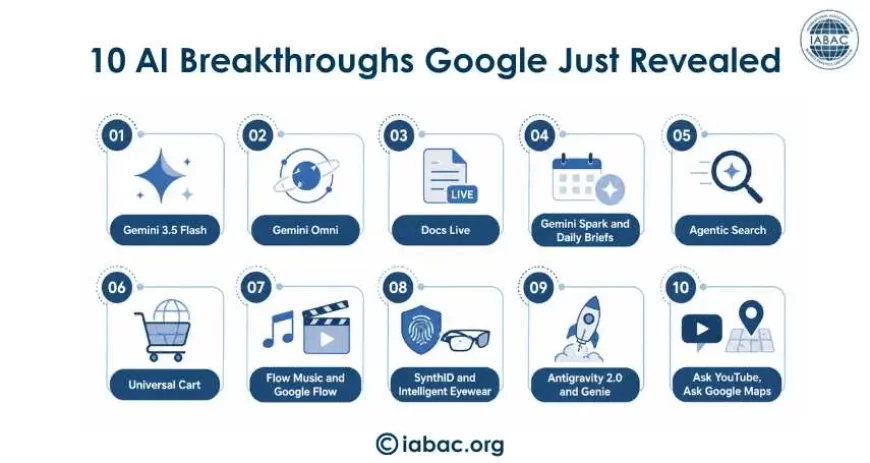
5. Agentic Search, Generative UIs, and Information Agents — Search Gets a Brain
Google Search has been largely the same for years. At I/O 2026, Google showed us what it looks like when search becomes truly intelligent.
Agentic Search with Generative UIs means that when you search for something complex, Google does not just show you links anymore. It builds you an interactive experience. Search for "how earthquakes happen," and instead of ten blue links, you get a 3D visualization where you can change parameters and see how the ground shifts and fault lines react in real time. Learning through search becomes hands-on, not just passive reading.
Information Agents take this even further. These are automated workflows you can set up for topics you check regularly, like a stock, a news topic, or an industry trend. The agent tracks it and surfaces new updates to you every day automatically. You do not have to keep searching. The search comes to you.
6. Agentic Shopping and Universal Cart — AI That Shops for You
One of the most practical announcements was Agentic Shopping with the Universal Cart.
Google Search can now shop on your behalf. You tell it what you are looking for say, the best deal on a specific laptop under a certain budget, and it goes out, browses multiple websites, compares options, and makes the purchase for you.
The Universal Cart allows the AI to buy items from different websites in a single flow, without you visiting each site, creating accounts, or entering your details repeatedly.
Beyond just buying, the Universal Cart also automatically tracks price drops, price history, and stock availability for any item you add to it. It is set to launch in the US this summer, and it is one of those features that has the potential to change how most people shop online.
7. Flow Music and Google Flow — AI for Creators
Google is making sure that creative professionals are not left behind in the agentic era.
Flow Music, available as a dedicated mobile app, is a complete music production platform. You can generate lyrics, create tunes, and produce full songs using simple prompts. You can "talk to the producer" give feedback in plain language, ask for specific edits, and remix tracks in real time. It supports multiple languages and dialects with impressive quality, making it genuinely useful for a much wider global audience.
Google Flow, Google's AI creative studio for video, has been significantly upgraded with Gemini Omni Flash. It lets you generate characters with specific personalities and voices, blend real-world inspiration with generated content, and edit video conversationally in real time.
A major new addition is the Google Flow Agent, which can now handle multi-step creative tasks on your behalf, planning, reasoning, and executing complex video projects under your direction. Previously, Flow could only handle one prompt at a time. Now it works like a true creative partner.
Both Flow and Flow Music are now available as dedicated mobile apps: Flow on Android in beta and Flow Music on iOS now.
8. SynthID and Intelligent Eyewear — Safety and Wearable Tech
As AI gets more powerful, using it responsibly becomes more important. Google addressed this head-on with two announcements.
SynthID is Google's AI content detection system, now three years old and getting a major expansion. It embeds hidden watermarks into AI-generated images, videos, and audio.
Bringing SynthID verification to Google Search and Chrome so users can identify AI-generated content right from their browser. You will soon be able to right-click any image in Chrome and ask Gemini whether it was AI-generated. In a world where deepfakes and synthetic media are becoming more common, this is an important tool for trust.
On the hardware side, Google announced two types of Intelligent Eyewear, not just one.
- The first is audio glasses that offer spoken AI help in your ear.
- The second is display glasses that show you contextual information right when you need it.
The audio glasses, made in partnership with Samsung, Warby Parker, and Gentle Monster, are launching this fall and will be compatible with both Android and iOS devices. The display glasses will follow at a later date.
9. Antigravity 2.0 and Genie — The Experiments That Blew Everyone's Mind
Every Google I/O has a moment that makes you stop and think. In 2026, there were two.
Antigravity 2.0 is Google's upgraded coding platform; think of it as Google's answer to tools like GitHub Copilot and Claude Code, but now fully agent-first.
Google demonstrated what it can do when pushed to its limits. Antigravity 2.0 was given the task of building an entire operating system from scratch. It coordinated multiple AI agents working simultaneously on the project and completed the entire OS using less than $1,000 worth of compute tokens. It is primarily a developer tool, but it shows the world just how far agentic AI can go when applied to large-scale engineering tasks.
Genie is a general-purpose model that creates interactive environments, but with an important detail your blog had wrong.
Google unveiled a new integration of Genie with Google Maps Street View.
- You can go to any real location in Google Maps, change its visual style to something like "desert sands" or "stone age," and then ask Genie to create a character and insert it into that world.
- You can explore these transformed environments and even save them.
It is not just a standalone world builder; it is tied directly to real-world geography, which makes it far more grounded and interesting.
10. Ask YouTube, Ask Google Maps, and Google Pics — Smarter Everyday Apps
The final set of announcements may not be the flashiest, but they will affect the most people on a daily basis.
Ask YouTube is an AI-powered feature that intelligently finds videos based on your questions and queries, surfacing digestible, to-the-point clips that directly answer what you are looking for. Instead of scrolling through long videos trying to find the right moment, you simply ask, and it finds it for you. Ask YouTube is rolling out this month on desktop as an experiment for a subset of users searching in English in the US.
Ask Google Maps brings conversational intelligence to navigation. Instead of typing a single destination, you describe a complex route with multiple needs: "I need to get home, stop for petrol, and find a good South Indian restaurant on the way," and Google Maps understands the full request and plans accordingly. It makes one of the most-used apps in the world feel genuinely smarter.
Google Pics is a brand new image creation and editing app. It is built to give users more precise control over AI-generated images rather than relying entirely on prompt-based generation. You can create posters, flyers, and infographics, similar to Canva. All content is watermarked with SynthID, and the app is rolling out this summer.
FAQs
1. What was the main theme of Google I/O 2026?
The central theme of Google I/O 2026 was the transition from AI assistants to AI agents. Google showcased technologies that can plan, reason, and complete tasks on behalf of users, from managing workflows and shopping online to creating content and conducting research autonomously.
2. How is Google’s agentic AI different from traditional AI assistants?
Traditional AI assistants typically respond to individual prompts and requests. Google's new agentic AI systems can handle multi-step tasks, make decisions, interact with multiple applications, and continue working toward a goal even when users are not actively engaged.
3. Which Google I/O 2026 announcement could have the biggest impact on everyday users?
While several announcements were significant, Gemini Spark, Agentic Search, and Universal Cart are likely to have the biggest impact on daily life. These tools aim to automate routine tasks, simplify information discovery, and make online shopping more efficient.
4. What do the Google I/O 2026 announcements mean for professionals and businesses?
The announcements signal a future where AI can automate administrative work, accelerate content creation, improve productivity, and support decision-making. Businesses that adapt early to AI-powered workflows may gain significant efficiency and competitive advantages.
5. Why is Google focusing so heavily on AI agents?
Google believes the next phase of AI is not just answering questions but helping users accomplish goals. By introducing AI agents that can reason, plan, and take action across multiple tools and platforms, Google is moving toward a more proactive and personalized computing experience.
From Tools to Agents — The Future Is Here
Every announcement from Gemini Spark running your workflows at night to the Universal Cart shopping for you during the day pointed to the same future. Universal Cart could significantly disrupt comparison-shopping websites and affiliate publishers because users may no longer need to visit multiple websites before purchasing. AI is becoming a quiet layer underneath your work, your creativity, and your daily life, getting things done on your behalf.
For working professionals, this means less time on repetitive tasks and more time on work that actually matters. For creators, it means tools once only available to large teams are now accessible to individuals. For everyday users, it means technology that finally feels built around your life.
And if all of this feels like a lot to keep up with, that is exactly why learning about AI through a structured artificial intelligence certification can help, so when these tools land in your hands, you already know what to do with them.