





















































What Are AI Agents and How Do They Work
Understand AI agents, how they work, their types, use cases, and key differences from agentic AI, along with skills needed to build careers in this space.

Artificial intelligence is entering a phase where systems are expected to do more than just respond; they are expected to act.
You’ve probably been hearing a lot about it, everyone talking about AI agents. They’re showing up in conversations across tech, business, and even in the everyday tools we use.
But what exactly are they? Are they just smarter chatbots, or something more powerful?
The interesting part is these artificial intelligence agents don’t just respond to instructions. They can think through tasks, make decisions, and take actions on their own. That’s a big shift from how AI was used before.
Let’s break down what they are and how they actually work.
Understanding AI Agents
AI agents are systems designed to go beyond basic automation. Instead of simply responding to inputs, they can interpret situations, make decisions, and take actions that move toward a defined outcome. They are built using advanced AI models, including large language models, which help them understand context and handle complex tasks more effectively.
What makes them stand out is how they operate in real scenarios. Rather than following fixed instructions like traditional bots, these systems can adjust their approach based on the situation. This makes them more flexible and useful in dynamic environments where conditions keep changing.
Many people associate AI with chat-based tools that generate answers. AI agents go a step further; they don’t just respond, they act.
For example:
-
A chatbot may answer a customer query
-
An AI agent can understand the query, check order status, update records, and send a solution.
This shift from “response” to “action” is what truly defines them.
Key Characteristics of AI Agents
To understand their real impact, it helps to look at what defines artificial intelligence agents at a functional level.
Autonomy
Artificial intelligence agents operate with minimal human intervention. Once given a goal, they can independently decide the steps needed to achieve it.
Tool Usage
They can interact with external tools such as browsers, APIs, databases, or enterprise software to fetch data or execute tasks.
Reasoning & Planning
Artificial intelligence agents break down complex problems into smaller, manageable steps and execute them sequentially.
Adaptability
They learn from feedback and outcomes, allowing them to adjust their behavior in changing environments.
These characteristics make them significantly more capable than traditional rule-based systems.
Core Components of an AI Agent
Every AI agent is built on a set of core components that enable it to function effectively in dynamic environments.
Brain (LLM): This is the central intelligence layer. Large Language Models provide reasoning, understanding, and decision-making capabilities.
Perception: This component allows the agent to interpret inputs such as user queries, system data, or environmental signals.
Memory: They store past interactions and results, helping them make better decisions over time.
Tools/Actuators: These include external systems like APIs, browsers, or software platforms that allow the agent to perform actions.
Together, these components create a system that can think, learn, and act in a structured way.
How AI Agents Work Step by Step
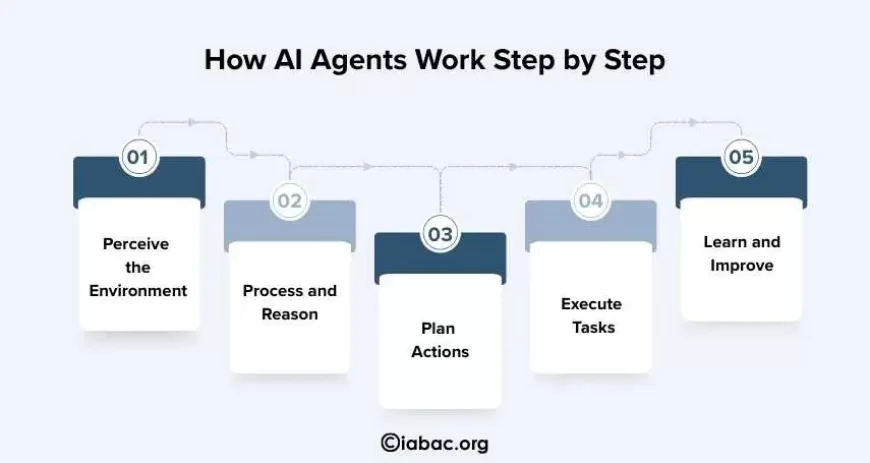
Let’s break down how an AI agent actually works
1. Perceive the Environment
This is the starting point of every AI agent’s operation. The agent gathers input from its environment, which can come from multiple sources such as user queries, system logs, APIs, databases, or even sensor data.
What’s important here is that the agent doesn’t just “receive” data; it interprets it. For example, if a customer asks about an order status, the agent understands the intent behind the question.
In real-world scenarios, perception can include:
-
Reading and understanding user messages
-
Collecting real-time data from systems
-
Monitoring events like transactions or alerts
-
Identifying patterns in incoming data
The quality of this step directly affects everything that follows. If the input is misunderstood, the outcome will not be accurate.
2. Process and Reason
Once the data is collected, the agent moves into reasoning. This is where the intelligence of the system comes into play.
Using Large Language Models (LLMs) and supporting algorithms, the agent analyzes the input, identifies the goal, and determines what needs to be done. It connects context, past interactions, and available data to form a clear understanding of the situation.
For example:
-
If a user says, “My payment failed, but money was deducted,” the agent identifies this as a transaction issue, not just a general query
-
It understands urgency, context, and expected outcomes
This step involves:
-
Interpreting intent and context
-
Matching the situation with possible actions
-
Evaluating different ways to solve the problem
Reasoning is what allows these agents to handle complex, real-world tasks instead of simple commands.
3. Plan Actions
After understanding the problem, the agent doesn’t jump directly into action. Instead, it creates a structured plan.
This step is critical because many tasks are not single-step processes. They require a sequence of actions to achieve the final goal.
For instance, resolving a customer issue might involve checking order details, verifying payment status, identifying the issue, updating records, sending a response
The agent breaks the overall objective into smaller, manageable steps and decides the order in which they should be executed.
Planning includes:
-
Defining sub-tasks
-
Prioritizing actions
-
Selecting the right tools or systems
-
Preparing for possible variations in outcomes
This is what makes artificial intelligence agents capable of handling multi-step workflows efficiently.
4. Execute Tasks
Once the plan is ready, the agent begins execution. This is where it interacts with tools, systems, or external platforms to complete the task.
Unlike basic automation, these agents can dynamically choose which tools to use based on the situation. They are not limited to a single system.
Execution can involve:
-
Calling APIs to fetch or update data
-
Interacting with databases
-
Sending emails or notifications
-
Updating CRM or enterprise systems
-
Generating responses or reports
For example, in a business setting, an AI agent might:
-
Retrieve customer data from a database
-
Update order status in the system
-
Send a confirmation message to the customer
This ability to act across systems is what makes them highly practical in real environments.
5. Learn and Improve
After completing the task, the agent evaluates the outcome. This is where learning happens.
Artificial intelligence agents use feedback, either explicit (like user ratings) or implicit (like success or failure of a task), to refine their future actions. Over time, this helps them become more accurate and efficient.
Learning can include:
-
Identifying what worked and what didn’t
-
Adjusting decision-making strategies
-
Improving response accuracy
-
Updating internal models or memory
For example:
-
If a response did not resolve a user’s issue, the agent can adapt its approach next time
-
If a certain workflow consistently leads to success, it reinforces that pattern
This continuous improvement is what makes them adaptable in changing environments.
Bringing It All Together
These steps don’t happen in isolation; they form a continuous loop:
-
The agent perceives new data
-
Processes and reasons through it
-
Plans the next steps
-
Executes actions
-
Learns from the outcome
Then the cycle repeats.
Because of this loop, these agents are not static systems. They evolve with every interaction, making them more effective over time and capable of handling increasingly complex tasks.
What Are the 5 Types of AI Agents?
Artificial intelligence agents can be categorized based on how they make decisions and interact with their environment. These five types represent increasing levels of intelligence and capability.
Simple Reflex Agents: They react to current inputs using predefined rules. These are the most basic form of artificial intelligence agents.
Model-Based Agents: They maintain an internal model of the environment, allowing them to make more informed decisions.
Goal-Based Agents: These agents focus on achieving specific objectives by evaluating possible actions.
Utility-Based Agents: They select actions based on maximizing performance metrics such as efficiency or accuracy.
Learning Agents: These agents improve over time by learning from data and feedback, making them highly adaptable.
Each type is suited for different levels of complexity in real-world applications.
Common Use Cases of AI Agents
Artificial intelligence agents are already being implemented across industries to handle tasks that require both intelligence and automation.
Some of the most practical applications include
Customer Support: Resolving queries autonomously, managing conversations, and updating systems in real time
Sales and Marketing: Qualifying leads, personalizing communication, and planning follow-ups
Task Automation: Automating IT workflows, generating code, and managing repetitive processes
Data Analysis and Robotics: Monitoring systems, analyzing data patterns, and managing smart environments
These use cases show how they move beyond simple assistance into active execution.
Who Are the Big 4 AI Agents?
When people refer to the “Big 4 AI agents,” they are typically talking about leading AI systems developed by major tech companies that are pushing the boundaries of agentic capabilities.
-
OpenAI’s ChatGPT (Agentic versions): Known for advanced reasoning, tool usage, and multi-step task execution
-
Google’s Gemini: Designed for multimodal understanding and integration across Google’s ecosystem
-
Microsoft Copilot: Integrated into enterprise tools like Office and Azure for productivity and automation
-
Anthropic’s Claude: Focused on safe, reliable, and context-aware AI interactions
These platforms are continuously evolving toward more autonomous, agent-like behavior.
Difference Between AI Agents and Agentic AI
This is a common point of confusion, so let’s simplify it in a clear and practical way.
Artificial intelligence agents and agentic AI are closely related, but they are not the same thing. The easiest way to understand this is to think of one as a real system and the other as the broader idea behind how such systems are designed.
AI agents are the systems you can actually use. They are built to perform tasks, follow goals, and take actions. For example, an AI agent might handle customer queries, update records, or automate workflows within a business.
Agentic AI, on the other hand, is the concept or approach behind building such systems. It focuses on creating AI that can act independently, make decisions, and manage tasks with minimal human input.
To make it even clearer:
-
AI agents = the application (what you use)
-
Agentic AI = the approach (how systems are designed)
In simple terms, these agents are practical examples of agentic AI. They show how the concept is applied in real-world systems.
Why 2026 Is Called the AI Agentic Era
The year 2026 is increasingly being referred to as the “agentic era” because of how rapidly AI systems are shifting from passive tools to active participants.
Several factors are driving this shift:
-
Rapid improvements in LLMs and reasoning capabilities
-
Increased demand for automation across business functions
-
Growth of AI ecosystems with tool integration
-
Enterprise adoption of AI-driven workflows
Organizations are now focusing on systems that can handle end-to-end processes rather than isolated tasks. This marks a clear transition toward agent-based architectures.
Benefits of AI Agents for Businesses
Artificial intelligence agents are not just a technological advancement; they directly impact how organizations operate and grow.
Some of the key benefits include
-
Improved efficiency by automating repetitive and complex tasks
-
Faster decision-making through real-time data processing
-
Cost optimization by reducing manual effort
-
Scalability across operations and customer interactions
-
Better customer experience through instant and accurate responses
These benefits make them a strategic investment for businesses aiming to improve performance.
Challenges in Implementing AI Agents
While the potential is significant, implementing these agents comes with its own set of challenges.
Organizations need to consider:
-
Data quality and availability: These agents depend on accurate and structured data, and poor data quality can lead to unreliable outcomes
-
Integration with existing systems: Connecting artificial intelligence agents with current tools and workflows can be complex and may require system-level adjustments
-
Security and compliance requirements: Handling sensitive data requires strong security measures and adherence to regulatory standards
-
Need for skilled professionals: Designing and managing these agents requires expertise in AI, data, and system architecture
-
Continuous monitoring and optimization: These agents need regular evaluation and updates to maintain performance and adapt to changing conditions
Addressing these challenges is essential for successful adoption.
Skills Required to Work with AI Agents
As demand for artificial intelligence agents grows, so does the need for professionals who can design, deploy, and manage them effectively.
Important skills include:
-
Understanding of machine learning and AI concepts
-
Knowledge of LLMs and prompt engineering
-
Programming skills in Python and related tools
-
Experience with APIs and automation frameworks
-
Ability to connect business problems with AI solutions
Along with these skills, structured certification programs play an important role in helping professionals gain hands-on experience and industry-relevant knowledge. They provide a clear pathway to understand how they are designed and applied in real business environments.
These skills are becoming increasingly important across roles in technology and business.
How AI Agents Are Shaping Future Careers
Artificial intelligence agents are influencing job roles across industries. Instead of replacing roles entirely, they are changing how work is done.
Professionals are expected to:
-
Work alongside AI systems
-
Focus on strategy and decision-making
-
Manage and optimize AI-driven processes
Roles such as AI specialists, automation engineers, and AI consultants are gaining importance as organizations adopt agent-based systems.
Artificial intelligence agents are shaping how intelligent systems operate by combining reasoning, action, and continuous learning in a single framework. Their ability to handle complex tasks and adapt to changing environments makes them highly valuable across industries. As adoption grows, understanding how they work and building the right skills will be essential for professionals looking to stay relevant and contribute effectively in an AI-driven landscape.