

















































What Artificial Intelligence Can Do: Benefits & Uses
Learn what artificial intelligence can do, its real benefits, and everyday uses across healthcare, business, farming, and daily life, explained simply.

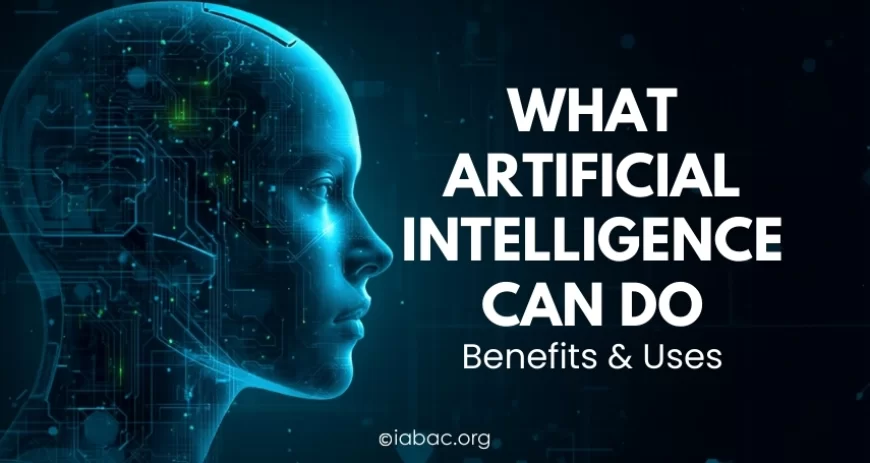
We see Artificial Intelligence everywhere these days, even if we don’t notice it. It’s in our phones, our apps, and even in the way businesses and hospitals work. AI helps doctors catch diseases early, farmers make smarter decisions, and companies serve their customers faster. But it’s not just for big industries, it’s becoming a part of everyday life. I’ll explain what AI really does, how it helps us, and why it matters, in plain and simple terms.
Understanding Artificial Intelligence
Artificial Intelligence (AI) refers to machines or software that can perform tasks typically carried out by humans, such as recognizing patterns, learning from data, making decisions, and solving problems.
Unlike traditional software that follows fixed instructions written by programmers, AI systems learn from experience. This means they improve over time as they are exposed to more information.
For example, when you teach a child to recognize animals by showing many pictures, they eventually learn the difference between a cat and a dog. In a similar way, AI systems learn to recognize patterns after examining many examples.
Why AI Matters in Today’s World
In the past, only scientists and engineers talked about AI. Today, its influence touches almost every part of our lives, whether we are aware of it or not.
Here are just a few reasons why AI is important:
-
Speed: AI can process huge amounts of information far faster than humans.
-
Accuracy: Machines can analyse data with precision and consistency.
-
Automation: Tasks that once required human effort can now be automated.
-
Insight: AI uncovers patterns and insights that would be nearly impossible for humans to see alone.
-
Scaling: It allows solutions and services to reach millions simultaneously.
These capabilities make AI a powerful force in business, healthcare, education, science, security, and many other areas.
Core Benefits of Artificial Intelligence
Let’s explore the key advantages that AI brings to individuals, organisations, and society.

1. Enhanced Efficiency and Productivity
One of the most visible benefits of AI is how it speeds up work.
In business, tasks like data entry, record keeping, invoice processing, and customer queries can consume hours of human time. AI systems can automate these repetitive jobs quickly and with fewer mistakes.
For example, an employee might spend hours reviewing customer emails to find common complaints. A simple AI tool can perform this analysis in seconds, freeing employees to focus on higher‑value work like creative problem‑solving.
In manufacturing, AI‑powered robots work consistently without fatigue, increasing production speed and reducing errors.
2. Better Decision‑Making with Data Insight
AI helps turn vast quantities of data into meaningful insights.
In the past, businesses made decisions based on limited information or intuition. Today, AI can examine market trends, customer behaviour, and operational data to forecast demand, identify opportunities, and reduce risk.
For instance, retailers use AI to study buying patterns and plan inventory so products are stocked when and where they are most likely to sell. Financial companies use AI to detect market shifts faster and design investment strategies accordingly.
3. Personalised Experiences for Individuals
AI learns from individual preferences to tailor experiences.
Have you ever noticed how a music app suggests songs or a video app recommends shows you might like? That’s AI analysing your past behaviour and predicting what you may enjoy next.
This personalised approach improves user satisfaction and engagement, and it’s used in many fields such as shopping, entertainment, travel planning, and even online education.
4. Extreme Scalability
AI systems are designed to scale. What once required teams of people can now be accomplished with minimal resources.
For example, traditional customer service centres required large support teams to respond to every phone call or email. Today, many companies use AI chat systems that can interact with thousands of customers simultaneously, instantly providing answers or guiding users to solutions.
This scalability boosts efficiency and allows organisations to serve a global audience without proportional staffing costs.
5. Reduction of Human Error
Humans, no matter how well trained, make mistakes, especially when performing repetitive or detailed tasks. AI systems, by contrast, follow rules consistently and can be retrained to correct errors.
In fields like finance, medicine, and engineering, this precision is crucial. AI can analyse patient images, check financial transactions, and inspect manufacturing quality without tiring or overlooking details.
6. Cost Reduction Over Time
Although implementing AI, like any technology, comes with upfront investment, it often leads to long‑term savings.
By automating routine processes and reducing the need for repetitive human labour, organisations can save on operational costs. When AI speeds up services and reduces errors, it also reduces waste and improves overall profitability.
Practical Uses of Artificial Intelligence Today
AI is no longer a concept for the future; it is being actively used across industries. Below are detailed examples of where AI is making an impact.
Healthcare: Precision, Speed, and Early Detection
AI has transformed the practice of medicine. Here are just a few ways it is used:
Diagnosis Support
AI systems help doctors interpret medical images, such as X‑rays, CT scans, and MRIs, to detect diseases earlier and more accurately. For example, AI can flag possible signs of cancer in screening images, supporting radiologists and reducing diagnostic delays.
Predictive Health Monitoring
By analysing patterns in medical records, symptoms, and test results, AI can predict potential health problems before they become serious. This allows doctors to prescribe preventive treatments and monitor high‑risk patients more closely.
Drug Discovery
Developing new medicines is a long and costly process. AI speeds up this process by simulating interactions and identifying promising compounds earlier, accelerating research timelines.
Remote Care
AI‑powered tools help monitor patients remotely, allowing doctors to track vital signs and intervene when necessary, especially useful for elderly people and those in rural areas.
Education: Personalised Learning Paths
Every learner is unique. AI helps tailor the educational experience to individual needs:
Adaptive Lessons
AI systems can assess a student’s performance and customise exercises based on strengths and weaknesses. Students struggling with a topic receive additional practice, while those who grasp concepts quickly move ahead.
24/7 Virtual Tutors
AI‑powered chat tutors can provide explanations and support outside classroom hours, helping learners study at their own pace.
Automated Feedback
Grading and evaluation can be time‑consuming for teachers. AI tools help by scanning tests, analysing essays, and providing instant feedback, giving teachers more time to focus on teaching.
Business and Finance: Intelligence Behind Growth
AI helps businesses operate more smoothly and make data‑driven decisions:
Customer Support Automation
AI chatbot systems handle common customer questions around the clock. These systems reduce waiting times and improve satisfaction by offering quick, accurate responses.
Fraud Detection
Financial institutions use AI to watch millions of daily transactions. When something looks unusual, AI flags it immediately, helping stop fraud before significant losses occur.
Market Forecasting
AI analyzes market trends, customer behaviour, and economic signals to help financial analysts predict future movements, manage risks, and build resilient strategies.
Transportation: Safer, Smarter Mobility
AI is revolutionising how we move:
Self‑Driving Technology
Autonomous vehicles use AI systems to interpret road conditions, recognise obstacles, and make driving decisions. While still evolving, this technology promises safer roads and improved mobility for all.
Smart Traffic Systems
Cities use AI tools to monitor traffic patterns in real time, reducing congestion, shortening commute times, and improving fuel efficiency.
Route Planning
AI calculates optimal routes in navigation apps, taking traffic, weather, and road closures into account to save time and fuel.
Entertainment: What You Love, Delivered to You
AI enhances how we consume media:
-
Recommendation Engines suggest music, movies, and shows that match your preferences.
-
Interactive Gaming uses AI to create responsive characters and evolving challenges.
-
Content Creation Support helps artists, writers, and designers brainstorm ideas and refine work.
These AI systems focus on personalisation and deep engagement, making entertainment more fun and relevant.
Agriculture: Smarter, More Sustainable Farming
AI helps farmers improve yield and conserve resources:
Crop Health Monitoring
AI systems use data from sensors and drone imagery to detect crop diseases early. By spotting problems before they spread, farmers can act quickly and reduce loss.
Precision Farming
AI predicts the right time to plant and harvest based on weather, soil data, and crop cycles. This helps optimise resource use, such as water, fertiliser, and labour, improving both cost and sustainability.
Security: Protecting Physical and Digital Spaces
AI boosts security in multiple domains:
-
Smart Surveillance systems detect unusual movements or activities in real time.
-
Cybersecurity tools watch network traffic for suspicious behaviour to prevent attacks.
-
Access Control uses face recognition and biometrics to secure buildings, devices, and information.
These technologies help keep people, property, and data safe.
Daily Life: Making Ordinary Tasks Easier
AI is part of everyday routines:
-
Smart Home Devices control lights, temperature, and security systems based on user behaviour.
-
Voice Assistants help with reminders, answers to questions, and task management.
-
Personal Finance Apps track spending patterns and suggest budgets.
These small enhancements save time and reduce friction in daily activities.
AI for Social Good & Making a Better World
AI is not just improving business and convenience. It also plays a role in solving larger social challenges.
Fighting Climate Change
AI models help scientists track environmental data, predict weather extremes, and design smarter energy systems. For example:
-
AI can optimise electricity use in cities to reduce carbon emissions.
-
It can analyse satellite data to detect deforestation and monitor endangered species.
Disaster Preparedness and Response
By processing large datasets on weather, terrain, and history, AI can help predict natural disasters such as floods and earthquakes, giving communities time to prepare and save lives.
Healthcare Access in Rural Areas
AI‑enabled telemedicine tools help doctors extend care to remote regions. When specialist doctors are not nearby, AI bridges the gap by assisting local health workers with diagnosis and care plans.
Ethical and Responsible Use of AI
As powerful as AI is, it must be used responsibly. Here are some key considerations everyone should understand:
Bias and Fairness
AI learns from data, and if the data reflects bias, the AI’s decisions can become biased too. For example, if an AI system is trained on historical hiring decisions that were unfair, it might repeat those unfair patterns.
Ensuring fairness means using diverse, carefully checked data and monitoring decisions to prevent discrimination.
Privacy and Data Protection
Many AI systems work by analysing personal data. Without proper safeguards, this data could be misused or exposed.
Strong privacy rules, transparent data use policies, and secure systems are essential to protect individuals.
Transparency and Explainability
Sometimes AI systems make decisions in ways that are not easy to understand. This “black box” problem can be frustrating or harmful, especially if people can’t see why a decision was made.
Transparency helps build trust. Users should be informed when decisions were influenced by AI and how their data is used.
Human Oversight and Accountability
AI is a tool, not a substitute for human judgement. At the end of the day, people must remain accountable for critical decisions, ensuring ethical values guide technology use.
The Future of Artificial Intelligence
AI is rapidly evolving. Below are some trends that are shaping the future:
1. Smarter Language and Interaction
AI will become even more fluent at understanding and responding in human language, making conversations with machines smoother and more natural.
2. Autonomous Agents and Robotics
More systems will act independently to complete complex tasks, from delivery robots to AI assistants that manage routine digital workflows.
3. Creativity and Innovation Support
AI will help artists, writers, designers, and innovators generate ideas, test prototypes, and explore new creative directions.
4. Integration with Everyday Tools
AI is being embedded into tools most of us use, from word processors and spreadsheets to health trackers and educational platforms.
5. AI as a Collaborative Tool
Rather than replacing humans, AI will increasingly work alongside people, augmenting abilities and enabling new forms of collaboration.
Artificial Intelligence is not just a technology; it’s a force that is reshaping how we live, work, and solve problems. Its benefits are broad and impactful:
-
Improved efficiency and productivity.
-
Personalised user experiences.
-
Better decision‑making with data.
-
Automation of routine tasks.
-
Advances in healthcare, agriculture, education, and security.
However, to ensure that AI promotes everyone's well-being, ethical use, justice, and privacy protections are essential.
Knowing AI is an important talent for both the now and the future. Pursuing the AI Certification can be an important step in mastering AI concepts and starting a great career in the field for people seeking organized study and professional credentials.