




















































Machine Learning vs Deep Learning: Which One to Learn First?
Learn the difference between machine learning and deep learning, which one to learn first, career paths, and a clear beginner-friendly learning roadmap.

If you’re stepping into the world of AI, chances are you’ve already faced this confusion:
“Should I start with Machine Learning or jump straight into Deep Learning?”
You’re not alone. This question stops many learners before they even begin. Not because the concepts are impossible, but because the internet makes it feel complicated. Everyone seems to have a different opinion. Some say deep learning is the future. Others insist that machine learning is the foundation. And somewhere in between, beginners feel lost.
This blog exists to end that confusion.
Not with theory-heavy explanations.
Not with intimidating math.
But with clear, honest guidance—so you can decide what to learn first based on your background, goals, and reality.
Let’s Clear the Biggest Confusion First: AI, ML, and DL
Before choosing what to learn, you need one simple clarity.
Think of it like this:
-
Artificial Intelligence (AI) is the big goal
-
Machine Learning (ML) is one way to reach that goal
-
Deep Learning (DL) is a more advanced subset of ML
AI is about making machines act intelligently. Machine learning teaches machines to learn from data. Deep learning teaches machines to learn using layered neural networks—closer to how the human brain works.
So when you compare machine learning vs deep learning, you’re not choosing two unrelated paths. You’re choosing where to start on the same journey.
What Is Machine Learning?
Machine learning is about teaching systems to learn patterns from data and make decisions without being explicitly programmed every step.
Instead of saying:
“If condition A happens, do B”
You say:
“Here’s data. Learn from it and decide.”
In real life, machine learning powers:
-
Email spam filters
-
Product recommendations
-
Credit scoring systems
-
Sales forecasts
-
Customer churn prediction
Machine learning usually works best with structured data—tables, numbers, categories.
Types of Machine Learning (Light, No Overload)
-
Supervised learning: Learning with labeled data (most beginner-friendly)
-
Unsupervised learning: Finding patterns without labels
-
Reinforcement learning: Learning by trial and reward (advanced, optional early on)
For beginners, machine learning feels logical. You can see how decisions are made. You can explain results. And most importantly—you can build useful projects quickly.
What Is Deep Learning?
Deep learning is a more advanced form of machine learning that uses neural networks with multiple layers.
Instead of manually selecting features, deep learning models try to learn features on their own.
That’s powerful—but it comes with trade-offs.
Deep learning shines when:
-
Data is huge
-
Data is unstructured (images, audio, text, video)
-
Patterns are too complex for traditional ML
Examples you already know:
-
Face recognition
-
Speech-to-text systems
-
Chatbots
-
Self-driving car perception
-
Image generation
Deep learning feels exciting—and it is. But it’s also resource-heavy, harder to debug, and less transparent.
Machine Learning vs Deep Learning: What Actually Matters
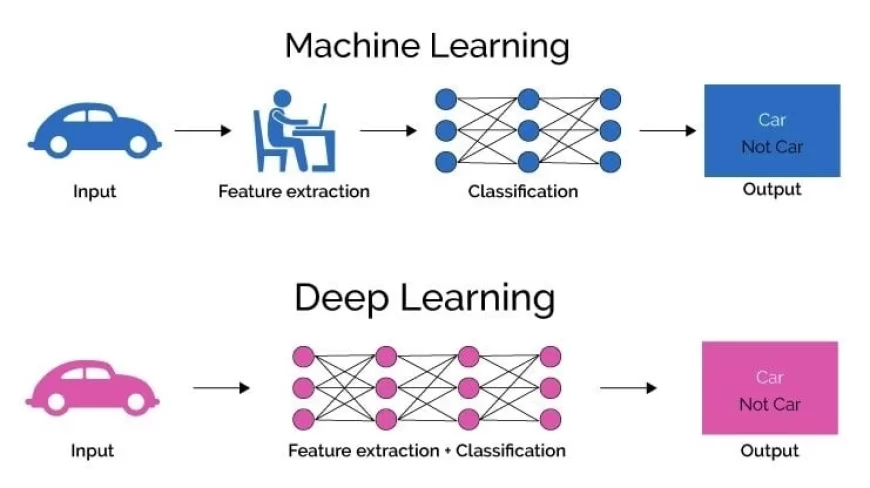
Let’s compare them the way a learner actually cares about.
|
Aspect |
Machine Learning |
Deep Learning |
|
Difficulty |
Beginner-friendly |
Steeper learning curve |
|
Math needed |
Basic statistics |
Linear algebra + calculus |
|
Data size |
Small to medium |
Very large |
|
Hardware |
Normal CPU |
Often needs GPU |
|
Explainability |
High |
Low |
|
Time to build projects |
Fast |
Slower |
|
Best for beginners |
✅ Yes |
❌ Usually no |
This table already answers half the question.
But let’s go deeper.
So… Which One Should You Learn First?
Short answer: