
















































Is Artificial Intelligence a Good Career Choice in 2026?
Is Artificial Intelligence a good career in 2026? See AI salaries, job demand, career opportunities, required skills, and future growth prospects.


Yes, for learners interested in technology, problem-solving, innovation, and data-driven decision-making, artificial intelligence is one of the strongest career choices in 2026.
Demand for AI professionals has outpaced supply for several years, and organisations across industries are investing heavily in AI adoption. Artificial intelligence offers strong demand, competitive salaries, diverse career paths, and opportunities across healthcare, finance, manufacturing, education, cybersecurity, and technology.
For students, working professionals, developers, analysts, and even non-technical learners willing to develop new skills, an artificial intelligence career offers significant growth potential and long-term career stability.
What Makes Artificial Intelligence a Strong Career in 2026?
Companies need AI professionals faster than the education system is producing them.
According to IDC, Global AI spending is projected to reach $301 billion by the end of 2026, up from $223 billion in 2025. That investment is flowing directly into hiring.
LinkedIn's 2026 Jobs on the Rise report ranked AI Engineer as the number one fastest-growing job title in the United States, with job postings rising 143% year-over-year.
The Stanford HAI 2026 AI Index found that AI-related skills now appear in 2.5% of all US job postings — a 297% increase over the past decade. The demand signal is growing roughly 20 times faster than the overall job market.
Also, according to PIB of India, India mirrors this closely. India leads the world in AI talent acquisition, with an annual hiring rate of about 33%. with demand soaring across finance, healthcare, manufacturing, and testing.
Three things drive this sustained demand:
1. Adoption has crossed the tipping point
72% of organisations now use AI in at least one function, up from 55% the previous year. Most of them are still in early stages, which means years of implementation work ahead.
2. Skills are scarce relative to demand
Over 90% of global enterprises are projected to face critical skills shortages by 2026, with sustained gaps risking $5.5 trillion in losses from global market performance, according to IDC.
3. AI creates more jobs than it displaces — for skilled professionals
The concern that AI eliminates AI jobs misunderstands the market.
New roles including AI trainers, governance specialists, MLOps engineers, AI product managers didn't exist five years ago and are now among the most actively recruited positions.
Artificial Intelligence Job Opportunities in 2026
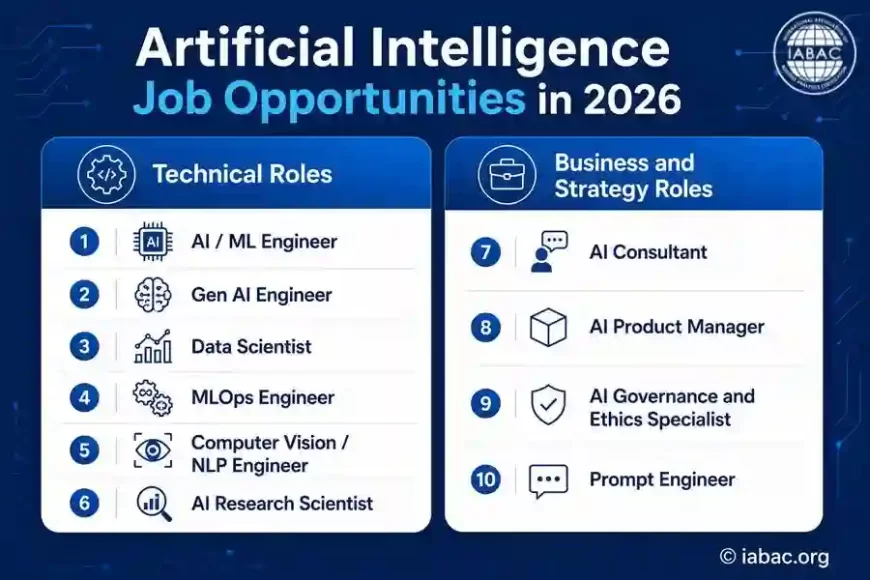
One reason the artificial intelligence career path attracts so much attention is the variety of opportunities available.
Technical Roles
1. AI / ML Engineer
Designs, builds, and deploys machine learning models into production systems. One of the fastest-growing titles globally.
Focuses on LLMs, RAG pipelines, and enterprise GenAI product development. GenAI and MLOps specialists command an additional 20–40% premium above generalist AI engineer salaries. Entry-level GenAI roles in India already start at ₹8–12 LPA for candidates with relevant project exposure.
3. Data Scientist
Works at the intersection of statistics, business analysis, and machine learning. Data analysis and mathematics roles lead AI job demand, with a median pay of $170,000 in the US.
Manages model deployment, monitoring, and reliability in production. As companies discover that models break and drift after launch, MLOps has become a critical function most teams understaffed.
5. Computer Vision / NLP Engineer
Specialised roles with consistently strong demand. NLP saw the largest growth in demand among technical AI skills, with a 155% increase in job postings.
6. AI Research Scientist — Advanced research role typically requiring a Master's or PhD. Highest salary ceiling, narrowest hiring funnel.
Business and Strategy Roles
1. AI Consultant — Advises organisations on AI strategy, tool selection, and implementation. Strong domain expertise matters as much as technical knowledge here.
2. AI Product Manager — Owns the roadmap for AI-powered products. Bridges engineering teams and business stakeholders. Growing faster than most people realise.
3. AI Governance and Ethics Specialist — Ensures AI systems meet regulatory, ethical, and legal standards. This role has expanded rapidly as governments introduce AI governance and regulation frameworks.
4. Prompt Engineer — Designs and optimises prompts for LLM-based systems. A newer role that has real technical depth despite what sceptics say.
AI Salary: How Much Can You Earn?
Compensation in AI varies more than almost any other tech field. Role, specialisation, experience, and location all shift the number significantly. Here's the global pattern.
Entry-Level (0–2 Years)
-
Global range: $45,000–$130,000 annually
-
Portfolio and project quality determine where you land — coursework alone puts you at the low end
-
Candidates with GenAI or MLOps project exposure start noticeably higher than generalists
Mid-Level (3–6 Years)
-
Global range: $110,000–$180,000 in most established tech markets
-
Total compensation — base, bonuses, and equity — regularly clears $200,000 in premium markets
-
Engineers at this level are expected to own production systems, not just contribute to them
Senior-Level (7+ Years)
-
Base pay range globally: $145,000–$310,000+, with total compensation reaching $400,000+ at the upper end.
-
Senior and lead professionals frequently cross $320,000 in the highest-paying markets
-
At this level, the role shifts from building models to defining technical strategy
The Specialisation Premium
Specialisation is the biggest salary lever in 2026 — more than years of experience.
-
LLM fine-tuning specialists earn 25–40% above the median AI salary in their market Computer vision and NLP specialists earn 30–50% above generalist AI engineers AI safety and alignment expertise commands a 45% premium
-
At the top end, AI Research Scientists earn $175,000–$300,000+ - a gap from entry-level generalist roles as wide as between a neurosurgeon and a medical assistant
How to increase your salary in AI career
1. Specialisation over generalism: Depth in one area across GenAI, MLOps, NLP, computer vision consistently outpays broad, shallow knowledge.
2. Company stage over company size: AI-first startups and frontier labs outpay large enterprises at every level, mostly through equity.
3. Portfolio depth over years logged: A three-year engineer with production deployments earns more than a five-year generalist with only internal tools.
Recognised credentials like IABAC's AI certifications - help bridge the gap for mid-career switchers where portfolio alone doesn't fully demonstrate depth.
What Determines Your AI Salary?
Salary depends on:
-
Technical depth
-
Portfolio quality
-
Domain expertise
-
Industry
-
Geography
-
Production experience
Two candidates with the same years of experience can have dramatically different salaries depending on these factors.
Which Industries Are Hiring AI Professionals?
AI talent is needed across nearly every major sector.
-
Healthcare: AI supports diagnostics, medical imaging, and patient care.
-
Finance and Banking: Banks use AI for fraud detection, risk assessment, and customer service.
-
Retail and E-Commerce: AI powers recommendation systems, forecasting, and personalisation.
-
Cybersecurity: Security teams use AI for threat detection and monitoring.
-
Education Technology: AI is helping create personalised learning experiences and intelligent tutoring systems.
-
Manufacturing: Manufacturers use AI to optimize operations and improve efficiency.
-
Government and Public Sector: Governments increasingly invest in AI for public services and operational efficiency.
AI Skills Companies Actually Want
Most of the learners focus heavily on certificates while overlooking practical skills.
Employers value both.
Technical Skills
-
Machine Learning Fundamentals
-
Python Programming
-
Statistics and Data Analysis
-
Deep Learning
-
Cloud Platforms
-
MLOps
Business Skills
Technical knowledge alone is rarely enough.
Employers value professionals who can:
-
Communicate effectively
-
Understand business goals
-
Work collaboratively
-
Translate technical outputs into business value
Projects Matter More Than Course Completion
A strong portfolio often carries more weight than multiple certifications without practical application.
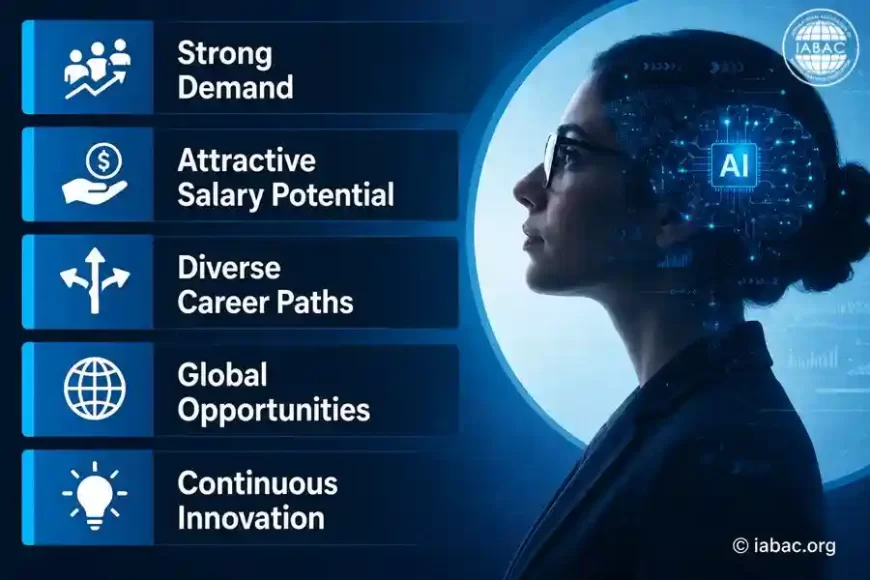
Advantages of Choosing an Artificial Intelligence Career
-
Strong Demand: Demand continues across industries and geographic regions.
-
Attractive Salary Potential: Many AI roles rank among the highest-paying technology careers.
-
Diverse Career Paths: Professionals can specialise in engineering, consulting, research, automation, governance, analytics, or product management.
-
Global Opportunities: AI skills remain valuable worldwide.
-
Continuous Innovation: For learners who enjoy solving problems and learning new technologies, AI offers ongoing opportunities for growth.
Challenges You Should Know Before Entering AI
-
Steep Learning Curve: AI combines programming, mathematics, statistics, and business understanding.
-
Continuous Skill Development: The field evolves quickly, so continuous skill development is needed.
-
Growing Competition: More professionals are entering the field each year.
-
Building Practical Experience Takes Time: Creating meaningful projects requires persistence and hands-on learning. Beginners underestimate this stage, even though practical experience is often the most important factor in building a successful AI career.
Learners can accelerate their progress by choosing beginner-friendly AI certifications that include real-world projects and practical application opportunities.
Artificial Intelligence vs Other Career Paths
1. AI vs Data Science
Data Science focuses on extracting insights from data.
AI focuses more heavily on intelligent systems and automation.
2. AI vs Software Development
Software development covers broader application development.
AI specialization focuses on machine learning and intelligent systems.
3. AI vs Cybersecurity
Cybersecurity protects systems and information.
AI focuses on learning systems capable of making predictions and decisions.
4. Which Career Path Is Best?
The answer depends on your interests.
People who enjoy data, automation, experimentation, and intelligent systems often find AI particularly rewarding.
How to Start an Artificial Intelligence Career in 2026
Step 1: Learn Core AI Foundations
Build knowledge in mathematics, statistics, and programming.
Step 2: Develop Technical Skills
Learn Python, machine learning, and data analysis.
Step 3: Build Projects
Practical projects help transform theory into experience.
Step 4: Create a Portfolio
Document your work and demonstrate problem-solving ability.
Step 5: Earn Relevant Credentials
A structured Artificial Intelligence learning pathway and industry-recognised certification can strengthen your profile.
Organisations such as IABAC offer certification programs designed to align with current industry requirements.
Step 6: Gain Practical Experience
Internships, research projects, freelancing, and collaborative projects all contribute valuable experience.
Step 7: Apply Strategically
Target roles aligned with your strengths and career goals.
Common Myths About AI Careers
✖ You Need a PhD to Work in AI
Many successful professionals enter AI through certifications, self-learning, degree programs, and project-based experience.
✖ AI Is Only for Programmers
The field includes consulting, product management, governance, education, and strategy roles.
✖ AI Jobs Exist Only in Big Tech Companies
Organisations across healthcare, retail, manufacturing, finance, and education hire AI professionals.
✖ AI Will Replace AI Professionals
Professionals who understand how to build, manage, and improve AI systems remain highly valuable.
Future of Artificial Intelligence Career
The future of artificial intelligence career growth remains highly promising.
Several trends are shaping the next generation of AI careers.
-
AI Agents and Autonomous Systems: Organisations are investing heavily in AI agents and systems capable of performing increasingly sophisticated tasks.
-
Human-AI Collaboration: Professionals who can effectively work alongside AI systems will remain in high demand.
-
Responsible AI: Demand for ethics, compliance, risk management, and AI governance expertise continues to grow.
-
Domain Expertise Becomes More Valuable: Professionals who combine AI skills with expertise in healthcare, finance, manufacturing, or other industries are likely to enjoy strong career growth.
Artificial intelligence is one of the strongest career choices in 2026, but success depends on more than learning AI tools. As organisations continue investing in AI, demand is growing for professionals who can combine technical skills with real-world problem-solving.
Whether you're a student, career switcher, or working professional, building practical projects, developing in-demand skills, and understanding business applications will create the strongest opportunities. The field is evolving rapidly, making this an ideal time to start building expertise and positioning yourself for long-term career growth.
Frequently Asked Questions
Is artificial intelligence a good career in 2026?
Yes. AI continues to offer strong demand, competitive salaries, and opportunities across multiple industries.
What qualifications do I need for an AI career?
Most employers look for technical skills, practical project experience, and relevant education or certifications.
Can beginners learn artificial intelligence?
Yes. Many professionals enter the field through structured learning programs, certifications, and practical projects.
Will AI jobs continue to grow in the future?
Current industry trends suggest continued demand for AI professionals across industries.
Which AI role pays the highest salary?
Senior AI Engineers, Machine Learning Engineers, AI Architects, and experienced AI Consultants often earn among the highest salaries in the field.