


















































Why Choosing the Wrong MS in Data Science Program Could Affect Your Career
Choosing the wrong MS in Data Science program can limit practical skills, career opportunities, and employer recognition, affecting long-term success in 2026.

Choosing an MS in Data Science looked easy when I first started researching. Every university promised great career opportunities, impressive salaries, and industry-ready skills. Honestly, I almost believed every brochure I read! After spending weeks comparing programs, talking with professionals, and reading real student experiences, I realized that picking the wrong course can slow down career growth instead of helping it. That was a big wake-up call for me.
One thing I also noticed was that many employers now value practical skills just as much as a degree. That made me explore Data Science Certifications, and I found they can strengthen technical knowledge, improve job readiness, and make a resume more competitive. A good certification also helps fill skill gaps that some university programs may not cover. From my experience, the best MS program is not always the one with the biggest name or the fanciest website. The real value comes from updated coursework, hands-on projects, experienced faculty, and strong industry connections. Trust me, a shiny campus photo never wrote a line of Python code! In this blog, I'll share what I learned and explain why choosing the right MS in Data Science program can make a huge difference in building a successful and rewarding career.
Why the Growing Demand for an MS in Data Science Is Leading to Risky Shortcuts
Data science is not a trend. It is infrastructure.
According to the U.S. Bureau of Labor Statistics, employment in data-related occupations is projected to grow 35% between 2022 and 2032 — far faster than the average for all occupations. The World Economic Forum's Future of Jobs Report 2023 lists data analysts and data scientists among the top five fastest-growing job roles globally. This demand has created a flood of programs claiming to offer a legitimate ms in data science. Universities, bootcamps, online platforms, and hybrid institutes have all rushed in. Some of them are excellent. Many of them are not.
The problem is that when you're at the beginning of your introduction to data science journey, it's genuinely hard to tell the difference.
What a Good Data Science Roadmap Actually Looks Like
Before you can evaluate a program, you need to understand what a solid data science roadmap covers. Here is what industry professionals and hiring managers consistently say they expect from an MS-level candidate:
Foundation Layer
- Statistics and probability (hypothesis testing, Bayesian thinking, distributions)
- Linear algebra and calculus (for understanding ML models, not just using them)
- Python and/or R programming at an intermediate-to-advanced level
- SQL and database management
Core Data Science Layer
- Machine learning: supervised, unsupervised, and reinforcement learning
- Data wrangling, cleaning, and feature engineering
- Model evaluation, bias-variance tradeoff, cross-validation
- Deep learning fundamentals (neural networks, CNNs, RNNs)
Applied and Specialization Layer
- Natural language processing (NLP)
- Computer vision basics
- Time-series analysis
- MLOps and model deployment
Domain and Ethics Layer
- Data ethics and privacy laws (GDPR, CCPA)
- Business communication and storytelling with data
- End-to-end data science project experience
If the program you're evaluating does not cover at least 70–80% of this, you will graduate with a credential but without the skills. That gap is what gets people stuck.
The 7 Warning Signs of a Bad MS in Data Science Program
This is where it gets important. These are the red flags that too many people ignore until it's too late.
1. The Data Science Syllabus Is Vague or Outdated
If a program's curriculum page says things like "students will learn about data analysis tools" without specifying which tools, which versions, and at what depth — that is a red flag. A legitimate program tells you exactly what you're learning. An outdated syllabus that still treats Hadoop as cutting-edge or ignores large language models in 2025 tells you the faculty haven't updated their thinking.
2. No Real Data Science Projects
This is the single biggest differentiator between programs that produce employable graduates and programs that don't. Employers do not hire you because you attended lectures. They hire you because you can show a portfolio. If the program does not require at least two to three substantial end-to-end data science project completions — from data collection to model deployment to business presentation — walk away.
3. Instructors With No Industry Experience
Academia and industry are not enemies, but they are different. A professor who has only published theoretical papers but has never built a production ML pipeline will teach you to think like a researcher, not an engineer. Good programs balance academic rigor with practitioners who have real-world scars.
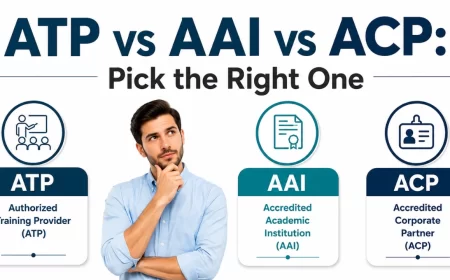
4. The Certification Has No Industry Recognition
This is massive. A certificate that no recruiter has ever seen is decorative at best. When you're looking at a data science certification, you need to ask: "Will this appear credible to a hiring manager in Singapore, Canada, Germany, or Brazil?" If the answer is uncertain, the certificate's value is uncertain.
5. No Mentorship or Career Support
Data science is a field where your network matters enormously. Programs that take your money and hand you PDFs are not investing in your career. Good programs offer mentorship, career coaching, mock interviews, and connections to industry professionals.
6. The Program Doesn't Teach the Full Data-to-Data Pipeline
Understanding data to data — how raw, messy, real-world data becomes a decision-making model and then becomes a business insight — is the essence of the job. If a program only teaches modeling and skips data collection, cleaning, and deployment, you will be useless on the first real project you encounter.
7. No Community or Alumni Network
When you're job hunting, your alumni network can be the difference between a referral and a rejection. Programs with no active alumni community are programs that haven't invested in the long-term success of their graduates.
How the Wrong MS in Data Science Program Can Impact Your Career
Let's be specific about consequences, because this matters.
You spend 12–24 months and significant money on a degree that doesn't translate. Average MS tuition ranges from $15,000 to $60,000 depending on the institution and country. That's money that could have funded multiple high-quality certifications, professional development, and real projects.
You graduate with a skills gap that takes another year to fix. Many graduates of weak programs spend the first year after graduation teaching themselves what their program should have taught them. This is called the "post-degree bootcamp phase" and it's sadly very common in the data science world.
Employers can tell. A hiring manager who interviews hundreds of Data Science candidates every year can tell the difference between someone who deeply understands a gradient boosting algorithm and someone who memorized its name. The interview will expose the gap, even if the certificate didn't.
You miss the window. Data science moves fast. Every year you spend in the wrong program is a year that the field moves forward without you. The tools, techniques, and expectations shift. Catching up becomes harder the longer you're behind.
What You Should Look for Instead: The IABAC Standard
This is where a globally recognized framework makes a real difference.
IABAC (International Association of Business Analytics Certifications) offers a structured, globally benchmarked pathway into data science that is designed specifically to be credible across industries and across borders. Their certifications are built around what practitioners actually need, not what's easiest to teach.
If you're evaluating where to get a certification in data science online or a full ms data science credential, the IABAC pathway is worth examining carefully because it is:
- Aligned with international industry standards
- Recognized by organizations across Asia-Pacific, Europe, and the Americas
- Built on a practical, project-based learning model
- Regularly updated to reflect real shifts in the field (including AI, GenAI, and MLOps)
You can explore the full range of available credentials at https://iabac.org/certifications.
The IABAC certification for data science covers the full spectrum from foundational introduction to data science concepts all the way through to advanced analytics and deployment — which is exactly what a rigorous datascience curriculum should do.
How to Evaluate an MS in Data Science Program Before You Enroll
Choosing the right MS in Data Science program can have a lasting impact on your career. Before you enroll, use this simple evaluation checklist. Give your program 1 point for every "Yes."
Program Evaluation Checklist
- The curriculum is detailed, up to date, and publicly available.
- The program includes at least two end-to-end data science projects.
- Faculty members have real-world industry experience, not just academic backgrounds.
- The certification or degree is recognized by employers internationally.
- The curriculum covers the complete data science journey—from fundamentals to model deployment.
- Mentorship, career guidance, or placement support is included.
- The program has an active and engaged alumni network.
- Data ethics, privacy, and business communication are part of the curriculum.
- Students complete a capstone project or receive portfolio review support.
- The program offers a flexible learning format (online, hybrid, or in-person) without sacrificing quality.
Score Your Program
- 8–10 points: Strong choice with a well-rounded learning experience.
- 5–7 points: Decent option, but be prepared to fill important skill gaps on your own.
- 0–4 points: Consider exploring other programs before making your investment.
A few minutes spent evaluating a program today can help you avoid costly mistakes and choose one that better prepares you for a successful career in data science.
Why Employers Value Skills Alongside an MS in Data Science
Here's a conversation happening in hiring teams all over the world right now: "Do we require a masters in data science, or is a strong portfolio with recognized certifications enough?" The data is increasingly clear. A 2023 LinkedIn Talent Insights report found that 72% of hiring managers in technology roles prioritize demonstrable skills over degree titles when both are on the table. This doesn't mean a degree is worthless — it means a degree from a poor program is worth significantly less than you paid for it.
A well-structured data science certification from a recognized body like IABAC, combined with strong projects, can outperform a weak MS degree from an unrecognized institution. This is the reality of the market in 2025 and beyond. The question isn't "degree or certification?" The question is: "What combination of credentials and demonstrated skills will make a hiring manager trust that I can do this job?"
What the Ideal MS in Data Science Learning Journey Looks Like
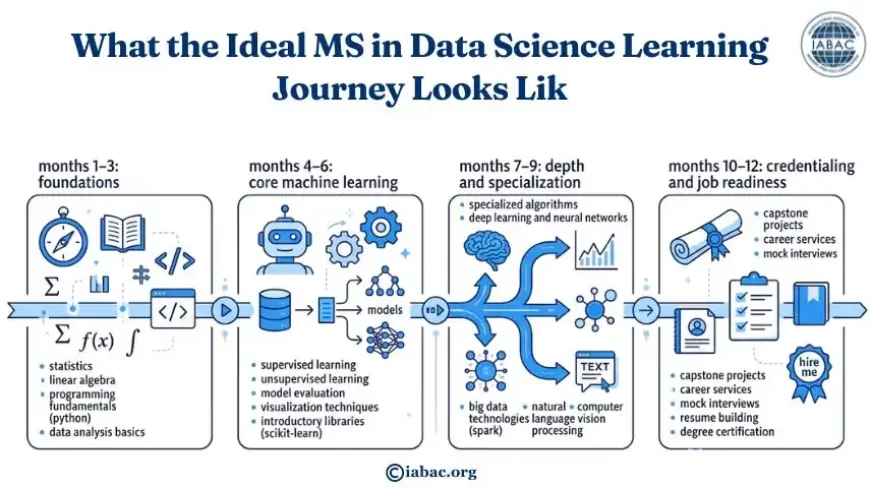
For anyone just starting their data science path, here is a realistic, practical roadmap:
Months 1–3: Foundations
- Learn Python properly (not just syntax — data structures, OOP, pandas, NumPy)
- Statistics fundamentals (distributions, testing, probability)
- Intro SQL for data retrieval and manipulation
- Take a structured introduction to data science course to set the mental model
Months 4–6: Core Machine Learning
- Supervised learning (regression, classification, tree-based models)
- Model evaluation and selection
- Feature engineering and data cleaning at scale
- Complete your first data science project end-to-end (use a public dataset)
Months 7–9: Depth and Specialization
- Deep learning basics
- NLP or computer vision depending on your target domain
- Cloud platforms (AWS, GCP, or Azure — pick one)
- Begin building your portfolio on GitHub
Months 10–12: Credentialing and Job Readiness
- Pursue a recognized certification in data science online
- Complete a capstone project with real business framing
- Refine your LinkedIn, portfolio, and resume
- Begin applying and interviewing
This is a one-year path. It is aggressive but achievable. And if your MS program covers this — great. If it doesn't, you now know what to add yourself.
The Side of Choosing the Right MS in Data Science Program
Choosing the wrong program doesn't just cost you money and time. It costs you confidence.
When you're six months into an MS and you realize you can barely answer basic interview questions, it doesn't feel like a program problem. It feels like a you problem. People start believing they're "not cut out for data science" when the truth is they were just handed a bad map.
The field of datascience is hard enough without carrying the extra weight of imposter syndrome caused by a program that didn't prepare you. This is why the decision matters so much. It's not just about a credential. It's about whether you arrive in the industry feeling prepared and capable — or whether you spend years recovering from a confidence hit that wasn't your fault.
Why Choosing the Right MS in Data Science Program Can Shape Your Future
The ms in data science space is large, competitive, and uneven. There are brilliant programs and deeply disappointing ones, and they often charge similar amounts of money. The difference is in what they teach, how they teach it, who teaches it, and what they do when you graduate.
Before you commit to anything:
- Demand a full data science syllabus, not a marketing page
- Verify that credentials are recognized internationally
- Confirm that real data science projects are central to the program
- Check whether the program follows a complete data science roadmap
- Look at what alumni are doing one and two years after graduation
It's built for the worldwide data science community — not one region, not one industry, not one definition of what a data scientist needs to know. Your career is not a draft. Make the first version count.