




















































Branches of Artificial Intelligence - 2026 Full Guide
Learn about major AI branches like deep learning, NLP, and expert systems. Learn their uses, applications, and best career specialization paths.

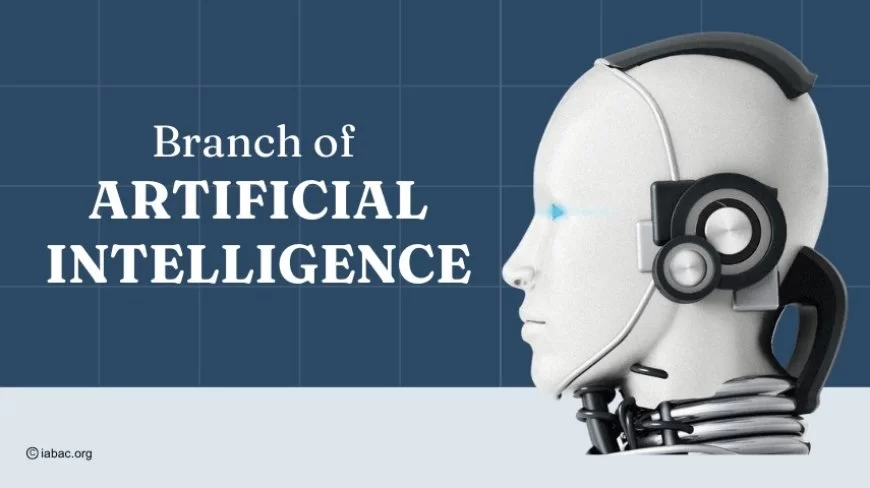
These days, Artificial intelligence (AI) plays a significant role in our daily lives. It assists us with a variety of tasks, such as utilising voice assistants like Siri and receiving suggestions for what to watch on Netflix next. However, what precisely is AI, and how does it function? Let's examine the various AI subfields and their functions to gain a deeper understanding of this.
I still use the same everyday examples when I explain this to peers — recommendation systems, phone assistants, search suggestions. They’re easy hooks. But once you scratch the surface, you see a web of methods and specialities working together.
AI shows up everywhere because different branches solve different parts of the same problem — sensing, reasoning, speaking, and acting.
The Rise of AI
Not long ago, AI seemed like something out of science fiction. We read about it in books and saw it in movies. However, now it’s all around us. Whenever we use our phones or shop online, AI is working behind the scenes to make our experiences better. But with all this technology, it’s easy to feel confused. What is AI, and how does it manage to do so many different things? To find answers, I began looking into the branches of AI, each of which plays a special role.
There’s been an acceleration in adoption and investment since 2022 — most organizations I talk with now include an AI roadmap or pilot. In 2024, surveys showed a big jump in active use of AI tools across industries, and this trend continued into 2025 as companies moved from pilots to production systems.
Understanding AI's Complexity
When I first started learning about AI, I felt overwhelmed. There are so many terms and concepts, and it can be hard to understand how everything fits together. How can one technology do so much? This made me realize that AI isn't just one thing. It has different branches, each with its purpose. To make sense of it all, I decided to break down these branches and understand what each one does.
A practical way to reduce complexity is to map the problem to the branch: do you need prediction (machine learning), language (NLP), vision (computer vision), control (robotics), or reasoning (expert systems/fuzzy logic)? That quick map stops you chasing buzzwords.
What Are the Branches of AI
As I researched, I asked myself a key question: What are the main branches of AI, and how do they work together? Here are the primary branches of AI that I discovered:

1. Machine Learning (ML)
One of the most important branches of AI is Machine Learning. This is all about teaching computers to learn from data. Instead of telling a computer exactly what to do, we can give it data and let it figure things out on its own. This helps computers become smarter over time.
Machine learning powers many real products: fraud detection, demand forecasting, product recommendations, and predictive maintenance. In 2024–25 the focus has shifted to not just model accuracy but deployability — MLOps and model governance are now central. That means pipelines, testing, versioning, and monitoring matter as much as the model itself.
Techniques in Machine Learning
There are a few techniques within machine learning:
- Supervised Learning: This is when we train a computer on data that has known answers. For example, if we want a computer to recognize cats in pictures, we show it many images of cats and tell it which ones are cats. This is like teaching a child by showing them examples.
- Unsupervised Learning: In this method, the computer learns from data without knowing the answers ahead of time. It finds patterns on its own. For example, if we give it a bunch of pictures, it might group similar ones without us telling it what they are.
- Reinforcement Learning: This is a bit like training a pet. We reward the computer for making good decisions, which encourages it to keep improving. This technique is often used in video games and robotics.
- There’s also semi-supervised and self-supervised learning — methods that reduce the need for labelled data by learning structure from raw inputs. Large language models (LLMs) rely heavily on self-supervised pretraining.
Key takeaway: choose the learning style that matches your data volume and labeling budget.
2. Natural Language Processing (NLP)
Another exciting branch is Natural Language Processing (NLP). This is about teaching computers to understand and interact with human language. With NLP, machines can read, write, and respond to us in a way that makes sense.
Applications of NLP
Here are some cool uses of NLP:
- Text Analysis: This helps businesses understand what people are saying about them online. For instance, if many customers leave positive reviews about a product, the business can see that and know they are doing something right.
- Machine Translation: NLP powers translation tools like Google Translate. This helps us communicate across different languages. For example, if I want to read a news article in Spanish, I can use this tool to get an English version.
- Chatbots and Virtual Assistants: Tools like Siri and Alexa use NLP to help us. We can ask them questions or give them commands, and they respond appropriately. This makes interacting with technology much easier.
- Text Summarization: This helps condense long pieces of text into shorter versions while keeping the main idea intact. For example, if you have a lengthy research paper or news article, an NLP-based summarize tool can quickly create a brief summary highlighting the key points. Businesses, students, and researchers use this to save time and understand information faster without reading the entire text.
- Grammar Checking: NLP-powered tools help users to find grammar or spelling mistakes and correct them. You can paste content into grammar check tool; it will understand the context, highlight grammatical errors, and provide suggestions to fix them. Professionals, students, and writers utilize grammar checkers for instant and accurate proofreading of their content.
- NLP work centered on making models smaller and cheaper to run (small language models) and on safety controls for hallucinations and bias. If you build an NLP feature, add clear fallback logic — when confidence is low, route to a human.
3. Computer Vision
Next, I learned about Computer Vision. This branch helps computers understand and interpret visual information, like images and videos. It allows machines to “see” and make sense of what they are looking at.
Key Areas of Computer Vision
Some important applications of computer vision include:
- Image Recognition: This helps computers identify objects or people in pictures. For example, when you tag friends in photos on social media, image recognition technology is at work.
- Video Analysis: This is used in many areas, including security. For instance, surveillance cameras can recognize unusual activities, alerting authorities when something is off.
- Medical Imaging: In healthcare, computers can analyze medical images (like X-rays) to help doctors diagnose diseases. This technology can make diagnosing patients faster and more accurate.
Recent progress includes better object tracking in low-light and multimodal vision+language models that can answer questions about images. For real projects, consider edge inference (running models on phones or cameras) when latency or privacy matters.
4. Robotics
Robotics is another fascinating branch of AI. It involves designing and programming robots to perform tasks, often without human help. This field is growing rapidly and has many practical uses.
Applications of Robotics
Here are some key areas where robotics is applied:
- Automation: Robots can perform repetitive tasks in factories, like assembling cars. This helps companies work faster and with fewer mistakes.
- Drones: Drones are flying robots that can be used for many purposes, like delivering packages or taking aerial photos. They use AI to navigate and avoid obstacles.
- Assistive Robots: Some robots are designed to help people with disabilities. These robots can assist with daily tasks, making life easier for those who need help.
Robotics often combines perception (vision), planning (ML), and control. Expect more collaborative robots (cobots) working alongside humans rather than replacing them.
5. Expert Systems
Expert Systems are another important branch of AI. They are designed to mimic human decision-making. These systems use a set of rules and facts to solve problems in specific areas.
Use Cases of Expert Systems
Some examples include:
- Medical Diagnosis: Expert systems can help doctors diagnose illnesses by analyzing patient symptoms. This can lead to better and quicker treatment.
- Financial Services: In finance, these systems can evaluate risks and suggest investment options based on data analysis. This helps businesses make smarter decisions.
- Expert systems are ideal for regulated environments because their transparent, rule-based logic is easy to audit, and they work best when combined with statistical models to balance compliance and performance
6. Fuzzy Logic
I also discovered Fuzzy Logic, which deals with reasoning that is not always black and white. This approach helps computers make decisions when the information is uncertain or imprecise.
Applications of Fuzzy Logic
Fuzzy logic is useful in:
- Control Systems: Many household appliances, like washing machines and air conditioners, use fuzzy logic to operate efficiently. For example, an air conditioner can adjust its cooling based on room temperature and humidity.
- Decision-Making: Fuzzy logic helps in situations where yes/no answers aren’t enough. It allows for more flexible and nuanced decision-making.
Fuzzy logic is lightweight and interpretable. Use it in embedded systems or where simple, readable rules are required.
Pro tip: pair fuzzy rules with sensors calibrated to real-world ranges for stable behaviour.
7. Neural Networks
Lastly, I explored Neural Networks, which are inspired by the human brain. These networks consist of interconnected nodes that process information, making them powerful tools for various AI tasks.
Deep Learning and Its Impact
Neural networks are at the heart of Deep Learning, a popular area of machine learning.
- Deep Learning: This technique uses many layers of neural networks to learn from large amounts of data. It’s great for tasks like recognizing speech and images. For example, when you talk to your phone, deep learning helps it understand your voice.
- Generative Models: These models can create new content, such as images or music, based on patterns they’ve learned. This opens up exciting possibilities for creativity and innovation.
Generative models (image, text, audio) changed how teams prototype content and interfaces. They’re powerful, but they also raise questions about copyright, attribution, and content quality.
Key takeaway: use neural models where creativity or complex pattern recognition delivers clear value, and plan guardrails for misuse.
The Interconnected Nature of AI Branches
As I pieced everything together, it became clear that these branches of AI are connected. Each branch supports the others, and advancements in one area can lead to improvements in another. For instance, progress in machine learning can help enhance natural language processing, and breakthroughs in computer vision can aid robotics.
In practice you rarely deploy a single-branch system. A practical product might combine vision for input, ML for prediction, NLP for user interface, and an expert system for rules and compliance. That modular approach makes systems easier to test, audit, and improve.
The Future of AI
Thinking about the future of AI excites me. The branches of AI will likely continue to grow and evolve, opening up new possibilities. We are already seeing emerging fields like ethical AI and explainable AI, which focus on making AI systems more transparent and accountable.
Trends (2024–2026):
A few concrete trends to watch:
- Foundation models & multimodal systems are driving many products (text + image + audio).
- MLOps and model governance are now business priorities as organizations scale AI in production.
- Regulation is catching up: bodies like the EU have staged enforcement steps since 2024, and organizations must plan for compliance.
- Small, efficient models running on edge devices are enabling offline and private use-cases.
Plan for responsible, measurable AI — accuracy matters, but so do safety, explainability, and compliance.
My exploration of the branches of Artificial Intelligence has been eye-opening. Learning about these branches not only helps us understand the technology but also shows how it impacts our lives. AI has the potential to make tasks easier, improve efficiency, and solve complex problems.
As we move forward, touching AI responsibly is crucial. By discussing the implications of AI and ensuring ethical development, we can use this powerful technology to benefit everyone.
I hope this journey through the branches of AI inspires you to explore more about this exciting field. AI is transforming our world, and understanding its branches is the first step in harnessing its full potential. Together, let’s continue to learn and discover how AI can shape our future.