
























































What is Real-Time Data Analytics: How It Works & Benefits
What is real-time data analytics? Learn how it works, benefits, tools, AI-powered applications, and real-world business use cases in 2026 today.

Key takeaways
• Real-time analytics processes data within seconds of it being created, instead of waiting for scheduled reports.
• It runs on a five-stage pipeline: sources, streaming, processing, analytics, and visualization or action.
• Real-time is not always the right choice; when a delayed decision costs little, batch is cheaper and simpler.
The 2026 shift is real-time data feeding AI and LLM systems for automated, decision-grade responses.
Real-time data analytics is the process of collecting, processing, analysing, and acting on data as it is generated, or within seconds of its creation. Instead of waiting for a report to be compiled overnight, the system reacts while the event is still happening.
Traditional data analytics often relies on historical data: reports are generated after data has been collected, stored, and processed. That approach is still useful, but it cannot support decisions that have to be made in the moment. Real-time analytics works on live information streams instead.
For example:
• A bank flags a suspicious transaction while it is being authorized, not the next day.
• An e-commerce platform recommends products while the customer is still browsing.
• A logistics company reroutes delivery vehicles as traffic conditions change.
• A hospital monitors patient vital signs continuously and alerts staff the moment they drift.
In each case, the insight arrives early enough to change the outcome, rather than simply explaining it afterward.
Real-Time Analytics vs Traditional Analytics
|
Feature |
Real-Time Analytics |
Traditional Analytics |
|
Data processing |
Immediate |
Scheduled |
|
Data source |
Live streams |
Historical data |
|
Response time |
Seconds or milliseconds |
Hours, days, or weeks |
|
Typical use |
Fraud detection, monitoring, alerts |
Reporting, forecasting, trend analysis |
|
Decision making |
Instant |
Delayed |
Why Real-Time Analytics Matters in 2026?
More organizations now operate in conditions where a slow decision is a lost one. Customers expect personalized experiences, cybersecurity threats evolve by the hour, supply chains shift without warning, and digital services generate enormous volumes of data every second.
Used well, real-time analytics helps organizations:
• Improve customer experiences as they happen
• Reduce operational delays and bottlenecks
• Detect risks earlier, before they escalate
• Optimize performance with live feedback
• Open new revenue opportunities through timely action
Companies that can act on information immediately often gain an edge over those that rely only on historical reporting. Major cloud providers have expanded their streaming and event-processing services in recent years, which reflects steady growth in enterprise demand for this capability.
How Does Real-Time Analytics Work?
Real-time analytics is easier to understand when you break it into five stages. Together they form a continuous pipeline rather than a one-off report.
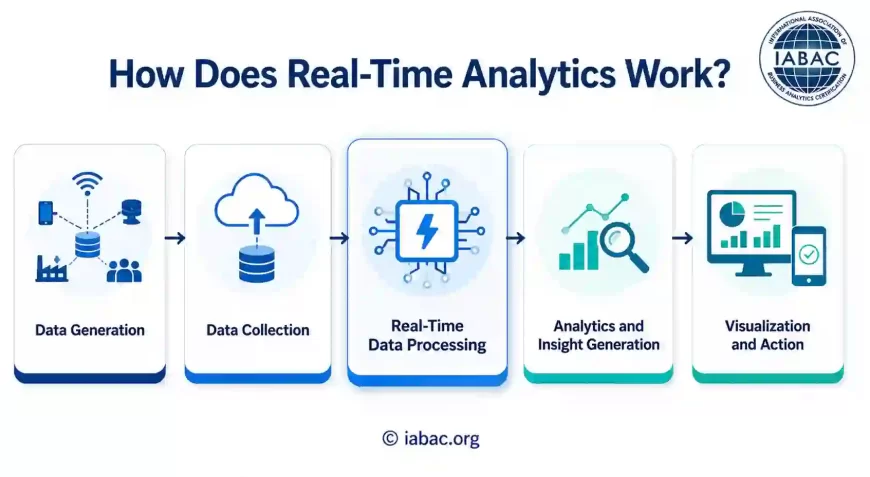
The real-time analytics pipeline, from raw events to automated action.
Step 1: Data generation
Data originates from many sources at once — websites, mobile apps, IoT devices, customer transactions, social platforms, CRM and ERP systems, and network logs. Every interaction creates a new event.
Step 2: Data collection
Those events flow into a collection layer built to handle high-volume streams. Common technologies include Apache Kafka, Amazon Kinesis, Azure Event Hubs, and Google Pub/Sub.
Step 3: Real-time data processing
Instead of storing data first and analyzing it later, processing engines evaluate each event as it arrives. Typical tasks include filtering, reformatting, detecting anomalies, aggregating metrics, and applying business rules. This is the stage people usually mean when they say real-time data processing.
Step 4: Analytics and insight generation
Analytics engines then evaluate the processed stream, performing trend analysis, pattern recognition, predictive analytics, behavioral analysis, and risk management. Insights are produced in seconds.
Step 5: Visualization and action
Finally, results surface through dashboards, automated alerts, mobile notifications, and AI-driven recommendations. From there, a person — or an automated system — can act immediately.
Components of a Real-Time Analytics Architecture
Most modern systems follow the same five-layer shape. The diagram below shows how data moves from raw sources through to action, with example technologies at each layer.
1. Data sources generate the incoming events — business applications, sensors, transaction systems, and websites.
2. Streaming layer transports those events continuously. Common choices include Apache Kafka, Amazon Kinesis, and Azure Event Hubs.
3. Processing layer analyzes the stream in motion using engines such as Apache Flink, Spark Streaming, or Databricks Streaming.
4. Analytics layer applies the models — statistical analysis, machine learning, and predictive scoring.
5. Visualization layer displays results through dashboards and business intelligence tools such as Power BI, Tableau, and Looker.
Real-Time vs Batch Analytics: Which Should You Use?
Most organizations use both. Batch analytics processes large volumes of data on a schedule — daily sales reports, monthly financials, quarterly reviews. Real-time analytics processes information continuously — fraud alerts, inventory updates, live monitoring. The practical question is which one a given use case actually needs.
Use this quick decision guide:
|
If this is true... |
Lean toward |
|
A delayed decision costs little or nothing |
Batch |
|
The value of the data drops within seconds or minutes |
Real-time |
|
You mainly need historical reporting and forecasting |
Batch |
|
A customer experience must adapt while the user is active |
Real-time |
|
Risk or fraud must be caught before it completes |
Real-time |
|
You need updates in minutes, not milliseconds, on a budget |
Micro-batch (a middle ground) |
Is Real-Time Worth It? When Batch Is the Smarter Choice
Real-time analytics is powerful, but it is not automatically better. The decision should be driven by the cost of waiting, not by what sounds modern. If a delayed answer changes nothing, real-time mostly adds expense.
Compared with batch, real-time systems usually cost more to run, are harder to debug, and need on-call monitoring because they never stop. A common and pragmatic middle ground is micro-batch processing, which groups events into small windows of a few seconds to a few minutes. It captures most of the value of “fast enough” without the full operational weight of true streaming.
Estimate what one hour of delay actually costs your business for a given decision. If the answer is close to zero, batch or micro-batch is almost always the right call.
Real-World Applications of Real-Time Data Analytics
Financial services: Banks process millions of transactions a day and use real-time analytics to detect fraud, monitor compliance, and assess risk as it happens.
Retail and e-commerce: Online retailers recommend products, personalize offers, and track inventory while customers are actively shopping.
Healthcare: Providers monitor patient vital signs, medical equipment, and emergency alerts continuously. (Real-time data supports clinical staff; it does not replace medical judgment.)
Manufacturing: Plants track equipment performance, production efficiency, and predictive maintenance needs.
Logistics and transportation: Operators optimize fleet management, route planning, and delivery tracking on the move.
Cybersecurity: Security teams identify suspicious activity, network anomalies, and potential threats before major damage occurs.
Benefits of Real-Time Business Analytics
• Faster decision-making: Leaders get immediate visibility into operations instead of waiting for delayed reports.
• Improved customer experience: Interactions can be personalized in the moment, which tends to raise engagement and satisfaction.
• Better operational efficiency: Live monitoring surfaces bottlenecks quickly, so teams can act before issues escalate.
• Reduced risk: Organizations detect fraud, security incidents, and compliance violations earlier than traditional approaches allow.
• Competitive advantage: Companies that act on live data often outperform those relying solely on historical analysis.
Common Challenges of Real-Time Analytics
The capability is powerful, but implementation is genuinely hard. The most common challenges include:
Data quality: Poor input produces poor insight, faster. Strong governance matters more, not less, when decisions are automated.
Infrastructure complexity: Streaming systems require specialized platforms and skills that many teams have to build up first.
Scalability: Event volumes keep growing, so systems must scale without falling behind the stream.
Security and compliance: Sensitive data has to stay protected while remaining accessible enough to be useful in real time.
Cost: Real-time environments often mean ongoing investment in cloud infrastructure, platforms, and skilled people.
A pitfall teams usually underestimate: Events do not always arrive in order. Late or out-of-order data forces hard choices about how long to wait before acting (often handled with “watermarks”), and “exactly-once” versus “at-least-once” processing changes whether the same event might be counted twice. In alerting use cases such as fraud, the real cost is often false positives; a system that cries wolf too often gets ignored. Designing for these realities early is what separates a demo from a production system.
Popular Real-Time Analytics Tools
Organizations rarely rely on a single product. These tools typically work together across the pipeline:
Streaming platforms: Apache Kafka, Amazon Kinesis, Azure Event Hubs, Google Pub/Sub.
Processing platforms: Apache Flink, Apache Spark Streaming, Databricks.
Analytics and visualization: Microsoft Power BI, Tableau, Looker, Qlik Sense.
Cloud platforms: AWS Analytics Services, Microsoft Azure Analytics, Google Cloud Analytics.
Real-Time Analytics and AI: What's Changing in 2026
Real-time analytics and AI increasingly run as one system, and this is where the field is moving fastest in 2026.
Predictive analytics: Machine-learning models score live data to forecast outcomes such as customer churn, demand spikes, or emerging risk as conditions change.
Anomaly detection: AI flags unusual patterns automatically, from fraud and equipment failures to security threats, without waiting for a human to query the data.
Streaming data into AI and LLMs: A growing pattern is feeding live streams into large language models and retrieval systems, so AI assistants can answer using up-to-the-second context rather than stale snapshots.
Decision intelligence and edge processing: More routine decisions are being automated at the point of action, and more processing is moving to the edge closer to devices to cut latency and bandwidth. Together, these push real-time analytics from “show me a dashboard” toward “decide and act for me.”
Building Real-Time Analytics Skills
Real-time analytics skills are valuable for business and data analysts, data scientists, IT and data-engineering teams, and business leaders who rely on live dashboards.
Demand spans roles such as data analyst, business analyst, data scientist, analytics engineer, BI developer, machine-learning engineer, and data engineer.
A practical learning path moves through four layers: solid data fundamentals (databases, SQL, data structures, and visualization), core analytics concepts (statistics, KPIs, business analytics), streaming technologies (Kafka, Spark Streaming, cloud event systems), and hands-on projects on a cloud platform such as AWS, Azure, or Google Cloud. Recognized certifications can then validate that skill set for employers.
Which Certification Fits Real-Time Analytics Work?
If you want a credential that reflects real-time and business analytics skills, these IABAC certifications map to different goals:
|
Certification |
Best for |
|
Business analytics, BI, and decision-making |
|
|
Advanced analytics and machine learning |
|
|
Reporting and dashboard development |
For professionals focused on the business side of real-time analytics turning live data into decisions, KPI monitoring, and performance measurement- the Certified Business Analytics Expert (CBAE) tends to be the closest fit. If your goal leans more technical (model building or AI systems), CDS or CAIE may suit you better.
Takeaway
Real-time data analytics lets organizations analyze information as it is generated, so they can make faster decisions, improve customer experiences, reduce risk, and optimize operations. The core idea is simple: act while the event is still happening, not after.
Just remember that real-time is a tool, not a default. Match it to decisions where speed genuinely changes the outcome, and use batch or micro-batch where it doesn't. As businesses keep investing in data-driven and AI-assisted operations, people who understand both the technology and when to apply it will stay in demand.
Ready to build practical, business-focused analytics skills? Explore IABAC's data analytics certifications to find the path that matches your goals.
Frequently Asked Questions
What is real-time data analytics?
Real-time data analytics is the process of analyzing data immediately after it is generated, so organizations can make decisions within seconds rather than waiting for scheduled reports.
How does real-time analytics work?
It collects data streams, processes them continuously as events arrive, applies analytics or machine-learning models, and delivers insights through dashboards, alerts, or automated actions.
What is the difference between real-time analytics and batch analytics?
Real-time analytics processes data immediately, while batch analytics processes accumulated data at scheduled intervals such as daily or weekly reports. Many organizations use both.
When is batch analytics the better choice?
When a delayed decision costs little, when you mainly need historical reporting, or when budget and simplicity matter more than speed. Micro-batch is a useful middle ground.
What are the most popular real-time analytics tools?
Common tools include Apache Kafka, Apache Flink, Spark Streaming, Power BI, Tableau, Amazon Kinesis, Azure Event Hubs, and Google Pub/Sub.
Why is real-time analytics important for businesses?
It helps businesses make faster decisions, personalize customer experiences, detect risks earlier, and optimize operations more effectively.
Which industries use real-time analytics?
Finance, healthcare, manufacturing, retail, logistics, telecommunications, and cybersecurity all rely on it widely.
Is real-time analytics a good career path?
Yes. Demand continues to grow for data analysts, business analysts, data scientists, analytics engineers, and cloud analytics specialists with real-time analytics expertise.