




















































Agentic AI Takes Over: 11 Shocking 2026 Predictions (With the Data to Back Them Up)
Discover 11 data-backed Agentic AI predictions for 2026, from enterprise adoption and AI jobs to market growth, governance, and future trends.

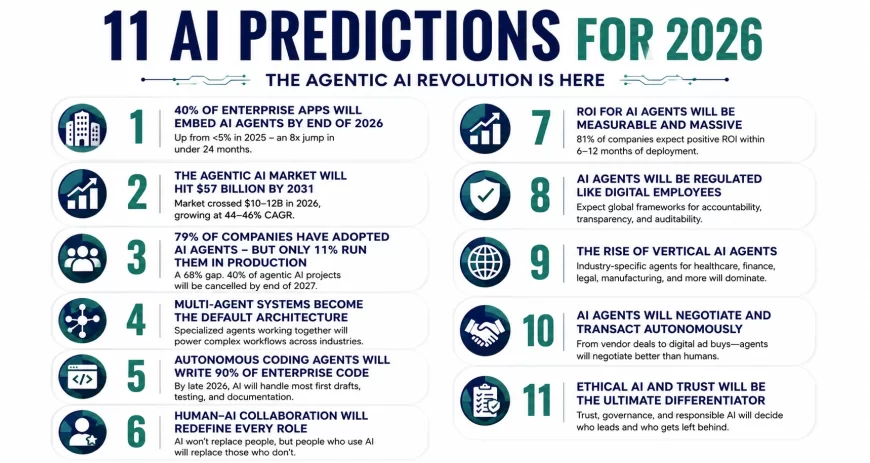
Quick answer overview: Agentic AI in 2026 is no longer experimental. The market has crossed $10–12 billion, Gartner forecasts 40% of enterprise applications will embed task-specific agents by year-end (up from under 5% in 2025), and McKinsey projects AI agents could unlock $2.9 trillion in annual U.S. economic value by 2030. But 40% of projects are at risk of cancellation by 2027 — mostly from poor governance, not bad models.
AI stopped being a tool in 2026. It became a workforce.
Not a metaphor. A literal, operational workforce of autonomous systems that plan, reason, browse the internet, write and execute code, send emails, negotiate with other agents, and report back — without a human holding their hand through each step.
This is agentic AI. And it has arrived faster and with more disruption than most predicted. If you are a professional, a business leader, or someone who simply wants to understand where the next five years are going, these 11 predictions are not thought experiments. They are happening now, with data attached.
What Is Agentic AI?
Traditional AI responds to prompts. You ask, it answers. Agentic AI pursues goals. You give it an objective — "find the three best suppliers for this component, compare pricing, and draft a shortlist email" — and it handles every step, using tools, browsing the web, coordinating with other agents, and delivering the output.
The shift is architectural: from AI as instrument to AI as participant. That one distinction is why the predictions below are so consequential.
Prediction 1: 40% of Enterprise Apps Will Embed AI Agents by End of 2026
Shocking level:
Just two years ago, fewer than 5% of enterprise applications included any form of task-specific AI agent. By the end of 2026, Gartner forecasts that figure will reach 40% — an eight-fold jump in under 24 months.
That is not gradual adoption. That is a structural overhaul of how enterprise software works.
The shift is already visible. Google Cloud's Gemini Enterprise Agent Platform, Microsoft Copilot Studio, Salesforce Agentforce, and OpenAI Workspace Agents all launched or scaled significantly in early 2026, eliminating what analysts had previously called "pilot paralysis" — the tendency of large organizations to experiment indefinitely without deploying.
For professionals, this means the software they use at work will increasingly do things rather than just display information. ERP systems that reorder inventory. CRM platforms that draft follow-ups. HR tools that screen candidates. The interface becomes the agent.
What this means for your career: Professionals who understand how to configure, evaluate, and govern these embedded agents will be disproportionately valuable. An IABAC Artificial Intelligence Certification builds exactly this fluency — not just the theory of agents, but how they integrate into real enterprise systems.
Prediction 2: The Agentic AI Market Will Hit $57 Billion by 2031
Shocking level:
The numbers are not subtle. The global agentic AI market sat at approximately $7.6–7.8 billion in 2025. By 2026, it has crossed $10–12 billion, growing at a 44–46% compound annual growth rate (CAGR). Analysts forecast the market reaching $57 billion by 2031, with some projections citing $236 billion by 2034 if adoption accelerates in line with current trajectories.
To put that growth rate in context: Gartner positions agentic AI as the fastest-growing technology category since cloud infrastructure in 2009–2012, with spending velocity 340% higher than robotic process automation at its peak.
The spending is not speculative. IDC projects AI-related spending will exceed 26% of global IT budgets by 2029, reaching $1.3 trillion. Organizations are not exploring agents. They are funding them at scale.
Prediction 3: 79% of Companies Have Adopted AI Agents — But Only 11% Run Them in Production
Shocking level:
This is the most important gap in enterprise AI today, and almost nobody is talking about it clearly.
Survey data shows 79% of organizations report adopting AI agents in some form. But verified production deployment data tells a different story: only about 11% are running agents in production at scale. That is a 68-percentage-point gap — the largest deployment backlog in enterprise technology history, according to analysts tracking the space.
What explains it? The failure pattern is consistent: unclear success criteria, missing tools and data access, and no evaluation discipline once agents go live. Forrester research finds that agent failures stem from ambiguity, miscoordination, and unpredictable system dynamics rather than model limitations. The problem is rarely the AI. It is the organization around it.
Gartner's forecast is sobering: more than 40% of agentic AI projects will be cancelled by the end of 2027, primarily due to escalating costs, unclear value, and inadequate governance.
The organizations that close this gap fastest — that move from the 79% to the 11% — will capture disproportionate competitive advantage as the market matures.
Prediction 4: Multi-Agent Systems Become the Default Architecture
Shocking level:
The era of asking one AI model to do everything is ending. Leading organizations in 2026 are deploying networks of specialized agents orchestrated toward shared goals — what analysts are calling AI's "microservices revolution."
The architecture is straightforward in concept, complex in execution. An orchestrator agent receives a high-level objective and delegates to specialists:
-
A research agent gathers and verifies information
-
A coding agent builds or tests technical components
-
An analyst agent validates results and flags anomalies
-
A governance agent monitors for policy and compliance violations
In healthcare, multi-agent systems now coordinate patient monitoring, diagnostics, treatment planning, and hospital operations simultaneously — each agent domain-specific, all working toward shared clinical outcomes. In financial services, agent networks run fraud detection, regulatory compliance, customer service triage, and portfolio analysis in parallel, catching errors that sequential workflows would miss entirely.
In supply chain operations, multi-agent systems monitor inventory across regions, predict shortages, and trigger replenishment — processing signals from ERP systems, weather forecasts, and market data in ways that once required entire analytics teams.
The value is not just speed. It is depth, context, and error correction at scale.
Prediction 5: AI Agents Will Generate $2.9 Trillion in Annual U.S. Economic Value by 2030
Shocking level:
McKinsey's midpoint scenario projects that AI-powered agents and robotics could generate roughly $2.9 trillion in U.S. economic value annually by 2030, representing the automation of approximately 27% of current work hours.
The broader global figure is equally striking: McKinsey estimates generative and agentic AI could add between $2.6 and $4.4 trillion annually to global GDP.
This is not a projection about what AI might eventually do. It is a projection about what organizations are already planning. According to NVIDIA, 86% of organizations are increasing their AI budgets in 2026. The spending commitments are already made. The economic impact is, in that sense, already in motion.
For those watching labor markets: McKinsey estimates 44% of U.S. work could be performed by AI agents with capabilities that already exist. The constraint is not technical readiness. It is organizational readiness.
Prediction 6: 40% of Global 2000 Roles Will Involve Direct AI Agent Engagement
Shocking level:
IDC projects that by the end of 2026, 40% of roles in Global 2000 companies will involve direct, daily engagement with AI agents — not using AI tools, but actively working alongside autonomous systems that share their workflows.
A new job category is already emerging in response: the AI Workforce Manager. These are not IT roles. They are operational roles responsible for task orchestration between human employees and AI agents, agent governance within defined policies and ethical frameworks, performance optimization across blended human-AI teams, and cross-system coordination across CRM, ERP, support, and analytics platforms.
Organizations that build this management layer deliberately will outperform those that assume agents self-organize. The human remains essential — but the nature of the human's work has fundamentally changed.
Prediction 7: Healthcare AI Agents Will Save $150 Billion Annually by 2026
Shocking level:
Healthcare is not the sector most associated with aggressive AI adoption, yet the data here is extraordinary. Accenture estimates that AI applications in healthcare can generate up to $150 billion in annual savings by 2026 across administrative, clinical, and operational functions.
Real deployments are already validating this. AtlantiCare in New Jersey rolled out an agentic AI clinical assistant to 50 providers and recorded an 80% adoption rate within the pilot group. Those using the agent saw a 42% reduction in documentation time, saving approximately 66 minutes per provider per day — time that goes directly back to patient care.
AI-powered imaging solutions are projected to prevent up to 2.5 million diagnostic errors annually (Frost & Sullivan), and four in ten healthcare executives are already using AI for inpatient monitoring and early warning systems.
The limiting factor in healthcare AI is not capability. It is governance — audit trails, explainability, and human-in-the-loop controls for clinical decisions. Organizations that build governance infrastructure now will deploy safely while others are still debating risk thresholds.
Prediction 8: The ROI Gap Between AI Leaders and Laggards Will Become Irreversible
Shocking level:
This may be the most consequential prediction on this list, because it is already in progress and most organizations have not registered its implications.
IDC and Microsoft jointly measure a 3.7x average return per $1 invested in generative and agentic AI. The top quartile of agentic AI deployments is already reporting ROI exceeding 540% within 18 months of going live. Median global ROI for production-scale agentic AI sits at 171%, with U.S. enterprises averaging 192%.
At the same time, IBM's 2025 CEO study finds only 25% of AI initiatives delivered expected ROI — and only 16% reach enterprise-wide scale. The gap between leaders and laggards is not measured in percentages. It is measured in competitive positioning that, once established, becomes self-reinforcing.
The organizations cancelling projects in 2027 are the ones that built without governance in 2025–2026. The ones still piloting in 2027 will be competing against companies already in their third generation of production deployment.
The window for catching up without permanent disadvantage is closing. McKinsey's State of Organizations 2026 survey (n=10,018) found that 60% of large enterprises are already in production-level deployments. The default assumption should be that competitors are deploying — not piloting.
Prediction 9: 92 Million Jobs Will Be Displaced — and 170 Million New Ones Created
Shocking level:
The World Economic Forum's Future of Jobs Report projects that by 2030, 92 million jobs will be displaced by AI and automation, while 170 million new roles will be created — a net gain of roughly 78 million positions globally.
The optimistic framing is mathematically sound but practically complex. Net gains at a global level do not distribute evenly across sectors, geographies, or skill profiles. Goldman Sachs estimates AI could affect roughly 300 million full-time equivalent jobs globally by 2030.
What does distribute evenly is agency. Professionals who build AI literacy now — who learn to direct, evaluate, and collaborate with agentic systems — will find their value multiplied regardless of which specific roles expand or contract.
Stanford HAI's 2025 Index documents agents already outperforming humans in verifiable domains like coding, enabling 10–50% faster outputs in controlled studies. McKinsey observes agents automating up to 70% of office workflows as co-pilots, raising human productivity 40% in pilots.
The career risk is not replacement. It is irrelevance through inaction. Professionals who treat AI literacy as optional are making a bet that is increasingly hard to justify with data.
How IABAC-certified professionals are positioned differently: IABAC's AI and data science certifications are specifically structured around the skills that matter in this transition — not just using AI tools, but understanding how to deploy, govern, evaluate, and lead AI-augmented workflows. The IABAC Certified AI Expert and AI Certified Executive programmes are built for exactly this career inflection point.
Prediction 10: Agentic AI Security Will Become a Board-Level Priority
Shocking level:
The 2026 Gartner Hype Cycle for Agentic AI places a striking emphasis on governance, security, and cost-focused profiles alongside core agentic technologies. This is unusual for a Hype Cycle — governance frameworks rarely emerge this early in an adoption curve. Their presence signals that the enterprise risk community has registered agentic AI as a new threat surface, not just a productivity tool.
The concern is structural. An agent with broad system access, minimal oversight, and a compromised instruction set can gain access to sensitive data, execute unauthorized transactions, or introduce vulnerabilities into critical infrastructure. The industry term for this failure mode is "double agents" — AI systems that carry unchecked risk because security was an afterthought.
Every deployed agent should have a clear identity, limited and audited access permissions, managed and logged data outputs, and protection from prompt injection attacks. Without these controls, organizations are not just accepting risk — they are building attack surfaces at scale.
According to PwC, 53% of U.S. businesses deploying AI agents are doing so in IT and cybersecurity — the very functions responsible for securing the rest of the organization. The security-aware deployment of agents is not a constraint on agentic AI adoption. It is a prerequisite for sustainable deployment.
Prediction 11: Model Context Protocol (MCP) Becomes the TCP/IP of the Agentic Layer
Shocking level:
This prediction is the most technical on the list, but its implications are the broadest for anyone building on or with AI systems.
Anthropic's Model Context Protocol (MCP) reached 97 million downloads within months of its release and now supports over 1,000 servers in its ecosystem. It is rapidly becoming the interoperability standard that enables agents to connect to external tools, databases, APIs, and other agents — the infrastructure layer that everything else runs on top of.
Analysts who track protocol adoption are comparing MCP's trajectory to TCP/IP in the 1990s: not the most glamorous technology, but the one that determines what is possible at scale. As the de facto standard for agent-tool connectivity, its adoption trajectory shapes which AI capabilities become universal and which remain siloed.
For enterprises building agentic workflows: the organizations that align their internal systems with emerging standards like MCP today will integrate new agent capabilities seamlessly as they emerge. Those who build in isolation will face expensive migration costs later.
The Through-Line: Why Governance Is the Real Differentiator
Across all 11 predictions, one variable separates the organizations that will succeed with agentic AI from those that will cancel projects in 2027: governance.
Not governance in the regulatory compliance sense — though that matters too. Governance in the operational sense: clear success criteria before deployment, observable agent behavior during deployment, and human-in-the-loop controls for high-stakes decisions.
Forrester's analysis of agent failures consistently finds that the problem is rarely the model. It is ambiguity, miscoordination, and a lack of evaluation discipline. The organizations building governance infrastructure now are positioning themselves to move from the 79% (adoption) to the 11% (production) — and that transition, as the ROI data shows, is where the returns actually materialize.
What This Means If You Are a Professional Right Now
The honest summary of these 11 predictions is this: agentic AI is not a technology story. It is a capability story. The organizations and individuals who treat it as such — who invest in understanding how to direct, evaluate, and collaborate with autonomous systems — will outperform those waiting for the picture to become clearer.
The picture is already clear. The data is in.
Three concrete things to do this quarter:
-
Understand the architecture. Multi-agent systems, orchestration frameworks, and tool-use APIs are the building blocks of agentic workflows. You do not need to build them — but you need to understand what they do and where they fail.
-
Build verified credentials. As agentic AI becomes embedded in hiring decisions, the credential gap between AI-literate and AI-unfamiliar professionals will widen. IABAC certifications in Artificial Intelligence and Data Science are globally recognised credentials that signal genuine, assessed fluency — not just self-reported familiarity.
-
Start with governance. Whether you are leading a team or an individual contributor, building the habit of asking "how do we know this agent is working correctly?" before deployment is the single most valuable AI discipline you can develop in 2026.
Sources Referenced
-
Gartner: 2026 Hype Cycle for Agentic AI; 2026 CIO and Technology Executive Survey; enterprise application forecast
-
McKinsey: State of Organizations 2026 (n=10,018); Future of Work agentic report; AI economic value projections
-
IDC: Global AI spending forecast; Global 2000 workforce engagement projections
-
World Economic Forum: Future of Jobs Report 2025; organizational transformation in the age of AI
-
Deloitte: State of Generative AI in the Enterprise; TMT Predictions 2025
-
PwC: AI Jobs Barometer; U.S. enterprise AI deployment data
-
Accenture: Healthcare AI savings projections
-
Frost & Sullivan: AI imaging and diagnostic error prevention
-
IBM: 2025 CEO Study on AI ROI
-
NVIDIA: 2026 enterprise AI budget survey
-
Anthropic: Economic Index; Model Context Protocol adoption data
-
Grand View Research / MarketsandMarkets: AI agents market sizing
-
First Page Sage: Agentic AI adoption statistics, Feb–Jun 2026
Frequently Asked Questions
What is agentic AI in simple terms?
Agentic AI refers to AI systems that pursue goals autonomously — planning, using tools, taking actions, and adapting without needing a human to manage each step. Unlike a chatbot that responds to questions, an AI agent executes tasks across multiple systems toward a defined objective.
Why is 2026 called the year of AI agents?
Because 2026 marks the transition from pilots to production. Gartner's data shows enterprise application embedding of AI agents jumping from under 5% in 2025 to a projected 40% by end of 2026. The infrastructure, models, and governance frameworks have matured enough for real operational deployment at scale.
What are the biggest risks of agentic AI?
Gartner predicts over 40% of agentic AI projects will be cancelled by 2027, primarily due to unclear ROI, poor governance, and inadequate security controls. The core risks are autonomous agents with excessive system access, missing evaluation frameworks, and no human-in-the-loop for high-stakes decisions.
How can professionals prepare for agentic AI?
Build fluency in how agents work, how to evaluate their outputs, and how to govern their behavior. Structured learning paths — like IABAC's AI and data science certification programmes — provide a systematic foundation that self-directed reading typically cannot replicate. Credentials also signal verified competency to employers actively hiring for these skills.
What industries are adopting agentic AI fastest?
Financial services and technology lead in production deployments (approximately 21% production penetration in finance). Healthcare, retail, and manufacturing are close behind. Customer service has the clearest ROI path due to high ticket volumes and measurable outcomes. Government and education lag due to procurement cycles and regulatory constraints.
This article is part of IABAC's ongoing coverage of artificial intelligence applications and technologies. Explore the full AI Applications & Technologies guide or view IABAC's AI certification programmes to build structured credentials in this space.