

















































Top AI Agents Transforming Business in 2026
Which AI agents are businesses using in 2026? Learn about the top platforms, key features, and real-world business applications.

Artificial Intelligence has grown far beyond simple chatbots and content generators. In 2026, businesses are increasingly adopting AI agents—intelligent systems capable of understanding goals, making decisions, using tools, and executing tasks with minimal human intervention. These advanced systems are helping organizations automate workflows, improve productivity, enhance customer experiences, and accelerate digital transformation.
As the era of Agentic AI gains momentum, AI agents are becoming strategic assets across industries. From customer support and sales to IT operations and enterprise resource planning, businesses are leveraging AI agents to streamline operations and achieve greater efficiency.
In this article, we'll explore what AI agents are, why they matter, and the top AI agents transforming business in 2026.
What Are AI Agents?
AI agents are autonomous software systems designed to perceive information, reason about tasks, make decisions, and take actions to achieve specific goals.
Unlike traditional AI tools that simply respond to user prompts, AI agents can:
-
Plan and execute multi-step tasks
-
Interact with external applications and tools
-
Analyze data and make recommendations
-
Learn from interactions and adapt over time
-
Work independently with minimal supervision
For example, instead of merely answering a question, an AI agent can schedule meetings, gather information from multiple systems, create reports, send emails, and track task completion—all within a single workflow.
AI Agents vs Traditional AI Tools
Traditional AI tools are reactive. They respond when prompted.
AI agents are proactive. They can:
-
Understand objectives
-
Break tasks into smaller steps
-
Execute actions automatically
-
Monitor outcomes
-
Adjust strategies when needed
This capability makes AI agents significantly more valuable for business operations.
AI Agents vs AI Copilots
While AI copilots assist users during tasks, AI agents can independently complete tasks on behalf of users.
For instance:
-
An AI copilot may suggest responses to customer inquiries.
-
An AI agent can handle the entire customer interaction, resolve issues, update records, and escalate cases when necessary.
Why AI Agents Are Becoming Essential for Businesses in 2026
Organizations are under constant pressure to improve efficiency while reducing operational costs. AI agents help achieve these goals by automating repetitive tasks and enabling smarter decision-making.
Increased Productivity
Employees spend a significant amount of time on repetitive administrative work. AI agents can automate these activities, allowing teams to focus on strategic initiatives.
Workflow Automation
From HR onboarding to procurement approvals, AI agents can manage complex workflows without constant human involvement.
Better Decision-Making
AI agents can analyze large volumes of data in real time and provide actionable insights, helping leaders make informed decisions faster.
Cost Reduction
Automating routine tasks reduces operational expenses and minimizes human errors that can be costly to organizations.
Enhanced Customer Experiences
AI agents can deliver personalized support, respond instantly to customer inquiries, and ensure seamless interactions across multiple channels.
Top AI Agents Transforming Business in 2026
1. OpenAI Operator
OpenAI Operator represents a significant step toward autonomous task execution. Unlike traditional AI assistants, Operator can interact with websites, complete workflows, perform research, and execute online tasks.
Key Capabilities
-
Web-based task execution
-
Research automation
-
Data gathering
-
Workflow completion
-
Productivity enhancement
Business Applications
Organizations use Operator for market research, lead generation, competitive analysis, and administrative automation.
2. Microsoft Copilot Agents
Microsoft has expanded its AI ecosystem by introducing customizable Copilot Agents that integrate deeply with enterprise applications.
Key Capabilities
-
Microsoft 365 integration
-
Automated document processing
-
Workflow orchestration
-
Knowledge management
-
Internal support automation
Business Applications
Companies use Copilot Agents to automate employee support, manage projects, generate reports, and improve workplace productivity.
3. Google Gemini Agents
Google's Gemini-powered agents combine advanced reasoning capabilities with access to enterprise data and productivity tools.
Key Capabilities
-
Multi-step task planning
-
Research assistance
-
Data analysis
-
Knowledge retrieval
-
Productivity automation
Business Applications
Businesses leverage Gemini Agents for market intelligence, business research, document analysis, and strategic planning.
4. Salesforce Agentforce
Customer relationship management is undergoing a major transformation through Salesforce Agentforce.
Key Capabilities
-
Autonomous customer support
-
Sales assistance
-
Lead nurturing
-
CRM automation
-
Customer engagement management
Business Applications
Sales and customer service teams use Agentforce to improve customer satisfaction while reducing response times and operational costs.
5. IBM Watsonx Agents
IBM's Watsonx platform is helping enterprises deploy AI agents with strong governance, security, and compliance features.
Key Capabilities
-
Enterprise-grade AI governance
-
Workflow automation
-
Decision support
-
Business process optimization
-
Risk management
Business Applications
Industries such as healthcare, banking, and insurance use Watsonx Agents to streamline operations while maintaining regulatory compliance.
6. ServiceNow AI Agents
ServiceNow continues to lead enterprise workflow automation with specialized AI agents.
Key Capabilities
-
IT service management
-
Incident resolution
-
Employee support automation
-
Workflow optimization
-
Process orchestration
Business Applications
Organizations use ServiceNow AI Agents to automate IT operations, reduce support tickets, and improve service delivery.
7. SAP Joule Agents
SAP's Joule Agents are transforming enterprise resource planning (ERP) and business operations.
Key Capabilities
-
Financial process automation
-
Supply chain optimization
-
Procurement assistance
-
Operational insights
-
Business analytics
Business Applications
Enterprises use Joule Agents to improve efficiency across finance, logistics, and procurement functions.
8. Oracle AI Agents
Oracle has integrated AI agents across its cloud ecosystem to support business operations and data-driven decision-making.
Key Capabilities
-
Workflow automation
-
Enterprise data analysis
-
Operational intelligence
-
Resource planning
-
Customer engagement support
Business Applications
Organizations use Oracle AI Agents to automate administrative tasks and improve business performance.
9. HubSpot Breeze AI Agents
Marketing and sales teams are increasingly relying on AI agents to streamline customer acquisition and engagement.
Key Capabilities
-
Content generation
-
Lead qualification
-
Customer communication
-
Marketing automation
-
Sales support
Business Applications
Businesses use Breeze AI Agents to improve marketing efficiency and drive revenue growth.
10. Multi-Agent Systems
One of the most exciting developments in 2026 is the rise of multi-agent systems.
Instead of relying on a single AI agent, organizations deploy multiple specialized agents that collaborate to achieve complex objectives.
Examples
-
A research agent gathers information.
-
An analytics agent processes data.
-
A reporting agent creates summaries.
-
A communication agent shares results with stakeholders.
This collaborative approach significantly increases efficiency and scalability.
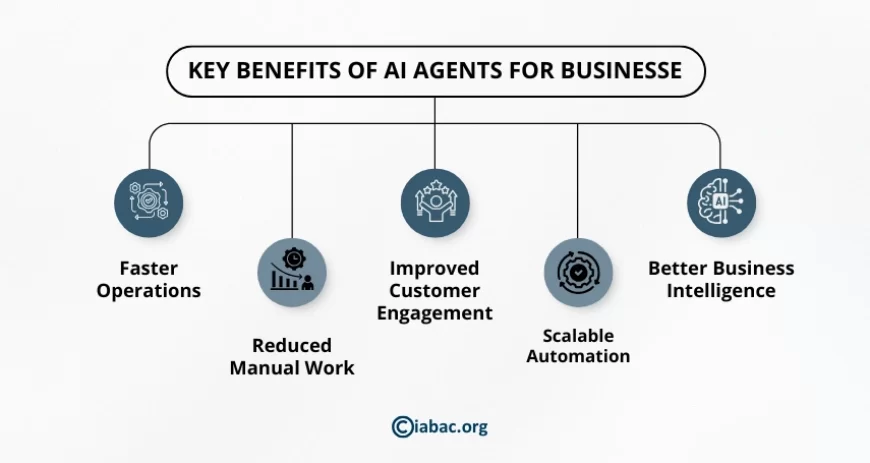
Key Benefits of AI Agents for Businesses
Faster Operations
AI agents can execute tasks around the clock, dramatically reducing turnaround times.
Reduced Manual Work
Routine and repetitive activities can be automated, allowing employees to focus on high-value work.
Improved Customer Engagement
AI agents provide faster responses and personalized experiences, leading to higher customer satisfaction.
Scalable Automation
Businesses can automate thousands of processes without significantly increasing operational costs.
Better Business Intelligence
AI agents continuously analyze data and provide insights that support strategic decision-making.
Challenges Businesses Should Consider
Despite their advantages, AI agents also present challenges.
Data Privacy and Security
Organizations must ensure that AI agents handle sensitive information responsibly and securely.
Governance and Compliance
Clear policies and oversight mechanisms are necessary to ensure responsible AI deployment.
AI Hallucinations
AI agents can occasionally generate inaccurate outputs, making human review important for critical tasks.
Human Oversight
AI should augment human capabilities rather than replace human judgment entirely.
Integration Complexity
Successfully integrating AI agents into existing business systems may require careful planning and technical expertise.
The Future of AI Agents
The next phase of business transformation will be driven by increasingly autonomous AI systems.
Autonomous Enterprises
Organizations will deploy AI agents across departments, enabling self-managing workflows and intelligent operations.
Agent-to-Agent Collaboration
AI agents will communicate and collaborate with one another to complete complex business objectives.
AI-Driven Decision Ecosystems
Businesses will increasingly rely on AI-powered insights for strategic planning and operational management.
Hyperautomation
The combination of AI agents, automation platforms, and advanced analytics will create highly efficient business ecosystems.
How Professionals Can Prepare for the AI Agent Revolution
As AI agents become mainstream, professionals must develop new skills to remain competitive.
Key areas to focus on include:
-
Understanding Agentic AI concepts
-
Learning workflow automation techniques
-
Developing prompt engineering skills
-
Building AI governance knowledge
-
Understanding multi-agent systems
-
Exploring enterprise AI applications
-
Earning recognized AI certifications
Professionals who understand how AI agents operate and integrate into business environments will be well-positioned for future opportunities.
AI agents are rapidly becoming one of the most transformative technologies in modern business. Unlike traditional AI tools, these intelligent systems can plan, reason, act, and collaborate to achieve business objectives with minimal human intervention.
From OpenAI Operator and Microsoft Copilot Agents to Salesforce Agentforce and SAP Joule, organizations are embracing AI agents to automate workflows, improve productivity, and drive innovation.
As Agentic AI continues to evolve, businesses that adopt AI agents strategically will gain a significant competitive advantage. At the same time, professionals who invest in AI skills and certifications will be better prepared to thrive in an increasingly AI-driven workplace.
The future of business is no longer just AI-powered—it is agent-powered.