






















































Artificial intelligence governance to reduce AI risk
Artificial intelligence governance helps organizations manage AI risks, ensure ethical use, build trust, and scale responsible AI across systems and teams.

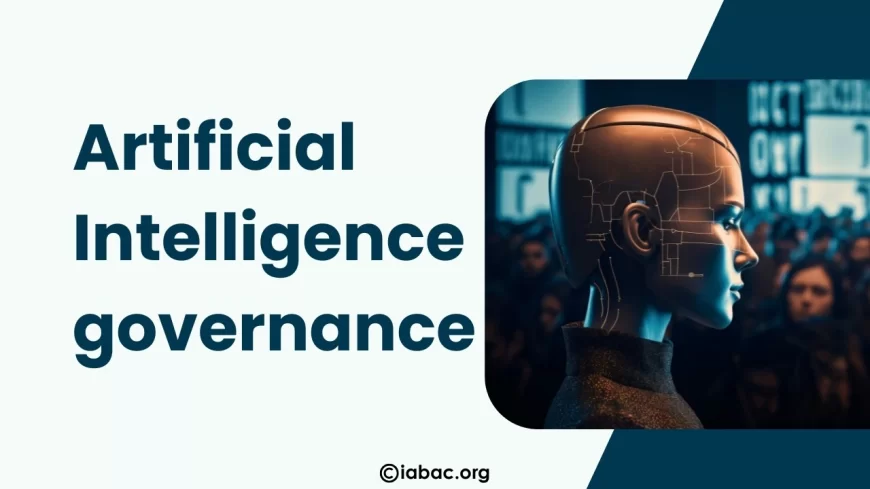
Artificial intelligence governance is about trust, responsibility, and using AI in a way people can depend on. AI tools are already being used to screen job applications, approve loans, detect fraud, and support medical decisions.
Bias, privacy issues, and unclear responsibility often appear when there are no clear rules in place.
Artificial intelligence governance provides structure through well-defined policies, human oversight, and risk controls that keep artificial intelligence aligned with ethical and legal expectations.
It helps organizations move forward with confidence, protect users and data, and ensure AI supports people rather than creating unintended harm.
What Is AI Governance
Artificial intelligence governance is the system of rules, policies, principles, and practices that guide how AI is designed, built, deployed, and used.
Think of it as the “rules of the road” for AI.
It ensures that AI systems are:
-
Ethical and fair
-
Transparent and explainable
-
Secure and privacy-aware
-
Accountable to humans
-
Aligned with legal and societal expectations
Artificial intelligence governance brings structure to something that can otherwise feel unpredictable. It defines who is responsible for AI decisions, how risks are identified, and what happens when something goes wrong.
It also connects closely with data governance, because AI systems are only as good and as fair as the data they learn from. Poor data leads to poor decisions, no matter how advanced the model is.
Most importantly, artificial intelligence governance helps organizations answer a simple but powerful question:
“Just because we can build this AI system, should we?”
Key Components of AI Governance
Strong AI governance is built on several interconnected pillars. When one is missing, the whole structure becomes fragile.
Ethical Principles
Ethics form the foundation of responsible AI. These principles guide how decisions are made before technology is ever deployed.
Common ethical pillars include:
-
Respect for human rights
-
Fairness and non-discrimination
-
Human-centered decision-making
-
Responsible and trustworthy AI use
When ethics are ignored, bias and harm tend to follow. Studies have shown that poorly governed AI systems can reinforce gender and racial bias at alarming rates.
Policies and Standards
Policies turn values into action.
They define:
-
Acceptable and unacceptable AI use cases
-
Data handling, storage, and access rules
-
Training data governance and data quality standards
-
Model development and deployment guidelines
Clear standards remove confusion and ensure teams build AI systems consistently and responsibly.
Accountability and Oversight
AI should never operate without human responsibility.
Artificial intelligence governance ensures:
-
Clear ownership of AI systems
-
Human oversight for high-impact decisions
-
Escalation paths when systems behave unexpectedly
AI can assist decisions, but humans remain accountable.
Transparency and Explainability
If an AI system can’t explain its decisions, trust disappears.
Transparency means:
-
Making AI decisions understandable
-
Keeping documentation and decision logs
-
Enabling audits and reviews
Explainable AI doesn’t mean revealing every technical detail. It means helping people understand why a decision was made.
Why AI Governance Is Important
Artificial intelligence governance isn’t just a compliance exercise; it’s a trust-building strategy.
1. Builds Trust
People are more likely to accept AI when they feel protected. Transparency and accountability reassure users that AI decisions are not random or unfair.
2. Manages Risk
AI systems can fail quietly and at scale. Governance helps catch problems early, including:
Bias in training data: When AI learns from unbalanced or flawed data, it can reinforce unfair patterns and produce discriminatory outcomes at scale.
Security vulnerabilities: Poorly protected AI systems can be exploited, manipulated, or attacked, leading to data leaks and unreliable results.
Privacy breaches: AI that handles sensitive information without proper safeguards can expose personal data and violate user trust and regulations.
Misuse of AI outputs: Without clear controls, AI-generated results can be misapplied, misunderstood, or intentionally used to cause harm.
According to global risk reports, AI-related incidents are rising each year, often due to lack of oversight rather than technical failure.
3. Enables Responsible Innovation
Clear rules actually make innovation easier. Teams know what’s allowed, what’s risky, and how to move forward safely.
4. Keeps AI Aligned
AI governance ensures AI aligns with:
-
Organizational values
-
Legal requirements
-
Social expectations
Without alignment, even successful AI projects can quickly turn into liabilities.
Key Challenges in AI Governance
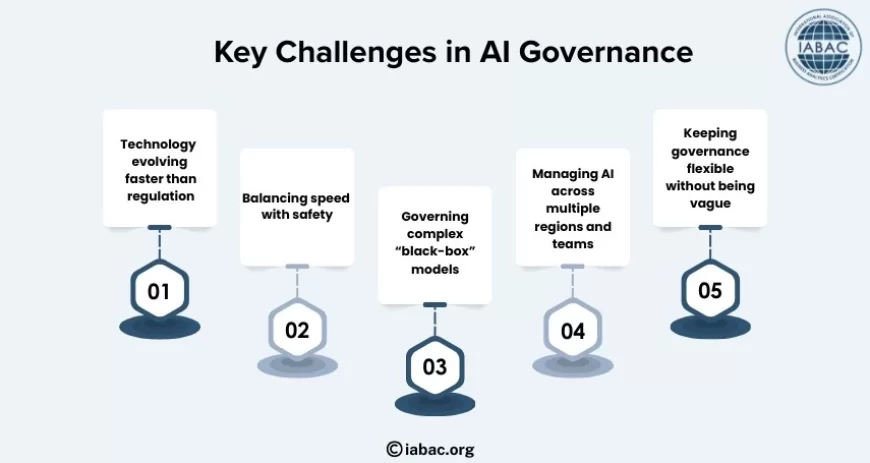
Even with the best intentions, AI governance is not easy.
Common challenges include:
-
Technology evolving faster than regulation
-
Balancing speed with safety
-
Governing complex “black-box” models
-
Managing AI across multiple regions and teams
-
Keeping governance flexible without being vague
Many organizations struggle because governance is treated as an afterthought instead of a foundation.
Generative AI Governance
Generative AI has changed everything.
From chatbots to content generation, these systems can create text, images, code, and more, but they also introduce new risks.
Generative AI governance focuses on:
-
Governing large language models
-
Prompt governance and usage controls
-
Preventing hallucinations and misinformation
-
Managing intellectual property risks
-
Ensuring responsible enterprise use
Recent studies show that over 60% of organizations worry about AI-generated inaccuracies, yet many lack formal controls. Without governance, generative AI can spread errors faster than humans can correct them.
Granular AI Lifecycle Controls
Artificial intelligence governance must cover the entire AI lifecycle, not just deployment.
This includes:
-
Training data governance and data lineage: Tracking where data comes from, how it is used, and whether it remains accurate, fair, and appropriate over time.
-
Model validation and testing: Evaluating AI models for accuracy, bias, reliability, and risk before they are put into real-world use.
-
Pre-deployment approval checkpoints: Requiring formal reviews and sign-offs to confirm models meet governance, ethical, and compliance standards.
-
Ongoing AI model monitoring: Continuously observing model performance to ensure outputs remain reliable and aligned with expectations.
-
Detecting model drift over time: Identifying when models degrade or behave differently as data, behavior, or environments change.
-
Retiring models that no longer perform safely: Decommissioning AI systems that no longer meet performance, risk, or ethical thresholds.
AI systems change as the world changes. Governance ensures they don’t quietly become unreliable or harmful.
Risk-Based AI Classification
Not all AI systems carry the same level of risk.
Artificial intelligence governance uses risk-based classification to apply the right controls to the right systems.
Typical classifications include
-
Low-risk AI (internal automation, recommendations)
-
Medium-risk AI (customer interaction, analytics)
-
High-risk AI (hiring, healthcare, finance, public services)
High-risk systems require stronger oversight, testing, and human involvement. This approach keeps governance practical rather than restrictive.
Tooling and Automation
Manual governance doesn’t scale.
Modern artificial intelligence governance relies on tools that support:
-
AI governance platforms and dashboards
-
Model inventories and registries
-
Automated monitoring and alerts
-
Policy enforcement through technology
-
Integration with risk and compliance systems
Automation helps teams track what AI systems exist, how they’re performing, and whether they remain compliant without slowing innovation.
Third-Party and Vendor AI Governance
Many AI systems are built outside the organization.
That creates new risks.
Third-party and vendor AI governance focuses on:
- Vendor due diligence: Evaluating external AI providers to ensure their models, data practices, and controls meet ethical, security, and compliance standards.
- Governing open-source models: Applying oversight to open-source AI to manage hidden risks, licensing issues, and unexpected behavior.
- Managing AI supply chain risks: Identifying and reducing risks introduced by third-party data, models, and infrastructure across the AI lifecycle.
- Contractual accountability and compliance: Defining clear responsibilities, obligations, and liability in contracts to ensure AI use aligns with legal and governance requirements.
If an external AI system causes harm, responsibility doesn’t disappear. Governance ensures risks are shared, understood, and managed.
Metrics, KPIs, and Measurement
What gets measured gets managed.
Artificial intelligence governance depends on meaningful metrics, such as:
-
Bias and fairness indicators
-
Model performance and accuracy
-
Compliance and audit readiness
-
Trust and transparency metrics
Tracking both technical and ethical performance helps organizations improve continuously rather than reactively.
Workforce Enablement and Training
Governance isn’t just about technology; it’s about people.
Strong certification programs focus on:
-
AI literacy for employees
-
Training on responsible AI use
-
Cross-functional collaboration
-
Change management support
When people understand AI, they’re more likely to use it responsibly and confidently.
Enterprise & Global Context
AI rarely operates in one place.
Enterprise-level artificial intelligence governance addresses:
- Centralized vs federated governance models: Choosing between a single oversight structure or shared governance across teams to balance control with flexibility.
- Consistency across business units: Ensuring AI policies and standards are applied uniformly while allowing teams to address local needs.
- Alignment with global regulations: Adapting governance practices to meet regulatory requirements across different regions and jurisdictions.
- Cross-border data and AI considerations: Managing how data and AI systems operate across borders while respecting privacy, security, and legal constraints.
Global alignment ensures governance doesn’t break when AI scales internationally.
How to Implement AI Governance
Effective artificial intelligence governance doesn’t happen overnight.
Successful organizations:
-
Establish a clear governance framework: Define roles, responsibilities, policies, and decision-making processes to guide how AI is developed and used.
-
Integrate AI governance with data governance and risk management: Align AI controls with existing data practices and enterprise risk processes for consistent oversight.
-
Form cross-functional governance teams: Bring together legal, technical, ethics, and business stakeholders to evaluate AI decisions from multiple perspectives.
-
Conduct regular audits and assessments: Periodically review AI systems to identify risks, bias, compliance gaps, and performance issues.
-
Use tooling to support oversight: Leverage governance platforms, dashboards, and monitoring tools to track AI systems at scale.
-
Continuously adapt governance as AI evolves: Update policies and controls as technology, regulations, and use cases change over time
Governance is a living system, not a static policy.
As AI systems influence more decisions, stronger governance becomes the difference between innovation that builds trust and innovation that breaks it.
By combining ethical principles, lifecycle controls, risk-based oversight, workforce enablement, and global alignment, organizations can use AI confidently and responsibly. Artificial intelligence governance ensures AI remains a powerful tool for progress guided by human values, accountability, and care.
In the end, governance isn’t about controlling AI.
It’s about protecting people while allowing innovation to thrive.