
















































AI Consulting vs In-House AI Team: What's Right for Your Business?
AI consulting and in-house AI teams to find the best fit for your business. Explore costs, expertise, scalability, and ROI.

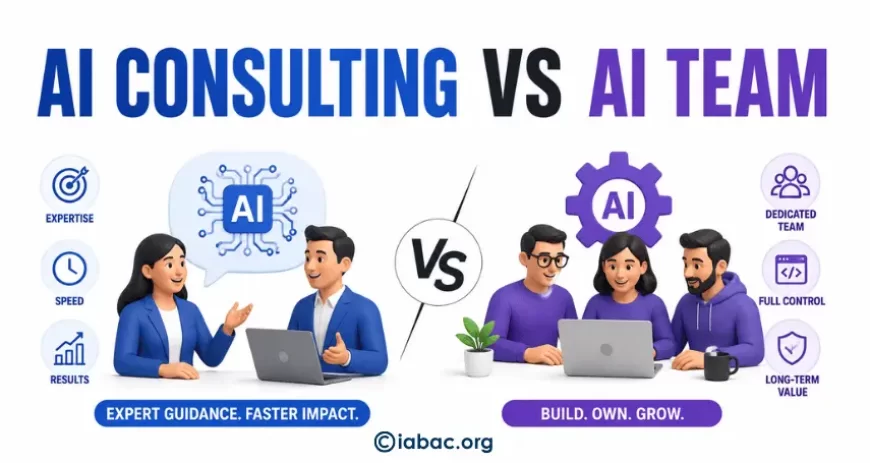
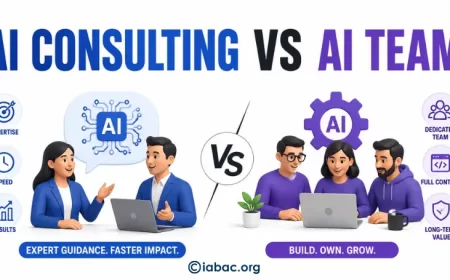
AI consulting means engaging certified external experts for specific AI projects, strategy, or implementation delivering working results in weeks, not months. An in-house AI team means hiring full-time data scientists and machine learning engineers who work exclusively on your business and build institutional knowledge over time. The right choice depends on three factors: your timeline, your budget, and whether AI is your core product or a support function. Most organizations in 2026 use a hybrid model starting with consulting to deploy fast and validate use cases, then building internal capability around the systems that prove their value.
What Is AI Consulting? (And What Does It Actually Include?)
AI consulting is a professional service in which certified external experts help organizations plan, design, build, and deploy artificial intelligence solutions. Unlike a software vendor selling a product, an AI consultant is engaged to solve a specific business problem and the engagement ends when the deliverable is complete, documented, and handed over to your team.
A structured AI consulting engagement typically delivers across five areas: AI strategy and roadmaps (what to build and in what order), machine learning development (building and training models against your data), data pipeline engineering (making sure your data is clean, structured, and ready for AI), process automation (connecting AI outputs to real business workflows), and data governance and compliance (ensuring systems meet regulations like GDPR, HIPAA, or India's DPDP Act 2023).
Consulting engagements come in three formats. Project-based engagements are scoped to a specific deliverable with a fixed timeline and budget ideal for first deployments or bounded problems. Retainer arrangements provide ongoing advisory or development support on a monthly basis. Advisory engagements focus on strategy and oversight, where a senior consultant reviews your internal team's work and keeps your AI program aligned to business goals.
IABAC-certified consultants bring an additional layer of credibility to every engagement: their expertise is independently verified against a globally recognized certification standard in AI, data science, or business analytics not just assessed through a portfolio or interview. Learn more about IABAC's AI consulting services and the industries they serve.
What Does Building an In-House AI Team Look Like?
An in-house AI team is a group of permanent employees data scientists, machine learning engineers, data engineers, and an AI product manager who work exclusively on your organization's AI initiatives. Over time, this team develops deep familiarity with your data, your systems, and your business context in ways an external consultant never fully replicates.
A minimum viable in-house team requires at least three roles: a senior ML engineer who owns model architecture and training, a data engineer who builds and maintains the pipelines that feed those models, and an AI product manager who translates business requirements into technical specifications and tracks outcomes. At full maturity, teams also include MLOps engineers, AI safety specialists, and domain experts aligned to specific business verticals.
The timeline to assemble a functioning in-house team is longer than most organizations anticipate. According to LinkedIn Talent Insights (2025), the average time-to-fill for a senior ML role is 4.2–6 months. Add 2–3 months of onboarding, and it is typically 9–14 months from the decision to hire before a newly assembled team delivers its first production-ready AI system.
The long-term advantage of in-house teams is real, however. Your team owns all intellectual property outright. They build institutional knowledge that compounds by month twelve, an embedded team understands your data quality issues, your operational constraints, and your customer patterns in ways that drive AI solutions no external consultant would design independently. If AI is genuinely your competitive moat the product, not just a tool that supports it in-house capability is the right long-term destination.
AI Consulting vs In-House AI Team: Head-to-Head Comparison
The following table compares both models across the factors that matter most to business leaders making this decision.
|
Factor |
AI Consulting |
In-House AI Team |
|
Time to first result |
2–8 weeks |
9–14 months |
|
Year-1 cost (typical) |
$200K–$500K (scoped project) |
$800K–$1.2M (fully loaded) |
|
Talent access |
Immediate — full specialist team |
4–6 months average per hire |
|
IP ownership |
Client-owned (by contract) |
100% internal ownership |
|
Scalability |
Flexible — scale per project |
Fixed headcount, high churn risk |
|
Cross-industry expertise |
High — built from 30+ country network |
Limited to your industry context |
|
Long-term capability |
Requires structured knowledge transfer |
Compounds over time |
|
Compliance & governance |
Built-in (GDPR, HIPAA, EU AI Act, DPDP) |
Must be developed internally |
|
Best for |
Speed, validation, specific projects |
AI-as-core-product, long-term moat |
The table makes the core trade-off clear: consulting wins on speed, cost certainty, and access to deep expertise in the first 18 months. In-house wins on long-term ownership, institutional knowledge, and continuous innovation once the team is established and running. The best-performing AI programs in 2026 aren't choosing one — they're sequencing both.
Cost Breakdown: What Each Option Actually Costs in 2026
Most cost comparisons between AI consulting and in-house teams undercount what in-house actually costs. Here are the real numbers.
The Real Cost of an In-House AI Team
A minimum viable in-house AI team — one senior ML engineer, one data engineer, and one AI product manager carries a combined base salary of $550K–$850K per year in major markets (US, UK, and major Indian tech hubs). That is salary only. Once you add employer payroll taxes, benefits, equity, equipment, and software licenses, the loaded cost is typically 1.3–1.5× base salary per employee.
Recruiting costs compound the picture further. Specialist AI roles are among the most competitive hires in the technology market. Agency recruiting fees run 20–25% of first-year salary per placement meaning a single senior ML hire can cost $40K–$65K in fees before they start. Each subsequent departure carries a replacement cost estimated at 150–200% of annual salary when you account for recruiting, onboarding time, and the productivity ramp that follows. The fully loaded cost of an in-house AI capability in year one before the team ships a single production deployment typically exceeds $800K to $1.2M.
The Real Cost of AI Consulting
A comprehensive AI consulting engagement covering readiness assessment, strategy, engineering, and deployment of 3–5 production AI systems typically costs $200K–$500K depending on scope and complexity. Monthly retainer arrangements for ongoing support run $5K–$20K per month. There are no recruiting costs, no bench costs between projects, no infrastructure procurement requirements, and no key-person risk.
The cost advantage of consulting is most pronounced in the first 18 months. Beyond that horizon, organizations running high-volume, continuous AI development programs often find that building in-house becomes more cost-effective per unit of output but only once the team is fully assembled and productive, which itself takes 12–18 months from the first hire. Ready to see what an engagement looks like for your organization? You can hire a certified AI consultant through IABAC and receive a match within 3–5 business days.
Speed Comparison: How Fast Can Each Model Deliver?
|
2–8 wks |
60–90 days |
9–14 months |
2.3× |
|
AI consulting: first working prototype |
AI consulting: production-ready deployment |
In-house team: first production deployment |
Faster to production with consulting (Forrester, 2024) |
Speed is often the deciding factor in this decision and the gap between the two models is larger than most organizations expect. An AI consulting team arrives with proven methodologies, pre-built components, and the muscle memory of dozens of prior deployments. They can deliver a working prototype within 2–8 weeks and a production-ready system within 60–90 days. An in-house team, by contrast, must complete hiring, onboarding, and alignment before a single model is trained pushing the first production deployment to 9–14 months in most markets.
Organizations using AI consulting partners reached production 2.3× faster than those relying solely on internal teams, according to Forrester (2024). That speed gap creates a compounding advantage: every six months of earlier deployment means six additional months of data accumulation, productivity gains, and organizational learning that late-movers never fully recover. In a market where 78% of organizations now use AI in at least one business function (McKinsey, 2025), the cost of waiting is no longer abstract.
When to Choose AI Consulting?
AI consulting is the right choice or the right starting point in the following situations:
- You need production results in under 90 days: If competitive pressure, a strategic window, or a board mandate requires visible AI output quickly, consulting is the only model that reliably delivers within that timeline.
- You have a specific, bounded problem to solve: Automating a business process, building a demand forecasting model, deploying a customer-facing chatbot scoped problems are well-suited to project-based consulting engagements that begin and end cleanly.
- You have no existing AI or data science talent in-house: Consulting gives you immediate access to senior expertise data engineers, ML engineers, MLOps architects without the 6-month recruiting and onboarding cycle.
- You want to validate AI's business value before committing to a team: Running a consulting engagement first lets you prove ROI on real use cases before making permanent headcount decisions that are expensive to reverse.
- Your AI initiative is project-based or low-frequency: If you need AI for a defined initiative rather than as an ongoing capability, hiring a permanent team for what may be a one-time project doesn't make economic sense.
- You need compliance expertise built in from the start: Regulations like GDPR, HIPAA, the EU AI Act, and India's DPDP Act 2023 have technical requirements that affect model architecture and data handling. Certified consultants build compliant systems by default internal teams must develop this expertise separately.
Explore IABAC Consulting to see how a certified engagement is structured and what industries we serve.
When to Build an In-House AI Team?
In-house AI teams are the right long-term choice in specific strategic circumstances. Building internally makes sense when:
- AI is your core product, not just a support function: If the AI model itself is what customers pay for if your competitive moat is a proprietary algorithm, a fine-tuned domain model, or a closed-loop data flywheel then every month of in-house tenure is institutional knowledge you cannot rent from a consultant.
- You need a continuous innovation engine, not a one-time build: In-house teams test improvements based on real-world results, identify new opportunities, and scale to multiple projects over time. Consultants deliver systems; internal teams build the capability to continuously improve them.
- You have proprietary data that must remain entirely internal: For organizations in regulated industries where data cannot leave controlled environments, in-house development may be the only viable path.
- Your AI development is continuous and high-volume: When AI projects run back-to-back at scale over multiple years, the per-unit cost of an in-house team eventually undercuts the cost of sustained consulting engagements.
- Long-term IP ownership and institutional knowledge are strategic priorities: Internal teams own 100% of all code, models, and data pipelines. That IP accumulates in value over time in ways a consulting engagement, however well-structured, cannot replicate.
The Hybrid Model: Why Most Successful Organizations Use Both
The majority of organizations running successful AI programs in 2026 do not choose one model exclusively. According to Gartner's 2025 AI Adoption Survey, 60% of organizations with successful AI programs use a combination of external consulting and internal teams. McKinsey's 2025 AI research found that organizations using hybrid models deployed AI 2.4× faster and achieved 35% higher ROI than those using either model exclusively.
The hybrid model works because it eliminates the two biggest risks at once: the speed risk of building everything from scratch, and the dependency risk of relying permanently on external consultants. The sequencing typically looks like this:
|
Phase 1 · Months 1–3 |
Phase 2 · Months 4–6 |
Phase 3 · Month 7+ |
|
Consultant-Led Delivery: Consultants deploy the first production systems, establish data pipelines, document architecture, and identify the highest-value use cases. Internal staff begin onboarding alongside the engagement. |
Co-Development: Internal hires shadow consulting work and take increasing ownership of deployed systems. Consultants transfer domain knowledge, codebases, and operational procedures through structured knowledge-transfer sessions. |
Internal-Led Operation: The internal team leads ongoing development and optimization. Consultants move to an advisory retainer, providing specialized expertise for new initiatives and complex problems as they arise. |
One critical requirement: the consulting engagement must include formal documentation standards, training sessions for internal staff, and a parallel operation period before full handover. Handovers without this structure frequently result in internal teams inheriting systems they cannot maintain, negating the entire knowledge-transfer goal. If you're a certified AI practitioner interested in joining this network, you can join IABAC's global consultant network and work on live client engagements.
How to Make the Decision: A 5-Question Framework?
Before committing to either model, work through these five questions in order. The answers will point clearly toward the right approach for your specific situation.
- Is AI your core product or a support function? If AI IS the product — if the model itself is what customers pay for — plan for in-house capability as your long-term destination. If AI improves operations but is not the product itself, consulting or a hybrid model almost always delivers better ROI.
- What is your timeline? Need visible results in 90 days? Consulting only. Have 18 months and want sustained internal capability? Start with consulting, and build in-house around the proven systems.
- What is your year-one budget ceiling? Under $500K in year one? Consulting wins on ROI — you get deployed AI systems without the $800K–$1.2M year-one cost of assembling a team. Above $500K with a multi-year commitment and continuous development needs? In-house becomes viable.
- Do you have existing AI or data science talent internally? Zero internal AI expertise means you should start with consulting to avoid the 9–14 month talent gap. If you have some internal capability already, consulting can accelerate it through co-development rather than replacing it.
- How well-structured is your data? Poor data quality fragmented systems, inconsistent schemas, no data governance undermines both models equally. Audit your data readiness first. If your data is not ready, fix that foundation before committing to either path. Bad data produces bad AI regardless of who builds it.
What IABAC Consulting Offers?
IABAC Consulting connects organizations with a verified global network of certified AI and data science professionals matched to your specific needs within 3–5 business days.
- 5,000+ certified consultants across 30+ countries
- Certification-backed expertise every consultant holds a verifiable IABAC credential in AI, Data Science, or Business Analytics
- Flexible engagement models — project-based, retainer, or advisory
- Industries served — healthcare, finance, retail, logistics, manufacturing, and HR
- Compliance built in — GDPR, HIPAA, EU AI Act, India DPDP Act 2023
- Knowledge transfer included — structured handover so your team owns what we build
Hire a Consultant View Consulting Services
Frequently Asked Questions
1) Is AI consulting cheaper than hiring an in-house team?
For the first 18 months, yes significantly. A comprehensive consulting engagement typically costs $200K–$500K. A minimum viable in-house team costs $800K–$1.2M in year one before delivering a single production deployment, once you factor in salaries, recruiting fees, benefits, infrastructure, and onboarding time. The cost equation begins to shift at 24–36 months for organizations running high-volume, continuous AI development programs.
2) How long does an AI consulting engagement take?
A typical engagement delivers a working prototype in 2–8 weeks and a production-ready system within 60–90 days. This compares to 9–14 months for a newly assembled in-house team to reach the same milestone from the point of first hire.
3) Can AI consultants work alongside our existing IT team?
Yes this is the standard hybrid model. Consultants typically lead delivery in months 1–3, co-develop alongside internal staff in months 4–6, then transition full ownership to your internal team from month 7 onward. The most successful engagements include formal documentation, training sessions, and a parallel-operation period before the handover is complete.
4) What happens to our data and IP when we use AI consultants?
IP ownership terms depend entirely on your contract. Reputable consultants — including IABAC-certified professionals structure engagements so that the client owns all code, models, data pipelines, and outputs. Always clarify IP ownership explicitly in the statement of work before the engagement begins. Never assume; it should be in writing.
5) How do I know if an AI consultant is actually qualified?
Look for verifiable, third-party credentials not just a portfolio. IABAC-certified consultants hold globally recognized certifications in AI, data science, or business analytics that can be independently confirmed through the IABAC certificate verification tool. This gives you objective confirmation of expertise before the engagement begins — something a CV alone cannot provide.
6) What is the best approach for a small or mid-sized business?
For SMBs, AI consulting almost always wins in the first phase. The economics of recruiting, onboarding, and retaining ML talent at market rates do not favor small teams competing with large enterprises for the same pool of engineers. Start with a scoped consulting engagement to validate your highest-value use cases and prove ROI. Then consider building selective in-house capability around the use cases that demonstrate clear, ongoing business impact.
The right answer for most organizations is not AI consulting or an in-house team it is the right sequence of both. Start with consulting to move fast, validate use cases, and prove ROI without the $800K+ year-one commitment of assembling a team. Build in-house capability around the systems that work. Use consulting on an ongoing basis for specialized expertise that doesn't justify permanent headcount.
The organizations winning with AI in 2026 are not the ones who built the biggest internal teams or spent the most on consultants. They are the ones who structured the relationship between external and internal capability intelligently and started earlier than their competitors.
If you're ready to take the first step, IABAC Consulting connects you with verified, certified AI professionals across 30+ countries matched to your specific requirements within 3–5 business days.