























































What is AI Consulting A Practical Explanation for Businesses?
What is AI consulting, and how it drive measurable business value? Understand strategy, data readiness, risks, and practical implementation for real impact.

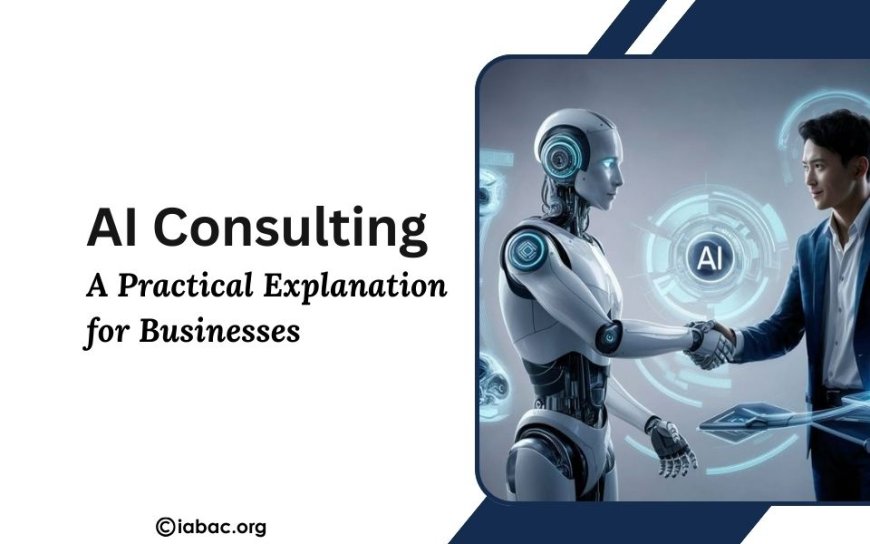
Many businesses are investing in artificial intelligence, yet a surprising number struggle to achieve meaningful results.
Not because AI lacks potential but because organizations often misunderstand how to apply it effectively.
This is where AI consulting becomes important.
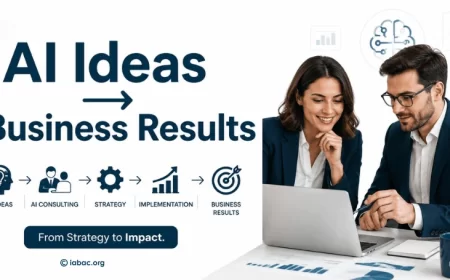
AI consulting is not just about algorithms or models. It focuses on helping businesses identify opportunities, design practical strategies, and implement AI solutions that address real-world challenges.
What Does an AI Consultant Actually Do?
AI consulting is often associated with complex models and advanced technologies, but the role of an AI consultant is much broader and more practical.
At its core, AI consulting focuses on helping businesses make better decisions about where and how artificial intelligence can create value.
AI consultants typically support organizations in several key areas:
1️⃣ Identifying Meaningful AI Opportunities
Not every business problem requires AI.
A consultant helps answer questions like
-
Where can AI genuinely improve outcomes?
-
Which processes can be automated or optimized?
-
What use cases are realistic and feasible?
This prevents wasted investments and random experimentation.
2️⃣ Assessing Data & Technical Readiness
AI success heavily depends on data quality and infrastructure.
Consultants evaluate:
-
Data availability and reliability
-
Existing systems and workflows
-
Technical constraints and risks
Without this step, many AI initiatives fail early.
3️⃣ Designing AI Strategy & Roadmaps
Instead of isolated experiments, consultants help build structured plans:
-
Prioritizing high-impact use cases
-
Defining success metrics
-
Aligning AI initiatives with business goals
-
Planning implementation phases
This introduces clarity and direction.
4️⃣ Guiding Solution Design & Implementation
Depending on the project, consultants may assist with:
-
Selecting tools, platforms, or models
-
Coordinating with internal teams
-
Ensuring solutions fit operational realities
-
Managing risks and expectations
The focus remains on business outcomes, not just technology.
5️⃣ Measuring Impact & Optimizing Results
AI projects should produce measurable value.
Consultants help organizations track:
-
Performance improvements
-
Cost reductions
-
Efficiency gains
-
Decision quality
This ensures AI initiatives remain aligned with business objectives.
Common Misconceptions About AI Consulting
AI consulting is a rapidly growing field, yet it is frequently misunderstood. Misconceptions often lead businesses to unrealistic expectations, poor decisions, or hesitation toward AI initiatives.
❌ Misconception 1: AI Consulting Is Only About Building Models
Many assume consultants primarily develop machine learning algorithms.
In reality, a significant portion of AI consulting involves:
-
Problem definition
-
Feasibility evaluation
-
Strategy design
-
Change management
Technology is only one part of the equation.
❌ Misconception 2: AI Consulting Is Only for Large Enterprises
AI consulting is not limited to big corporations.
Small and mid-sized businesses often benefit from consulting because they:
-
Lack in-house AI expertise
-
Need guidance on prioritization
-
Want to avoid costly mistakes
❌ Misconception 3: AI Consulting Guarantees Immediate ROI
AI initiatives require experimentation, iteration, and adaptation.
Consultants reduce risks and improve direction, but results depend on execution, data, and organizational readiness.
❌ Misconception 4: AI Consulting Replaces Internal Teams
Consultants typically work with internal teams, not instead of them.
Their role is to provide:
-
Expertise
-
Structure
-
External perspective
-
Strategic guidance
How AI Consulting Differs From Traditional Consulting
Businesses are familiar with various types of consulting: IT consulting, management consulting, digital transformation consulting, and software advisory services.
While AI consulting shares certain similarities with these domains, its focus, challenges, and value creation mechanisms are distinctly different.
1️⃣ AI Consulting Is Decision-Centric, Not System-Centric
Traditional consulting often revolves around:
-
Improving processes
-
Implementing systems
-
Optimizing workflows
-
Reducing operational inefficiencies
AI consulting, however, primarily focuses on:
✔ Enhancing decision-making
✔ Predictive capabilities
✔ Pattern recognition
✔ Intelligent automation
The emphasis shifts from “how systems operate” to “how decisions are made.”
2️⃣ AI Consulting Deals With Uncertainty & Experimentation
Most traditional consulting projects follow relatively predictable paths:
-
Defined requirements
-
Known solutions
-
Established methodologies
AI initiatives are different.
They involve:
-
Hypothesis testing
-
Data variability
-
Model behavior uncertainty
-
Iterative refinement
AI consulting, therefore, requires a mindset of experimentation rather than fixed execution.
3️⃣ Data Plays a Central Role
In many consulting engagements, data supports decisions.
In AI consulting, data drives outcomes.
Consultants must consider:
-
Data quality
-
Data availability
-
Bias and limitations
-
Continuous learning dynamics
Without strong data foundations, AI strategies rarely succeed.
4️⃣ Outcomes Are Probabilistic, Not Deterministic
Traditional solutions often produce predictable outputs.
AI systems generate probabilistic results:
-
Predictions
-
Classifications
-
Recommendations
-
Confidence levels
This fundamentally changes how success is measured and managed.
5️⃣ AI Consulting Blends Strategy & Technology Deeply
Unlike purely technical consulting, AI consulting requires tight integration between
✔ Business strategy
✔ Data science concepts
✔ Operational realities
✔ Risk considerations
It is neither purely strategic nor purely technical but a hybrid discipline.
Where AI Consulting Creates Real Business Value
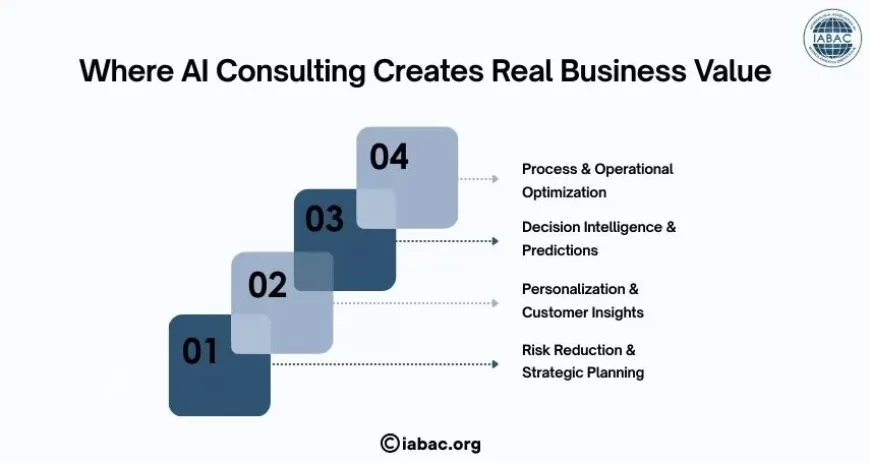
The true value of AI consulting becomes clearer when viewed through practical business scenarios rather than abstract concepts.
✔ Process & Operational Optimization
AI consultants help identify opportunities where AI can:
-
Reduce manual effort
-
Improve efficiency
-
Detect anomalies
-
Optimize resource allocation
Example: demand forecasting, workflow automation.
✔ Decision Intelligence & Predictions
AI enables businesses to move from reactive decisions to predictive ones.
Common areas include:
-
Sales forecasting
-
Risk assessment
-
Customer behavior analysis
-
Preventive maintenance
✔ Personalization & Customer Insights
Consulting engagements often focus on:
-
Recommendation systems
-
Customer segmentation
-
Behavioral modeling
-
Experience optimization
✔ Risk Reduction & Strategic Planning
AI consulting also supports:
-
Fraud detection
-
Compliance monitoring
-
Scenario modeling
-
Sensitivity analysis
When Should a Business Consider AI Consulting?
Not every organization needs AI consulting at the same stage of its AI journey. However, certain situations strongly indicate when external expertise can provide significant value and prevent costly missteps.
✔ When AI Opportunities Feel Unclear
Many businesses recognize the importance of AI but struggle with questions like
-
Where can AI actually help us?
-
Which use cases are realistic?
-
Are we solving the right problems?
AI consulting helps introduce structure and clarity, ensuring initiatives are driven by business needs rather than trends.
✔ When AI Initiatives Lack Direction
Organizations often experiment with AI tools or pilots but face challenges such as:
-
Fragmented projects
-
Uncertain priorities
-
Undefined success metrics
-
Difficulty scaling
Consultants help align efforts into a coherent strategy and roadmap.
✔ When Data & Readiness Are Uncertain
AI success depends heavily on data quality, availability, and infrastructure.
Consulting becomes valuable when businesses need to assess:
-
Data maturity
-
Technical feasibility
-
Integration challenges
-
Risk factors
Without this evaluation, AI investments can become inefficient or ineffective.
✔ When Business Risks Are High
In industries involving:
-
Financial decisions
-
Compliance constraints
-
Operational dependencies
-
Customer-sensitive processes
AI consulting helps reduce uncertainty, identify risks, and guide safer implementation paths.
✔ When Scaling AI Becomes Difficult
Early AI experiments may succeed, yet scaling often introduces complexity:
-
Model reliability
-
Operational integration
-
Change management
-
Performance monitoring
Consultants provide frameworks and experience to navigate these challenges.
AI consulting is not merely about technology or algorithms.
Its true value lies in helping organizations make smarter decisions about how artificial intelligence can create meaningful, measurable impact.
As AI continues to reshape industries, the challenge for businesses is no longer whether to adopt AI but how to apply it effectively, responsibly, and strategically.
This is precisely where AI consulting plays a defining role.