



















































New Report Highlights Data Science Academy Training Worldwide
Read the latest report on data science academy training, highlighting learning trends, industry demand, practical skills, and certification opportunities in 2026.

Data science did not ask anyone's permission before quietly becoming the most important skill on Earth. One day, the world was happily running spreadsheets and sending memos. The next, every company on the planet was posting job listings for Data Scientists, offering salaries that made accountants cry into their calculators. And somewhere in the middle of all this glorious chaos, the global Data Science Academy ecosystem exploded — and it is nowhere close to stopping.
- $322B — Global Data Science Market by 2026
- 36% — Projected Job Growth (US Bureau of Labor Statistics)
- 11.5M — New Data Science Jobs Globally by 2026
- $120K+ — Average Annual Salary, Senior Data Scientist (USD)
A sweeping new global report published in early 2026 confirms what anyone who has checked LinkedIn in the last three years already suspects: demand for structured data science training — from certified bootcamps to university-grade programs — has reached a fever pitch. The numbers are staggering, the salaries are dizzying, and the career trajectories are the stuff of motivational posters. And yet, the gap between industry demand and available talent remains cavernously wide.
According to the World Economic Forum's Future of Jobs Report 2025, data and AI roles are among the fastest-growing occupations globally, with an estimated 11.5 million new data-related jobs expected to be created worldwide by the end of 2026. Meanwhile, McKinsey Global Institute estimates that the shortfall in data-literate professionals could cost the global economy upward of $430 billion in unrealised productivity annually. If data science were a bus, the world needs about twenty more buses — and trained drivers for all of them.
Why the World Suddenly Cannot Get Enough Data Scientists
The short answer: data is now worth more than oil. The long answer involves a decade of digital transformation, the explosion of cloud computing, and the terrifying-yet-exciting arrival of generative AI in every boardroom and bedroom simultaneously. When a small convenience store in Jakarta and a Fortune 500 bank in New York both need people who can make sense of their data pipelines, you know something seismic has happened.
The rise of the Data Science Academy model — whether classroom-based, online, or hybrid — is a direct, rational response to this global hunger. Unlike traditional four-year degree programs (which are magnificent but slow), academy-style training compresses the critical skill set — Python, Machine Learning, SQL, Data Visualisation, and Statistical Modelling — into focused, placement-oriented courses that get people employed fast. Some of the most respected academies now offer specialised Data Science Certifications that carry real industry weight, backed by bodies like IABAC (International Association of Business Analytics Certifications).
IABAC, accessible at iabac certifications, has emerged as one of the most recognised credentialing bodies globally, offering certification frameworks that are understood — and respected — by hiring managers from Singapore to São Paulo. When an employer sees an IABAC credential, they do not need to guess what the candidate knows. That clarity is priceless. The single biggest risk for any organisation in 2026 is not a cyber-attack or a supply chain disruption. It is walking into a data-rich world completely blind — with no one who can read the numbers. — Global Technology Talent Report, Gartner 2025
|
Region |
Demand Index |
|
North America |
92% |
|
South & SE Asia |
88% |
|
East Asia & Pacific |
83% |
|
Europe |
79% |
|
Middle East & Africa |
61% |
|
Latin America |
54% |
How Courses for Data Science Support Every Data Scientist Roadmap
People often imagine the data scientist roadmap as a cold, algorithmic checklist. In reality, it is more like a coming-of-age story — complete with confusion, a breakthrough moment at 2 a.m., and the eventual, deeply satisfying feeling of watching a machine learning model you built actually work on real data. Here is how the journey typically unfolds in 2026, according to industry benchmarks and academy curricula worldwide.
Phase 01 — Foundations: Mathematics & Statistics Linear algebra, probability, descriptive and inferential statistics. This is where legends discover they actually enjoy calculus. Duration: 4–6 weeks.
Phase 02 — Programming: Python & SQL Python for data manipulation (Pandas, NumPy) and visualisation (Matplotlib, Seaborn). SQL for querying databases. Duration: 6–8 weeks.
Phase 03 — Machine Learning Core Regression, classification, clustering, decision trees, random forests, XGBoost. Scikit-learn becomes a best friend. Duration: 8–10 weeks.
Phase 04 — Deep Learning & AI Neural networks, CNNs, RNNs, Transformers. TensorFlow and PyTorch make an entrance. Duration: 6–8 weeks.
Phase 05 — Domain Specialisation & Certification Finance, Healthcare, Retail, Manufacturing — choosing a vertical multiplies employability. Earning a recognised credential such as IABAC adds a powerful signal to the CV. Duration: 4–6 weeks.
Phase 06 — Portfolio, Projects & Placement Capstone projects on real datasets. GitHub, Kaggle competitions, mock interviews. This is where academy placement support becomes worth every rupee, dollar, and euro. Duration: 4–6 weeks.
How Courses for Data Science Can Lead to Higher Data Science Job Salaries
|
Role |
India (₹ LPA) |
USA (USD) |
UK (GBP) |
Germany (EUR) |
|
Junior Data Analyst |
₹4–7 LPA |
$65K–$80K |
£28K–£38K |
€38K–€50K |
|
Data Scientist |
₹8–18 LPA |
$95K–$130K |
£50K–£75K |
€60K–€85K |
|
Senior Data Scientist |
₹20–40 LPA |
$120K–$170K |
£75K–£110K |
€85K–€120K |
|
ML Engineer |
₹15–35 LPA |
$110K–$160K |
£65K–£100K |
€75K–€110K |
|
Chief Data Officer (CDO) |
₹50–120 LPA |
$180K–$280K |
£120K–£200K |
€130K–€220K |
It is also worth noting a small mathematical reality: the cost of a quality data science course — typically ranging from ₹60,000 to ₹2,00,000 in India, and $3,000 to $15,000 internationally — represents a return-on-investment that most financial instruments would be embarrassed to compete with. One year's salary increase alone, in many cases, exceeds the total programme cost by a factor of five or ten.
|
Year |
Market Size |
|
2020 |
$38B |
|
2021 |
$57B |
|
2022 |
$85B |
|
2023 |
$123B |
|
2024 |
$178B |
|
2025 |
$241B |
|
2026 (projected) |
$322B |
|
2027 (projected) |
$394B |
The Anatomy of a Great Data Science Course
Not all courses for data science are created equal. The global proliferation of academies means a prospective learner today faces an almost paradoxical challenge: too much choice. How does one distinguish a programme that genuinely transforms a career from one that merely issues a certificate and wishes everyone luck?
The best programmes share a set of non-negotiable characteristics. They begin with a curriculum built around real data problems. The best academies partner with industry to supply live datasets: messy, incomplete, frustrating, and therefore invaluable. A learner who has cleaned a 500,000-row retail sales dataset riddled with nulls and inconsistencies is infinitely more valuable to an employer than one who has only worked with pristine textbook examples.
- Curriculum Benchmarks — What Top Programmes Cover in 2026:
- Python programming: Pandas, NumPy, Scikit-learn, Matplotlib, Seaborn
- Statistical foundations: Hypothesis testing, probability distributions, Bayesian inference
- Machine Learning: Supervised, unsupervised, and reinforcement learning paradigms
- Deep Learning & Neural Networks: TensorFlow, Keras, PyTorch frameworks
- SQL & NoSQL databases: Query optimisation, MongoDB, PostgreSQL
- Data Visualisation: Tableau, Power BI, Plotly, ggplot2 (R)
- Big Data & Cloud: Spark, Hadoop, AWS/Azure/GCP data services
- Generative AI & LLMs: Prompt engineering, RAG architectures, fine-tuning
- Domain specialisation: Finance, Healthcare, Retail, Manufacturing verticals
- Capstone projects: End-to-end ML pipeline on real industry datasets
Placement support, once a selling point, is now a baseline expectation. Top academies maintain active hiring networks, run dedicated placement cells, conduct mock technical interviews, and assist with portfolio development on GitHub and Kaggle. Academies accredited by international bodies such as IABAC tend to have stronger corporate trust, simply because the certification standard is well-defined and verifiable. Explore the full catalogue at iabac.org/certifications.
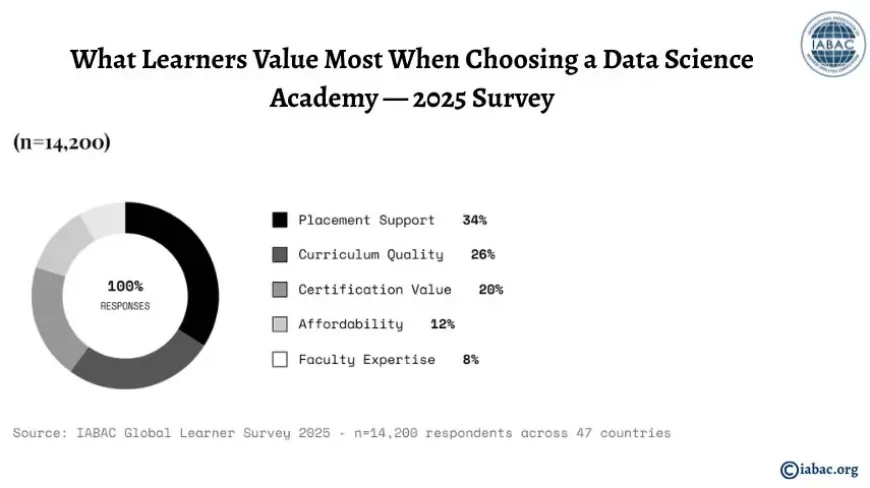
|
Priority |
% of Respondents |
|
Placement Support |
34% |
|
Curriculum Quality |
26% |
|
Certification Value |
20% |
|
Affordability |
12% |
|
Faculty Expertise |
8% |
A Little Mathematics Never Hurt Anyone (Promise)
Since this is a field built on numbers, it feels appropriate to let some numbers appear in their natural habitat. Consider a simple but powerful concept at the heart of machine learning: the Mean Squared Error (MSE), the metric by which a model's predictions are judged.
Formula — Mean Squared Error:
MSE = (1/n) × Σ (yᵢ − ŷᵢ)²
Where:
n = number of observations
yᵢ = actual value
ŷᵢ = predicted value by the model
Worked Example:
Actual sales: [100, 200, 150]
Predicted: [110, 190, 160]
Errors: [−10, 10, −10]
Squared errors: [100, 100, 100]
MSE = (100 + 100 + 100) / 3 = 100
Lower MSE → better model. The entire goal of training a machine learning model is minimising this number. Every data scientist in training will spend meaningful time with equations like this — not because mathematics is a hazing ritual, but because understanding why a model performs well or poorly separates a practitioner who can diagnose real problems from one who can only copy-paste code from Stack Overflow. (No disrespect to Stack Overflow. It has saved approximately every developer alive.)
Why Courses for Data Science Open More Career Opportunities in 2026
One of the most encouraging developments in the modern data science career landscape is its sheer breadth. A decade ago, "data scientist" was almost exclusively a tech-industry title. Today, the role — and its many adjacent specialisations — spans healthcare, agriculture, climate science, legal analytics, sports performance, journalism, urban planning, and dozens more sectors. This diversity is a structural advantage for learners who choose domain specialisation early. A data scientist with deep knowledge of clinical trial data is not competing in the same pool as one specialised in e-commerce recommendation engines. They occupy distinct, high-demand niches where their skills are genuinely scarce and therefore generously rewarded.
The emergence of AI-adjacent roles — Prompt Engineer, AI Product Manager, MLOps Engineer, Responsible AI Analyst — has further broadened the landscape. These roles did not meaningfully exist five years ago; today, companies are paying significant premiums for them. The data scientist roadmap of 2026 therefore looks less like a single highway and more like an interstate network, with multiple valid entry points and dozens of rewarding destinations. The most dangerous assumption any professional can make in 2026 is that data literacy is someone else's job. It is everyone's job — and the people who took a Data Science Academy seriously are already several steps ahead. — IABAC Global Workforce Intelligence Briefing, Q1 2026
How Courses for Data Science Help You Earn Valuable Data Science Certifications
In a world flooded with online courses and self-declared experts, Data Science Certifications serve a crucial function: they create a verifiable, standardised proof of competence. Not all certifications are equal, however. The most valued are those issued by organisations with genuine industry credibility — bodies whose assessments are rigorous, whose syllabi are current, and whose names are recognised in hiring rooms globally.
IABAC (International Association of Business Analytics Certifications) has established itself as precisely this kind of body. Its certifications — spanning Data Science, Machine Learning, Business Analytics, and AI — are designed to be both technically rigorous and practically applicable. Crucially, they are globally portable: an IABAC-certified professional is recognised not just in the country where they trained, but in markets worldwide. The full certification suite is available at iabac.org/certifications, and increasingly appears as a preferred qualification in job postings from the United States to the United Arab Emirates, Australia to Austria. A certified datascience professional also tends to earn measurably more. A 2025 survey by Analytics Insight found that data scientists holding internationally recognised certifications reported salaries 22–35% higher than non-certified peers with equivalent experience — a premium that typically pays back the certification investment within the first three months of employment.
Why the Success of Courses for Data Science Goes Beyond the Statistics
It would be a disservice to end this report on pure statistics. Behind every data point in these charts and tables is a human story. Someone who spent years in a job that did not use their mind fully. Someone who made a decision — perhaps terrifying at the time — to enrol in a Data Science Academy, to spend evenings learning Python while the rest of the household slept, to submit their first Kaggle solution and feel the particular sting of finishing in the bottom half of the leaderboard, and then try again.
The global data science community is, at its core, a community of people who believe that understanding the world through numbers is not a cold exercise but a deeply human one. It is about asking better questions. It is about finding the pattern in the noise that tells you which patients need attention soonest, which supply chain will break under pressure, which neighbourhood needs better infrastructure investment. Data Science at its best is not statistics for its own sake — it is empathy, operationalised.
The rising demand documented in this report, therefore, is not just an economic trend. It is evidence of a world that is, slowly and imperfectly, trying to make better decisions. And the Data Science Academy — in Bangalore, Berlin, Boston, or Bogotá — is where that transformation begins, one trained mind at a time.
KEY TAKEAWAYS FROM THIS REPORT
- The global data science market is projected to exceed $322 billion in 2026, with 36% job growth expected in the US alone
- 11.5 million new data science roles are expected globally by end of 2026, with talent shortfall remaining severe
- A senior data scientist earns $120K–$170K (US), ₹20–40 LPA (India), and €85K–€120K (Germany) on average
- The data scientist roadmap spans 6 structured phases: from mathematical foundations through domain specialisation
- Internationally recognised certifications (e.g., IABAC) provide a 22–35% salary premium over uncertified peers
- Placement assistance (34%) is the top decision factor for learners choosing a Data Science Academy globally
- New roles — MLOps, Prompt Engineer, Responsible AI — have broadened the data science career horizon significantly