


















































AI Consulting for Small Business: What It Actually Takes to Do It Well
How AI consulting helps small businesses solve real challenges, automate workflows, improve efficiency, and achieve measurable business results.

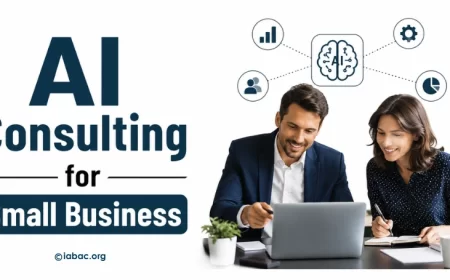
AI consulting for small business is a structured service that helps small and mid-sized companies identify, plan, and implement AI solutions — automation, chatbots, predictive analytics — tied to measurable outcomes, rather than buying software and hoping it works. That much, most guides agree on. What fewer explain is what actually separates a consultant who delivers results from one who just installs tools and disappears.
This guide breaks down the real skill set behind good AI consulting, the mistakes that trip up even experienced advisors, and how to decide whether to hire that skill in or build it inside your own team.
What AI Consulting for Small Business Actually Means
At its core, AI consulting for small business means paying for judgment, not just software. A consultant looks at how your business actually runs — where time gets wasted, where decisions are made on gut feel instead of data — and designs a plan to fix that using AI, one step at a time.
That is different from simply buying AI tools. A subscription to a chatbot platform or an automation app does not ask what problem you are solving first; it assumes you already know. Most small businesses do not, and that is exactly where consulting earns its cost — in the diagnosis, not the software license.
Key AI Consulting Requirements for Small Businesses
Before you bring in a consultant or start building this skill in-house, a few things need to be in place. Without them, even a good consultant is working blind.
• A clearly defined business problem — not "we want to use AI," but a specific workflow that is slow, error-prone, or expensive today.
• A realistic budget range — even a rough figure helps a consultant scope a phase one that matches what you can actually commit to.
• A decision-maker who is actually involved — AI projects stall when the person who can approve changes isn't part of the early conversations.
• Accessible, reasonably clean data — spreadsheets, CRM records, or documents the AI solution will actually work from. Perfect data isn't required, but it has to exist and be reachable.
• One internal point of contact — someone on your team who owns the project day-to-day, answers questions fast, and will carry the capability forward once the consultant leaves.
• An agreed definition of success — the specific number (hours saved, response time, error rate) that will tell you the engagement worked.
Small businesses that walk into a first consulting conversation with these six things already thought through get scoped faster, spend less on discovery, and see results sooner — because the consultant is scoping a plan instead of hunting for basic facts.
The Four Things a Good AI Consultant Actually Does
Good AI consulting looks similar from the outside — a discovery call, a proposal, a pilot project. What separates the consultants who deliver real results comes down to four habits.
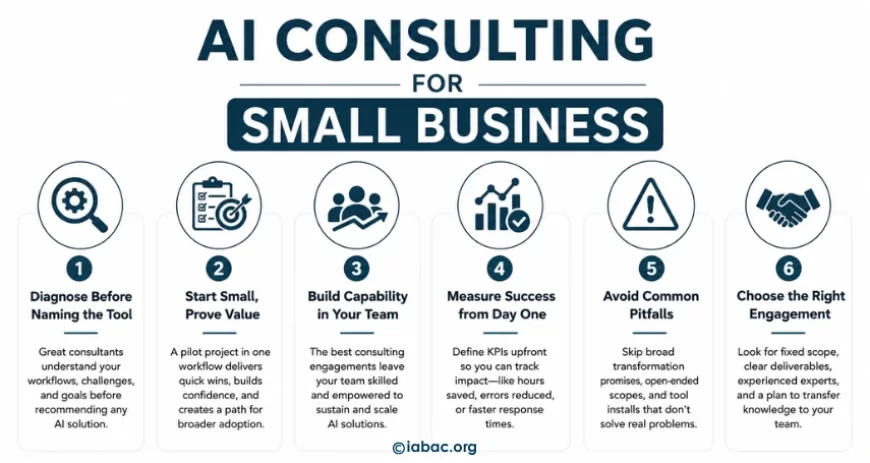
1. They diagnose the workflow before naming the tool
A strong consultant spends more time asking questions than pitching software. They want to know where a task repeats every week, where errors creep in, and where a decision takes longer than it should — before they ever mention a specific AI product.
2. They scope a small, provable pilot first
Instead of a company-wide rollout, they pick one workflow — customer intake, document processing, or support triage — and prove it works there first. A pilot that saves five hours a week is easier to trust, fund, and expand than a broad promise of transformation.
3. They build capability inside your team, not just around it
The best engagements leave your team more capable, not more dependent. This is the same foundation covered in structured credentialing programs like IABAC's Certified Artificial Intelligence Expert (CAIE) certification — the practical skills a consultant applies are largely the same ones a certification validates.
4. They set up measurement before the project starts
If nobody agreed on what "success" looks like before the work began, ROI becomes a guess after the fact. Good consultants define the metric — hours saved, error rate, response time — on day one, not at the final invoice. For a fuller picture of what these credentials cover, IABAC's full range of AI certification programs outlines the skill levels behind this kind of work, from foundational to expert.
Why This Is Harder Than It Looks
Even experienced advisors fall into predictable traps. Three show up again and again:
- Broad "transformation" pitches — a plan to change everything at once, with no clear starting workflow, usually stalls before it delivers anything measurable.
- Open-ended scope — engagements billed by time-and-materials with no fixed phase-one deliverable tend to run long and lose focus.
- Tool installs mistaken for strategy — setting up a chatbot or automation script is not the same as solving the underlying workflow problem it was meant to fix.
In-House Skill vs. Hiring a Consultant
Not every small business needs to hire out. The decision usually comes down to how often the work repeats and how much internal bandwidth you already have.
If AI-driven work will be a recurring, ongoing part of how your business runs — not a one-time project — it often makes more sense to build that capability internally. Programs like the Certified AI Business Leader (CAIBL) program are built for exactly this: business leaders who want to run AI strategy themselves rather than outsource it indefinitely.
If the need is narrower — a single complex integration, or expertise you do not have time to build right now — bringing in outside help makes more sense. IABAC's consulting services connect businesses with certified consultants matched to the specific problem, rather than a generic package.
What to Look for If You Do Hire One
If you decide to bring in outside help, a short, vendor-neutral checklist protects you more than any sales pitch will:
• A fixed-scope phase one with a defined deliverable and end date — not an open-ended retainer.
• Named people, not just a company logo — ask who will actually do the work and what they are certified or experienced in.
• A measurement plan agreed upfront — what number will prove this worked, and when will you know?
• A path to internal ownership — ask how the engagement leaves your team more capable, not just how it leaves the software running.
Executives who want to be able to evaluate these conversations from a position of knowledge — not just trust — often find programs like the Artificial Intelligence Certified Executive (AICE) certification useful groundwork before that first consultant conversation even happens.
Key Takeaways
- Good AI consulting diagnoses the problem before naming the tool, proves value with a small pilot, and leaves your team more capable — not more dependent.
- Recurring, ongoing AI work often justifies building the skill in-house; narrow, one-off needs usually justify hiring out.
- Whoever you hire, insist on fixed scope, named people, and an agreed measurement plan before work begins.
Frequently Asked Questions
How much does AI consulting cost for a small business?
Engagements typically range from a few thousand dollars for a basic readiness assessment to significantly more for full implementation, depending on scope. Cost should be tied to a fixed phase one, not an open-ended hourly arrangement.
Do I need a consultant, or would better AI tools be enough?
If you already know exactly which workflow you are automating and why, tools alone may be enough. If you are unsure where AI would actually help, that diagnostic step is what consulting adds.
Can someone on my team learn to do this instead of hiring out?
Yes, particularly if AI-driven work will be ongoing rather than a one-time project. Structured certification is a practical starting point — see IABAC's guide on how to become an AI expert for a step-by-step path.
Where to Go From Here
Whether you decide to build this capability yourself or bring in outside expertise, the fundamentals are the same: diagnose before you buy, prove value on a small scale, and measure before you scale up.
If you want to build this expertise yourself, start with IABAC's Certified Artificial Intelligence Expert (CAIE) certification. If you would rather bring in a vetted expert, explore IABAC's consulting services to get matched with a certified consultant suited to your business.