
















































Data Science Training Partnership: Benefits for Institutes in 2026
The benefits of data science training partnerships for institutes in 2026. Improve curriculum, industry ties, and student outcomes.


Training institutes offering data science programs face a growing credibility problem. The curriculum may be current, the instructors qualified, and the learner outcomes strong. But without a recognized credential at the end, employers find it harder to verify what graduates actually know, and prospective learners increasingly choose programs that offer proof over programs that don't. That gap between teaching quality and credential recognition is a real and present concern for institutes in 2026, and it is costing them enrollment, corporate contracts, and competitive position. Closing it requires more than curriculum improvement. It requires a formal data science training partnership with a certification body whose credentials employers already trust.
The solution isn't to rebuild your curriculum from scratch or apply for full university accreditation. Entering a structured data science training partnership with a recognized certification body is one of the most practical routes available, letting your institute deliver training under an internationally recognized framework, issue verified credentials to graduates, and compete for corporate L&D contracts that were previously out of reach. This article walks institute directors through what these partnerships actually involve, what you gain, how to evaluate potential certification bodies, and why one model is setting the standard globally.
What a data science training partnership actually involves?
There's genuine confusion in the market about what these partnerships are. A data science training partnership is not a branding arrangement, a referral agreement, or a logo license. It is a formal, structured relationship where a training institute delivers instruction that meets a certification body's competency standards, and learners who complete the program earn a credential issued or authorized by that body. The institute handles teaching, learner support, and local assessment. The certification body defines the standards, designs or authorizes assessments, and issues the credential that carries weight with employers.
This structure matters because the value flows in both directions. The institute gets curriculum credibility and commercial differentiation. The certification body extends its reach through qualified delivery partners. Learners get outcomes that are verifiable and portable. The whole arrangement only works, however, if the institute and the certification body are aligned on what the credential means and how it is earned.
1)The difference between a curriculum license and a certification partnership
A curriculum license gives an institute the right to teach certain content. A certification partnership ties that content to a recognized credential pathway. These are not the same thing, and the distinction matters enormously for how you market your program. When a learner sees that completing your course leads to an internationally recognized certification, the enrollment decision changes. When an employer sees that your graduates hold a verified credential from a body they recognize, the hiring decision changes. A curriculum license gives you content; a certification partnership gives you outcomes that people can act on.
2) How the institute-certification body relationship is structured?
In a well-structured data science upskilling partnership, responsibilities are clearly divided. The institute manages instruction, learner engagement, local assessment, and program delivery. The certification body sets competency standards, designs the final assessment framework, authorizes or administers credentialing, and issues the official credential. There are also operational and legal touchpoints: trainer qualification requirements, branding usage guidelines, co-marketing rights, and periodic quality audits. Understanding these elements upfront prevents friction later and ensures both parties are aligned on what success looks like.
What institutes actually gain from a data science training partnership?
The gains from a certification partnership are both academic and commercial. On the academic side, aligning with a recognized competency framework forces curriculum sharpness. You're not just teaching data science concepts; you're building toward verifiable, defined outcomes that correspond to what employers actually need. That discipline improves program quality, and program quality drives the outcomes that generate word-of-mouth enrollment growth.
On the commercial side, the gains are significant. Institutes that hold authorized partner status commonly experience stronger enrollment conversion because prospective learners tend to choose programs offering recognized credentials over those that don't. More importantly, corporate L&D contracts become accessible. Companies running enterprise data science training programs want instruction that results in a credential their HR teams can record, verify, and use to demonstrate investment in workforce development. Without that credential component, your institute may be effectively invisible to a large and growing segment of the market. For guidance on structuring enterprise programs that lead to verifiable credentials, see this industry perspective on data science corporate training.
1)The credential advantage that changes learner outcomes
Employer attitudes toward certifications have shifted. Some organizations now actively prioritize certified candidates during hiring, particularly for data science, analytics, and AI roles where skill verification through interviews alone is difficult. When your graduates hold a credential from a recognized certification body, their job market competitiveness improves. For the institute, that translates into stronger placement rates, better alumni outcomes, and the kind of employer recognition that becomes a marketing asset over time. Institutes that join authorized partner programs often report enrollment growth driven by exactly this dynamic.
2) Business-side gains for the institute
Beyond learner outcomes, authorized partner status delivers commercial leverage that standalone training providers struggle to replicate. It creates differentiation from competitors whose programs end without a recognized credential. It provides access to co-marketing support from the certification body, including listing in their global partner directory. It also opens the door to approaching enterprise clients with a structured, credentialed offering, a corporate data science training partnership, rather than a bespoke training proposal. These advantages compound over time: as your graduate base grows, so does your reputation as a provider whose credentials employers trust. Many institutes complement such partnerships with formal Corporate Partner Accreditation, IABAC Partnership to strengthen commercial engagement with enterprise customers.
The most common partnership models and how they compare
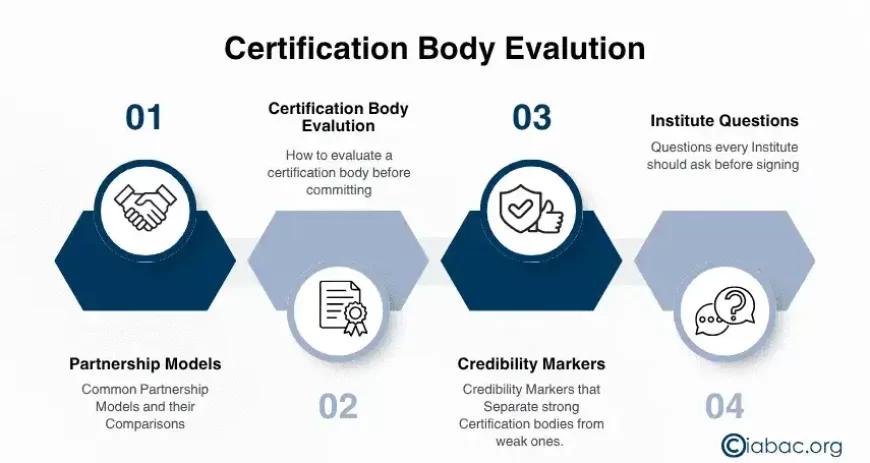
Several partnership structures exist in the market, and they are not equally valuable for institutes whose primary goal is to offer job-market-ready credentials. The Authorized Training Partner model is the most comprehensive. It gives an institute official authorization to deliver training that leads directly to the certification body's credentials. The institute gains certification authority, assessment access, branding rights, and curriculum support. This is not a loose affiliation; it is a formal, operationally structured arrangement that positions the institute as an extension of the certification body's delivery network. For institutes that want a full ecosystem rather than a course license, this is the model that delivers the highest return. Learn more about the Authorized Training Provider, IABAC Partnership model and what it includes.
Other models exist and serve specific purposes. Train-the-trainer data science collaborations are useful when an institute wants to build internal delivery capacity under a recognized framework, particularly for organizations with large-scale rollout plans. Co-licensing is lower-commitment but also produces lower-weight credentials because the connection to a certification body is less direct. Academic-industry training partnerships work well when formal accreditation depth or research-informed programming is the priority. For most training institutes looking to attract both individual learners and corporate clients with a credentialed outcome, however, the ATP model remains the strongest option, see this primer on ATP, IABAC for practical next steps.
1) How to evaluate a certification body before committing?
Name recognition alone is not a sufficient evaluation criterion, and folding that observation into your broader due diligence is important. Some certification bodies with strong marketing have weak assessment rigor or credentials that don't travel beyond a narrow geography. Institutes need a structured evaluation framework before committing to a training provider partnership that will affect their brand and their learners' career outcomes.
Start with framework alignment: is the credential built on a recognized global competency standard, or is it based on the body's own self-defined framework? Self-defined standards are losing traction with employers who want credentials they can benchmark against something objective. From there, evaluate global recognition, are employers in your target markets familiar with the credential, and does it carry weight outside the home country? Examine assessment rigor next: a credential earned without a structured, proctored process carries limited employer confidence. Then review what the certification body actually provides to partner institutes post-onboarding; curriculum support, trainer qualification pathways, and dedicated partner resources are markers of a serious program. Finally, assess domain coverage, does the body offer specializations relevant to your learner base, or only generic credentials?
2) Credibility markers that separate strong certification bodies from weak ones
Three markers indicate a certification body is worth partnering with. The first is alignment with a recognized global competency framework rather than self-defined standards, this is the single most important signal of institutional credibility. The second is a proctored or structured assessment process that employers can independently verify. The third is demonstrated global presence across multiple markets and industries. Credentials backed by government-recognized or internationally established frameworks are gaining ground precisely because employer confidence in self-issued certificates is declining. If a certification body can't point to an external framework their standards map to, that represents a significant risk for your institute's credibility and your learners' career outcomes.
3) Questions every institute should ask before signing
Before formalizing any partnership, get clear answers to the following. What competency framework does the credential map to, and is that framework externally recognized? Are credentials valid and portable outside the certification body's home country? What trainer qualification requirements must your instructors meet? What ongoing support does the body provide after onboarding? What is the process for renewing or auditing your partner status? These questions protect your institute academically and commercially, and any credible certification body should answer them clearly and without hesitation.
Why IABAC's ATP program is the model institutes are choosing?
IABAC, the International Association of Business Analytics Certification, addresses every evaluation criterion outlined above. IABAC is aligned with the European Commission's Edison® Data Science Framework, providing a structured, government-backed competency standard for the data science profession. That alignment means IABAC credentials map to defined competency levels that employers, multinational organizations, and educational institutions can verify against an external benchmark. For institutes whose learners work in or aspire to work in globally competitive environments, this level of credential portability is a genuine competitive edge. For additional context and commentary on the Edison framework, see this overview on Edison Data Science Framework.
1) What the IABAC ATP program delivers to training institutes?
IABAC's Authorized Training Partner program gives institutes authorization to deliver IABAC-certified training across Data Science, Business Analytics, and AI, along with a range of domain-specific specializations. Partner institutes receive access to the globally recognized IABAC certification ecosystem, co-branding and co-marketing support, trainer certification pathways, proctored assessment infrastructure, and listing in IABAC's international partner directory. The domain-specific credential offering is particularly valuable for institutes serving professional verticals: a healthcare professional earning a certified AI credential for their specific domain carries far more career relevance than a generic data science certificate. For practical advice on running partner training at scale and maximizing the value of co-marketing and onboarding, review these partner training programs best practices.
2)The Edison® framework advantage that sets IABAC apart
The Edison® Data Science Framework was developed under a European Commission initiative to standardize what data science competence means across education, employment, and professional development. IABAC positions itself as a certification body operating in alignment with this framework globally, a distinction that carries real weight for partner institutes. For those institutes, that means their learners earn credentials benchmarked against a structured, externally validated standard rather than a proprietary syllabus. This directly addresses the employer trust question: when a hiring manager sees an IABAC credential, they can reference the Edison® framework to understand exactly what competency level it represents. Few certification bodies in the market combine that breadth, domain specificity, and government-backed framework alignment in a single vendor partnership for data science training.
How to move forward and set up your partnership in 2026?
The process of becoming an IABAC Authorized Training Partner is structured and supported. It begins with an application and eligibility review, followed by trainer certification to ensure instructors meet IABAC's qualification requirements. The institute then completes a curriculum alignment review, where existing course content is mapped against the Edison® competency framework. Final authorization follows, after which the institute is cleared to deliver IABAC-certified training and register candidates for credentialing. IABAC provides onboarding support throughout this process, so institutes are not navigating it alone. The program is designed for providers of all sizes, from specialist bootcamps to established universities.