




















































What is Data Collection? Guide to Methods & Tools
Stop collecting useless data. Learn exactly what data matters, the best methods & tools, and how to turn insights into real business decisions.

Here's The Truth Nobody Tells You About Data
Most businesses collect tons of data but make decisions blindly. They're swimming in information yet drowning in uncertainty. Why? Because collecting more data isn't the solution, collecting the RIGHT data is.
This guide cuts through the noise. You'll discover exactly what data matters, which methods actually work for your situation, what tools fit your budget, and common mistakes that kill data quality. Just practical strategies that separate thriving companies from those stuck in the motions.
Let's get into it.
What is Data Collection?
Data collection is simply the process of gathering information from various sources to answer questions, solve problems, or inform decisions. It's that straightforward.
Think about it this way: When you ask customers for feedback, track website visitors, monitor social media mentions, or record sales transactions, you're collecting data. It's happening everywhere, all the time.
The catch? Not all data is created equal. The data you collect needs to be relevant, accurate, and actionable. Collecting random information is like throwing darts blindfolded, eventually you might hit something, but it's a waste of time and resources.
Why Should You Care About Data Collection in 2026?
Here's a reality check: Organizations that prioritize data collection and analysis are 23 times more likely to acquire customers, 6 times more likely to retain them, and 19 times more likely to achieve above-average profitability, according to recent Forbes research.
That's not just a nice-to-have stat. That's the difference between thriving and struggling in today's competitive landscape.
Whether you're running a startup, managing a research project, or building AI models, data collection is your foundation. Poor data in = poor insights out. Simple as that.
The Two Main Types of Data You Need to Understand
Before jumping into methods and tools, let's clarify something important: there are two fundamentally different types of data you can collect.
Primary Data (Original & Fresh)
This is data you collect yourself, directly from the source. It's original, tailored to your specific needs, and usually more expensive and time-consuming to gather.
When to use primary data:
-
You need highly specific information
-
Existing data doesn't answer your unique questions
-
You're conducting original research
-
Your competitive advantage depends on unique insights
-
You're testing new hypotheses or strategies
Secondary Data (Existing & Available)
This is data that's already been collected by someone else. It's cheaper, faster, and readily available, but it might not perfectly align with your exact needs.
When to use secondary data:
-
You need quick market validation
-
Budget constraints exist
-
Supporting existing primary research
-
Benchmarking against industry standards
-
Building context for your own data collection
Pro tip: The smartest teams use both. Start with secondary data for context, then collect primary data for deeper insights.
7 Core Data Collection Methods
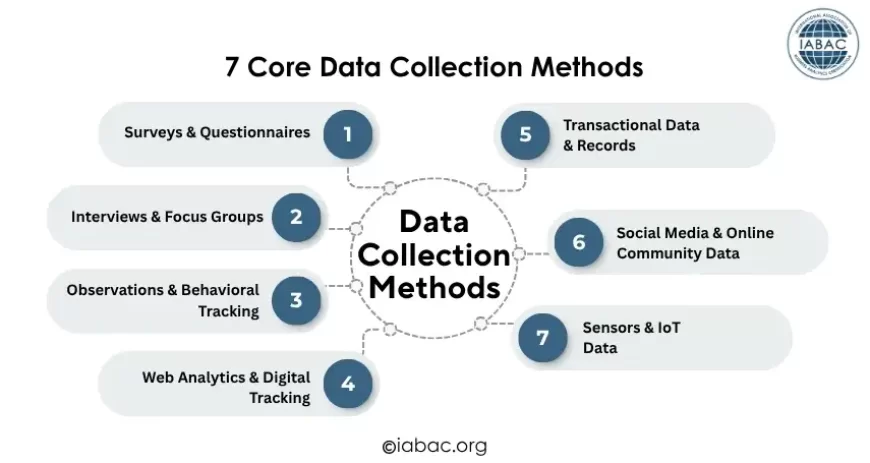
1. Surveys & Questionnaires
The most common method. You're basically asking people directly for information.
Best for:
-
Getting feedback on products or services
-
Understanding customer preferences
-
Measuring satisfaction levels
-
Quick, scalable data gathering
Real talk: Surveys seem easy, but designing a good one is an art. Bad questions = bad data. You need clear, unbiased questions with well-defined answer options.
Timeline: 2-4 weeks
Cost: Low to moderate
Data quality: Medium to high (depends on question design)
2. Interviews & Focus Groups
One-on-one conversations or small group discussions where you dig deeper into "why" people do things.
Best for:
-
Understanding motivations and emotions
-
Getting detailed qualitative insights
-
Testing product concepts with real users
-
Exploring complex behaviors
Why it works: People open up in conversations. You can ask follow-up questions and really understand their perspective.
Timeline: 3-8 weeks
Cost: Moderate to high (requires skilled facilitators)
Data quality: Very high
3. Observations & Behavioral Tracking
You watch what people actually do (not what they say they do).
Best for:
-
Understanding real behavior patterns
-
Identifying workflow inefficiencies
-
Spotting usability problems
-
Testing user experience changes
The power: People often say one thing but do another. Observation reveals the truth.
Timeline: Ongoing
Cost: Moderate
Data quality: High (less biased than self-reporting)
4. Web Analytics & Digital Tracking
Monitoring how people interact with your website, app, or digital products.
Best for:
-
Understanding user journeys
-
Identifying drop-off points
-
Measuring engagement
-
A/B testing decisions
Tools you'd use: Google Analytics, Mixpanel, Amplitude, Hotjar
Timeline: Immediate data collection
Cost: Low to moderate
Data quality: Very high (automatic, unbiased)
5. Transactional Data & Records
The data is automatically generated when business happens, purchases, sign-ups, and form submissions.
Best for:
-
Understanding customer purchase behavior
-
Predicting customer lifetime value
-
Identifying high-value customers
-
Building recommendation systems
Why it matters: This data tells you what people actually valued enough to pay for.
Timeline: Real-time
Cost: Very low (already existing)
Data quality: Extremely high
6. Social Media & Online Community Data
Mining public conversations, reviews, mentions, and discussions.
Best for:
-
Brand sentiment analysis
-
Competitive intelligence
-
Trend spotting
-
Understanding public perception
The catch: You need to respect privacy and the platform’s terms of service.
Timeline: Continuous
Cost: Low (tools available)
Data quality: Good (represents specific audience segment)
7. Sensors & IoT Data
Devices automatically collect information about physical phenomena.
Best for:
-
Environmental monitoring
-
Equipment performance tracking
-
Real-time health monitoring
-
Supply chain visibility
Timeline: Continuous and automatic
Cost: High upfront (equipment), low operational
Data quality: Very high (machine precision)
The 4-Step Implementation Roadmap
Data collection without a proper process is chaos. Follow this roadmap:
Step 1: Define Your Success Metrics
Before collecting anything, know what success looks like.
-
What questions are you trying to answer?
-
What decisions does this data need to support?
-
What's your target accuracy/precision?
-
What's your timeline?
Step 2: Choose Your Method & Tools
Match your methods to your goals and resources.
-
Can you afford primary or secondary data?
-
Do you need real-time or historical data?
-
What's your technical capability?
Step 3: Build Quality Controls
Implement validation mechanisms:
-
Data entry checks
-
Duplicate detection
-
Outlier flagging
-
Consent/privacy verification
Step 4: Analyze & Act
Collect data you actually use.
-
Document your findings
-
Share insights with stakeholders
-
Implement changes based on learnings
-
Measure the impact of decisions made
Best Data Collection Tools in 2026
You don't need fancy software to start, but the right tools definitely help.
For Surveys:
-
Typeform, SurveySparrow, Qualtrics
-
Why: User-friendly, beautiful designs, fast analysis
For User Research:
-
Userlytics, Validately, PlaybookUX
-
Why: Video recording, heatmaps, session replays
For Web Analytics:
-
Google Analytics 4, Mixpanel, Segment
-
Why: Comprehensive tracking, real-time dashboards
For Social Listening:
-
Brandwatch, Sprout Social, and Mention
-
Why: Automated trend detection, sentiment analysis
For Internal Data Management:
-
Airtable, Notion, Monday.com
-
Why: Centralized storage, easy collaboration
5 Critical Mistakes That Kill Your Data Collection (Avoid These)
Mistake #1: Biased Questions
A leading question biases responses. "Isn't our product amazing?" will always get "yes." Solution: Use neutral language. Test questions with a small sample first.
Mistake #2: Ignoring Data Privacy
Collecting without consent or storing insecurely damages trust and breaks laws. Solution: Know GDPR, CCPA, and your local regulations. Be transparent about data use.
Mistake #3: Collecting Without a Clear Purpose
"We collect data because everyone does" wastes resources and money. Solution: Start with a specific question you want answered.
Mistake #4: Not Validating Your Data
Garbage in, garbage out. Bad data ruins decisions. Solution: Implement validation checks. Test data for completeness and consistency.
Mistake #5: Forgetting About Response Quality
A survey with 1,000 low-quality responses is worse than 100 genuine ones. Solution: Screen respondents. Offer appropriate incentives. Remove spam responses.
Data Collection by Industry: Real-World Applications
E-Commerce: Track product views, cart abandonment, purchase history, and reviews to personalize recommendations and reduce churn.
Healthcare: Collect patient data, treatment outcomes, and symptom patterns to improve diagnoses and discover treatment innovations.
Manufacturing: Monitor equipment sensors, production metrics, and quality checks to prevent downtime and optimize processes.
Education: Gather student performance data, engagement metrics, and learning patterns to personalize instruction and identify struggling students.
Finance: Analyze transaction data, credit patterns, and market trends to assess risk and make lending decisions.
The Future of Data Collection: What's Changing
AI-Powered Collection: Machines are learning to collect and clean data automatically.
Ethical Data: Privacy-first approaches are becoming standard, not optional.
Real-Time Processing: We're moving from "collect then analyze" to "analyze while collecting."
Decentralized Data: Users keeping control of their own data is becoming the norm.
Stay ahead by understanding these trends now.
Frequently Asked Questions
How much data do I need?
Enough to answer your question with confidence. More data = more certainty, but with diminishing returns. Most projects work well with 100-1,000 samples.
Is my data collection legal?
Check your local regulations (GDPR in the EU, CCPA in California). Always get explicit consent. When in doubt, ask a legal professional.
How do I ensure data quality?
Validation checks, clear instructions, participant screening, and quality control reviews.
What's the typical timeline?
Simple surveys (2-3 weeks), interviews (4-8 weeks), and ongoing analytics (immediate but needs time to mature).
Level Up Your Data Collection Skills: Your Next Step
If you're serious about data collection and want to build expertise that employers actually value, consider pursuing professional certification.
The IABAC Data Analytics for Manager Certification is specifically designed for professionals who want to master:
-
Advanced data collection methodologies
-
Statistical analysis and interpretation
-
Data governance and compliance
-
Team leadership in analytics
-
Strategic decision-making with data
-
Industry best practices and tools
This certification is recognized globally and positions you for senior-level roles where data-driven strategy actually matters. Whether you're managing a team or improving your organization's data practices, it's the kind of credential that opens doors.
The investment in your skills compounds over time better understanding of data collection means better insights, which means better business decisions, which means real career advancement.
Your Action Plan Starting Today
-
Define your question: What specific problem do you need data to solve?
-
Choose your method: Pick one or two methods from our list above.
-
Set up basic tracking: Start simple. You can get sophisticated later.
-
Validate one time: Check your data quality before scaling up.
-
Take action: Analyze your initial findings and make one decision based on them.
Data collection isn't complicated when you have a clear purpose. Start there, and everything else falls into place.