






















































The Hidden Benefits of Working With Data Science Consulting Firms
Learn the hidden benefits of working with data science consulting firms in 2026, from faster project delivery and expert guidance to better business outcomes

Many businesses reach a point where they realize they have plenty of data but are not sure how to use it effectively. Teams may have reports, spreadsheets, and dashboards, but turning that information into clear business decisions can be challenging. This is when many organizations choose to work with consulting services that specialize in data science. Data Science consulting helps businesses understand their data, solve complex problems, and make better decisions without spending months building an in-house team. Experienced consultants bring technical knowledge, industry experience, and proven methods to help organizations complete projects faster and more efficiently.
Whether a company wants to improve customer experience, predict future sales, automate business processes, or build machine learning solutions, the right consulting services can provide practical guidance from planning to implementation. They also help businesses avoid common mistakes, reduce project risks, and focus on solutions that deliver real value. In this guide, we'll explore how Data Science Consulting works, the benefits of working with experienced consultants, the challenges businesses should consider, and how building internal skills through certifications can support long-term success.
Why Businesses Choose Data Science Consulting Firms in the First Place
Let's set the stage with some numbers, because data people respect data, even when talking about themselves.
The global data science consulting and services landscape has been expanding at a pace that genuinely surprises people outside the industry. Verified Market Reports estimates that the Data Science Consulting Solutions Market recorded a value of USD 5.5 billion in 2024 and is projected to rise to USD 18.2 billion by 2033, growing at a CAGR of roughly 15.9 percent. Zoom out further to the broader data science platform and services category, and Fortune Business Insights pegs the global data science platform market at USD 171.16 billion in 2025, projected to grow to USD 220.9 billion in 2026 and reach USD 975 billion by 2034, at a CAGR of 20.40 percent.
Why does this matter to you, the reader, who may not care about market-research PDFs at all? Because this growth isn't happening in a vacuum. It's happening because companies everywhere are discovering the same uncomfortable truth: they have more data than they know what to do with, and not nearly enough people who know how to do anything meaningful with it.
This is where the hidden benefits of data science consulting really start to surface — not the obvious "they build us a dashboard" benefit, but the deeper, quieter wins that compound over time.
Hidden Benefit 1: You Borrow Years of Pattern Recognition Overnight
Here's something nobody tells you when you're staring at your first messy dataset: the hardest part of data science isn't the math. It's knowing what you're even looking at. A consultant who has worked across forty different client engagements has, in effect, already seen your problem before — just wearing a different company's logo. This is pattern recognition you cannot buy in a textbook. It comes from scar tissue. It comes from a failed churn model in 2021 that taught someone exactly which features actually mattered. When you work with Data Science Consulting experts, you are not paying for hours of coding. You are paying for the years of mistakes they already made on someone else's dime, so you don't have to make them on yours.
Think of it as a kind of compressed time travel. A capable internal team might take eighteen months of trial and error to develop the same intuition an experienced consulting team brings to the table on day one.
Hidden Benefit 2: Objectivity You Cannot Manufacture Internally
Internal teams, however brilliant, are emotionally entangled with their own systems. Nobody wants to be the person who tells the VP that the flagship product's "customer satisfaction model" has been silently broken for eight months. Office politics quietly shape what gets reported and what gets buried. External consultants don't carry that baggage. They walk in, look at the data with fresh eyes, and say the uncomfortable thing out loud. This isn't a small benefit — it's often the single most valuable thing a Data Consulting engagement provides: permission to be honest about what the numbers actually say.
Hidden Benefit 3: The Infrastructure Reality Check
Here's a twist that catches a lot of leadership teams off guard. They hire a consulting firm expecting fireworks — fancy machine learning models, predictive AI, maybe even a chatbot. What they often get told instead is something far less glamorous: "Your data pipelines are broken. Let's fix the plumbing first." This lines up with what practitioners have been saying in open discussions across the data community for years — that client demand in consulting often leans more heavily toward foundational data infrastructure (ETL pipelines, data warehousing, analytics engineering) than purely advanced model development. It is the unglamorous truth of the industry: you cannot build a skyscraper of machine learning on a foundation of inconsistent timestamps and duplicate customer records.
This is, paradoxically, one of the most valuable hidden benefits. A good consulting firm will tell you the truth even when the truth is boring. The firms that just want to sell you a flashy AI dashboard without fixing the underlying mess are doing you a disservice, and increasingly, organizations are wising up to that.
Hidden Benefit 4: Speed That Compounds Into Competitive Advantage
Let's talk numbers again, because this is where the emotional stakes get real for businesses. The World Economic Forum's Future of Jobs Report 2025 found that 94 percent of leaders face AI-critical skill shortages today, with one in three reporting gaps of 40 percent or more. That is not a minor staffing inconvenience — that is a structural crisis quietly playing out inside boardrooms across the planet. Meanwhile, the U.S. Bureau of Labor Statistics projects that data science employment will grow 34 percent from 2024 to 2034, nearly nine times the national average for all occupations. And one widely cited estimate from McKinsey suggests demand for skilled data scientists will outstrip supply by roughly 50 percent by 2026.
Read that again. Outstrip supply by 50 percent. That means for every two data science roles that need filling, the market is realistically able to fill one.
This is the quiet emergency hiding behind every "we'll just hire a data team" plan. You cannot hire your way out of a talent shortage of that magnitude on a normal timeline. Consulting firms, because they aggregate talent across dozens of clients, can deploy expertise in weeks instead of the six-to-twelve months it typically takes to recruit, interview, and onboard a qualified in-house data scientist.
For a business racing against a competitor who already has analytics maturity, that speed difference isn't a convenience. It's survival.
Hidden Benefit 5: A Live Masterclass for Your Internal Team
This is perhaps the most underappreciated benefit of all, and it is deeply, quietly emotional if you've ever experienced it firsthand. When a consulting team embeds with your internal staff — even for a few months — something shifts. Your junior analyst, who has only ever built models from YouTube tutorials, suddenly watches a senior consultant debug a production pipeline live. Your data engineer picks up a new way of structuring a feature store just by being in the room.
This is mentorship by proximity, and it cannot be replicated by reading documentation alone. Good consulting engagements leave behind more than deliverables — they leave behind upskilled people. This is precisely why so many professionals who go through a serious consulting engagement come out the other side hungry to formalize what they just learned. They've tasted what real-world data science looks like under pressure, with real stakeholders, real deadlines, and real consequences — and they want the credential and structured knowledge to back it up.
That hunger is exactly where structured data science certification paths enter the picture.
The Quiet Bridge Between Consulting Exposure and Career Growth
Here is something rarely said out loud: working alongside (or for) a data science consulting firm is one of the fastest ways to discover exactly how much you don't yet know. It is humbling. It is occasionally a gut-punch to the ego. And it is, honestly, one of the best motivators a career can get. This is where a recognized, vendor-neutral Certification in Data Science Online becomes more than a line on a resume — it becomes a structured way to close the exact gaps that consulting exposure reveals. If you've sat in meetings where consultants threw around terms like "feature engineering pipelines," "model drift monitoring," or "A/B testing significance thresholds," and quietly Googled them under the table afterward, you already understand the gap we're talking about.
IABAC (International Association of Business Analytics Certifications) has built its certification framework around exactly this real-world applicability gap. The goal isn't to hand out another piece of paper — it's to mirror the actual competencies that consulting firms, enterprises, and analytics teams are hiring for right now. If you're exploring a structured data science roadmap, starting with a recognized Certification for data science gives you a sequenced path instead of a chaotic scramble through scattered online tutorials.
You can explore the structured learning tracks and data science syllabus options directly on iabac.org, where the certification pathways are mapped against real industry skill requirements rather than abstract academic theory.
Understanding the ROI of Working With Data Science Consulting Firms
Let's get a little quantitative, because data science people deserve a little math in their blog posts.
Suppose a mid-sized company decides to build an in-house predictive analytics capability from scratch.
Option A: Build entirely in-house
- Recruiting timeline for 2 qualified data scientists: roughly 6–9 months
- Average ramp-up time to project productivity: 3–6 months
- Total time to first deployed model: approximately 9–15 months
- Risk: high, since internal hires may lack exposure to your specific industry's edge cases
Option B: Engage a Data Science Consulting Firm
- Deployment timeline: 4–8 weeks
- Time to first deployed model: approximately 2–4 months
- Risk: lower, due to prior pattern recognition across similar projects
- Added bonus: internal staff upskilled in parallel
If we express this as a rough "time-to-value" ratio:
Time-to-Value Ratio = Time to Build In-House ÷ Time via Consulting Engagement
= 12 months ÷ 3 months
= 4x faster value realization
That 4x multiplier isn't an exact figure for every organization — it will vary by industry, data maturity, and team size — but it illustrates the structural reality consulting firms operate inside. Speed is the product, just as much as the model itself.
And speed has compounding value. A predictive maintenance model in manufacturing that goes live three months earlier could mean three additional months of catching equipment failures before they become catastrophic. Industry analysis on external analytics partnerships has noted predictive maintenance systems implemented by external partners reducing equipment downtime by 30 to 50 percent — a number that only matters if the model is actually live and running, not still sitting in a recruitment pipeline.
How Different Data Science Consulting Firms Deliver Value Across Industries
It helps to understand the landscape isn't one-size-fits-all. Broadly, the ecosystem breaks into a few categories:
- Global strategy and management consultancies tend to operate at the boardroom level — shaping enterprise-wide data strategy, governance frameworks, and large-scale AI deployment roadmaps. They are excellent when the problem is organizational alignment as much as technical execution.
- Large multi-service consultancies bring scale. They can mobilize hundreds of people across data engineering, analytics, and cloud migration simultaneously — useful for sprawling, multi-year digital transformation programs.
- Boutique, specialized analytics firms are leaner, deeply technical, and often the right call when you need someone to live and breathe a single hard problem — a fraud detection model, a churn-prediction engine, a supply-chain optimization algorithm — without the overhead of a massive program.
- Technology integrators bridge the gap between the data science layer and the broader enterprise IT stack, which matters enormously when your AI model needs to actually plug into decades-old legacy systems without breaking everything.
Choosing between these isn't about which is "best." It's about matching the type of problem you have to the type of firm built to solve it. A board-level data strategy question doesn't need the same partner as a narrow, technical predictive-modeling sprint.
The Talent Gap Is the Real Story Here
It's worth sitting with one more statistic, because it reframes everything we've discussed so far. According to research highlighted by the World Economic Forum, demand for digital skills such as AI, big data, and technology literacy is accelerating faster than global supply. And separately, employer-side research has found that 63 percent of employers say skills gaps are their biggest obstacle to growth. This isn't a problem that resolves itself by hiring harder or posting more job ads. It is a structural mismatch between how fast the world is generating data problems and how fast the world is producing people qualified to solve them. Consulting firms exist, in large part, because they aggregate scarce talent and deploy it efficiently across many organizations at once — a kind of shared infrastructure for expertise that no single company could afford to build alone.
But here's the part that matters most for you personally, reading this as an individual rather than as a business: that talent gap is also your opportunity. Every statistic about scarcity is also a statistic about leverage — leverage for the people willing to build verifiable, structured skills right now, while the gap is still wide open.
Building Your Career Roadmap With Insights From Data Science Consulting Firms
If there's one emotional throughline in everything above, it's this: watching a consulting team operate at a high level is inspiring, but inspiration alone doesn't close skill gaps. Structure does.
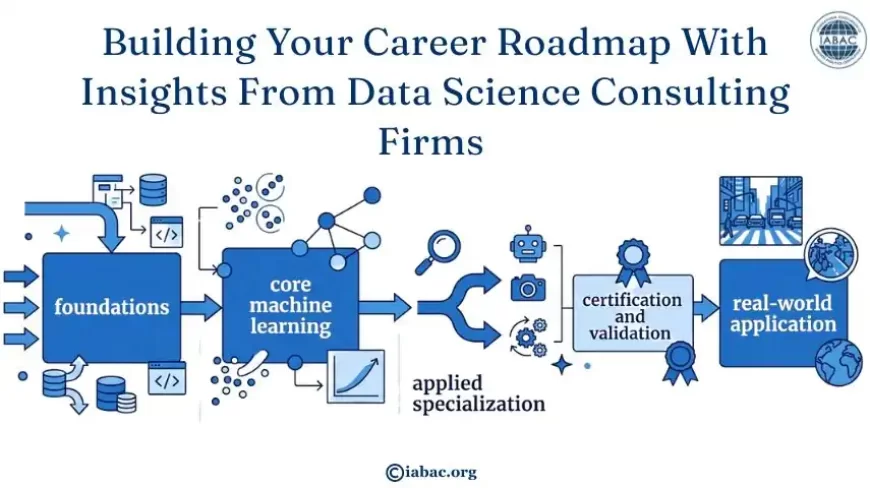
A practical data science roadmap generally moves through these stages:
- Foundations — statistics, Python or R, SQL, and an understanding of how data actually moves through real systems (not just clean Kaggle datasets).
- Core machine learning — supervised and unsupervised learning, model evaluation, and the discipline of knowing when a model is good enough to deploy versus when it needs more work.
- Applied specialization — picking a lane, whether that's predictive analytics, NLP, computer vision, or MLOps, and going deep rather than staying shallow across everything.
- Certification and validation — formalizing your skills through a recognized Certification in Data Science Online, which signals to employers and consulting firms alike that your skills aren't just self-reported.
- Real-world application — through internships, freelance projects, or junior roles where the lessons from structured learning meet the chaos of real, messy, human data.
IABAC's certification tracks are designed to map cleanly onto this exact progression, with a data science syllabus structured around what hiring managers and consulting firms are actually screening for in 2026 — not outdated theoretical frameworks from a decade ago.
Why Data Science Consulting Firms Continue to Shape the Future of Business
Working with data science consulting firms was never really about outsourcing a problem. The hidden benefit, the one that rarely makes it into a polished pitch deck, is that these engagements quietly transform the people inside the organization too. They raise the bar for what "good" looks like. They expose the gap between where your skills are and where the market actually needs them to be. And for a meaningful percentage of professionals who experience that gap firsthand, it becomes the spark that sends them looking for a structured Certification for data science — not because a recruiter told them to, but because they finally understood, viscerally, what they didn't yet know.
That moment of humbling clarity, followed by deliberate skill-building, is the real success story hiding inside the data science consulting industry. The market numbers, the talent shortages, the infrastructure-first reality — all of it points toward the same conclusion: this field rewards people and organizations willing to combine outside expertise with relentless, structured self-improvement. If that's the chapter you're in right now, the next right step is simple: stop treating data science as something mysterious that only consultants understand, and start building the credentialed, structured knowledge that lets you stand confidently in that same room.