

















































Why More Students and Professionals in Bhopal Are Choosing Data Science
Students and working professionals in Bhopal are gaining practical analytics, AI, and machine learning skills to improve career prospects and meet industry needs in 2026.

There is a moment — maybe you have lived it — where you are sitting with a pile of Excel sheets, manually typing numbers, and someone walks in and says, "Why don't you just run a model on this?" And you nod confidently, fully pretending you know exactly what a "model" means in this context. That is the moment life is telling you: it is time to learn Data Science.
All jokes aside, the world is changing faster than most of us expected. And Bhopal — the City of Lakes, the heart of Madhya Pradesh — is quietly but confidently becoming one of the most exciting cities in India for data science education and career growth. Students, working professionals, and even people switching careers in Bhopal are waking up to a truth that the global job market confirmed long ago: Data Science is not a trend. It is the foundation of every modern industry. This blog is for everyone — whether you are a student in Bhopal who just finished graduation, a professional who has been looking at the same job title for five years, or someone on the other side of the world reading this at midnight wondering if you should finally make that career switch. You are in the right place.
The Growth of Data Science: What the Numbers Show
Let us start with some real data, because this is a data science blog and it would be embarrassing not to.
According to the World Economic Forum's Future of Jobs Report, Data Analysts and Data Scientists rank among the top three fastest-growing job roles worldwide through 2027. The U.S. Bureau of Labor Statistics projects that data science roles will grow by 35% between 2022 and 2032 — far ahead of almost every other profession. In India, LinkedIn's Emerging Jobs Report has consistently placed Data Science in the top five most in-demand skills for multiple years in a row. This is not just a story from the West. India's National Association of Software and Services Companies (NASSCOM) reported that India needs over 250,000 data science professionals every year, but the supply currently fills only about 30% of that demand. The gap is real. The opportunity is real. And Bhopal, for the first time, has everything needed to help you step right into that gap.
Why Bhopal? Why Now?
You might be thinking: "Sure, data science is big in Bangalore or Hyderabad. But Bhopal?"
That is exactly the kind of thinking that is quietly being proven wrong every year. Bhopal has a growing IT scene, a large number of young engineering and commerce graduates, strong government spending on digital infrastructure, and — most importantly — a rising number of quality training partners who are now offering globally recognized certifications right here in the city.
Institutes offering Data Science Courses in Bhopal are now working with the IABAC (International Association for Business Analytics Certification) framework — a globally recognized certification body built on the European Commission's EDISON initiative. This is not a local certificate you frame and forget. IABAC certifications are recognized worldwide, which means a professional in Bhopal who earns an IABAC credential is speaking the same professional language as someone in London, Singapore, or Toronto. The fact that you can earn this in Bhopal — whether through offline classroom learning or live online sessions — without relocating, without spending a huge amount, without leaving your family — is something worth paying attention to.
What Exactly Is Data Science? (For Anyone Who Wants to Know)
Data Science is the work of pulling useful meaning out of raw data using a mix of statistics, programming, and subject knowledge. But let us make this more real.
Picture a retail shop in Bhopal that has 10 years of sales records — millions of rows tracking what was sold, when, to whom, in what weather, and during which festivals. A data scientist looks at that huge pile of data and finds patterns that a human brain simply cannot process by hand:
- Why do sales of a specific product jump 3 days before Diwali but not during Navratri?
- Which group of customers is most likely to stop buying in the next 60 days?
- When the store opens a new outlet in a different area, what kind of income can it realistically expect in Year 1?
These are not made-up questions. These are the exact problems that companies pay data scientists to answer — and they pay them well.
A simple prediction model in Python might work like this:
Input Variables (Features):
- Days to nearest festival
- Rainfall in the week
- Product category
- Customer age group
- Previous purchase history
(Machine Learning Algorithm — e.g., Random Forest)
Output:
- Probability of purchase: 0.82 (82%)
- Recommended action: Send targeted discount coupon
This is the kind of work that Data Science Courses in Bhopal, built around the IABAC curriculum, are now training people to do from day one.
The IABAC Certification Path: What It Looks Like for a Bhopal Learner
The IABAC framework is built to support learners at every point in their career. Think of it as a staircase with clear steps, not an elevator that either works or does not.
- Step One: Data Science Foundation (DSF) This is the starting point. If you are new to this field — if words like "regression" and "algorithm" still feel strange — DSF is made for you. It covers the basics of statistics, the kinds of roles that exist in data teams, and a simple introduction to core algorithms. It is honest about what the field is, and it does not throw you into the deep end on Day One.
- Step Two: Certified Data Scientist (CDS) This is the main credential. The one that opens doors. It covers the full life of a data science project — from collecting and cleaning data (which, in real life, takes up about 60–70% of any project, as every experienced data scientist will quietly admit), through analysis, building models, testing them, and putting them to work. Python programming is central here, and so is learning how to explain findings to people who are not technical.
- Step Three: Certified Data Science Developer For people who lean toward the engineering side — who want to build the systems and tools that put machine learning models into real production — this credential covers the technical side of data science at scale.
- Step Four: Certified Data Analyst Not everyone wants to build models. Some people are built for business analysis — for reading dashboards and telling clear stories from charts and numbers. The Certified Data Analyst credential is for those people. It covers tools like Power BI and Tableau, diagnostic analysis, and the business numbers that drive real decisions in companies.
All of these credentials, their full outlines, and global exam details are available at https://iabac.org/certifications — a clear, internationally structured Data Science Career Certification framework that gives you real credibility beyond any single country or employer.
The Curriculum Breakdown: What You Actually Learn
Whether you are in Bhopal or Bangkok, the IABAC-aligned curriculum covers a solid set of core skills. Here is a clear view of what the learning covers:
- Programming Foundations Python is the main language of data science. It is easy to read, powerful, and has a huge collection of tools — NumPy, Pandas, Scikit-learn, Matplotlib, TensorFlow — that handle everything from working with data to building neural networks. SQL is just as important for anyone working with databases, and that is basically everyone in this field.
- Mathematics and Statistics This is where many learners feel a bit nervous, and that is completely okay. The good news is that you do not need to be a mathematician.
You need to understand the thinking behind the math. For example:
Linear regression — one of the most widely used models — is written mathematically as:
ŷ = β₀ + β₁x₁ + β₂x₂ + ... + βₙxₙ
Where ŷ is the number you are predicting, x values are your input data points, and β values are the weights your model learns from the data. The idea is simple: find the best connection between your inputs and your output. Once you understand why this works, the formula is just a way of writing it down.
Other key statistics ideas you will learn include hypothesis testing, p-values, confidence intervals, probability distributions, and Bayesian reasoning. Each of these has clear, practical uses — not just exam questions that disappear from your memory the next day.
- Machine Learning This is the core of modern data science. You will study supervised learning (where you teach models using labeled examples — think spam detection, loan approvals, disease prediction), unsupervised learning (where you find hidden groups in unlabeled data — think customer grouping, spotting unusual activity), and deep learning (where neural networks with many layers learn from complex data — think image recognition, language tools).
- Data Visualization Data without a chart is like a story with no ending — technically there, but not satisfying. Tools like Power BI and Tableau help data scientists build dashboards that turn technical findings into visual stories that business leaders, clients, and decision-makers can actually use.
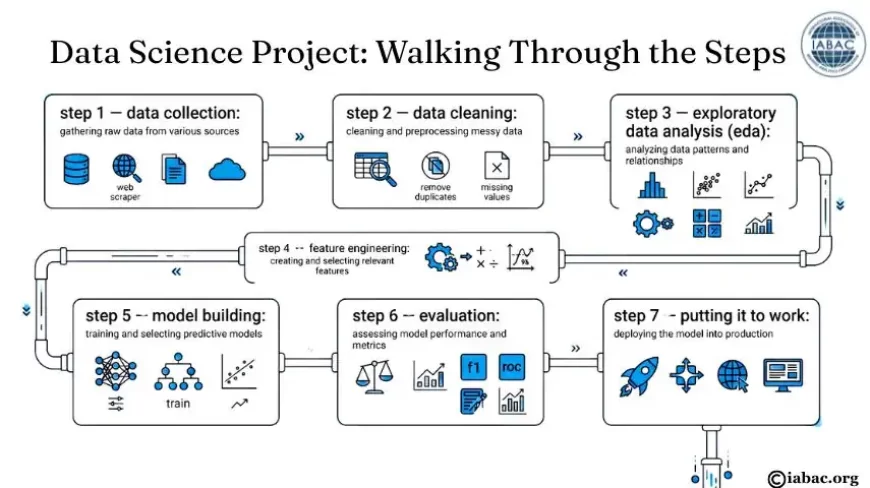
Data Science Project: Walking Through the Steps
To understand what a data science project actually looks like, here is an example from the education sector — something directly relevant to anyone reading this right now.
Problem Statement: A university in India wants to figure out which new students are at risk of dropping out in their first year.
Step 1 — Data Collection: Gather past records — admission data, attendance, grades, financial aid status, distance from home, entrance exam scores, family income data.
Step 2 — Data Cleaning: Real data is messy. Values are missing, formats are inconsistent, and there are outliers. A student listed as "19" in one row and "nineteen" in another needs to be fixed. This step takes time but it is not optional.
Step 3 — Exploratory Data Analysis (EDA): Before building any model, look at the data visually. Plot attendance against dropout rates. Check what connects to what. You might find something like this:
Step 4 — Feature Engineering: Build new variables that might make predictions better. For example, "distance from campus × financial stress score" might tell you more than either number alone.
Step 5 — Model Building: Train a model (Logistic Regression, Random Forest, or Gradient Boosting) to predict the chance of a student dropping out.
Step 6 — Evaluation: Measure how well your model works using accuracy, precision, recall, and AUC-ROC score. In this case, recall matters most — you want to catch as many at-risk students as possible, even if it means a few false alarms.
Step 7 — Putting It to Work: The model runs automatically at the start of each semester. Students flagged as high-risk are connected with academic advisors and financial support teams right away.
Result: A 20–30% drop in first-year dropout rates is a realistic and documented outcome from universities that have used data-driven early-warning systems like this.
This is data science. Not magic — just clear thinking with the right tools.
Career Growth After Learning Data Science
Let us be straightforward. The reason most people think about Data Science Courses in Bhopal — or anywhere — is career growth. And the numbers support the optimism.
Entry-level data analyst roles in India currently pay in the range of ₹3.5 to ₹6 lakh per year. With 2–3 years of experience and a recognized Data Science Career Certification like IABAC's Certified Data Scientist, that range climbs to ₹8–₹18 lakh per year. Senior data scientists and machine learning engineers with strong portfolios can earn ₹25 lakh and above, with global remote roles pushing those numbers much higher.
Outside India, the global picture is even more striking:
Average Data Scientist Salaries by Country (2024 Estimates):
- United States : $120,000 – $180,000 per year
- United Kingdom : £55,000 – £90,000 per year
- Germany : €60,000 – €95,000 per year
- Canada : CAD 85,000 – CAD 130,000 per year
- Australia : AUD 100,000 – AUD 150,000 per year
- India (Senior) : ₹18L – ₹40L per year
For a student in Bhopal who completes a globally recognized IABAC certification, these numbers are not out of reach. They are real targets — especially with the rise of remote work, which has genuinely reduced the advantage that big metro cities once had over everyone else.
The Real Feelings Behind a Career Change (And Why It Is Worth It)
Let us step away from the numbers for a moment and talk about something that does not get enough attention in career blogs: the weight of making a big change.
Many people reading this have been working for years in a field that pays the bills but does not excite them. Maybe it is accounting. Maybe it is sales. Maybe it is a technical job that used to feel interesting but has become the same thing over and over. The idea of going back to learning — of sitting in a class (or opening a laptop at 10 PM after the kids are asleep) and trying to understand Python and statistics — feels like a lot. That feeling is completely understandable. But here is what is also true: the structure of IABAC-aligned programs in Bhopal is built specifically for working adults. The step-by-step learning approach means you are not expected to take in everything at once. Capstone projects give you something real to show for your effort — not just a certificate, but an actual data science project that shows any hiring manager that you can do the work.
And the moment when something finally clicks — when you write your first Python script that works on a real dataset and gives you something useful — that moment is worth all the struggle. Everyone who has been through it says the same thing.
What to Look for in a Data Science Training Program in Bhopal
Not all programs are the same. Here is a simple checklist for checking any Data Science training program, whether in Bhopal or anywhere else:
- Global Recognition: Does the certification come from a body that is known internationally? IABAC's connection to the European Commission's EDISON framework means the credential is understood by employers around the world. Check everything carefully at certifications before signing up anywhere.
- Practical Learning: Theory matters, but employers hire for real skill. Look for programs that use real datasets, capstone projects, and actual tools — not just slides and theory sessions.
- Placement Help: Does the institute actively help with interview preparation, resume building, and connections to companies? This is not a bonus — it is a major difference-maker, especially for people switching careers.
- Flexible Learning Options: Offline classroom, live online, and recorded content each work better for different people. A good institute offers more than one format so you can choose what fits your life.
- Community and Support: Learning data science by yourself is much harder than it needs to be. A group of fellow learners, access to instructors, and a community that shares resources and job leads makes a real difference in both finishing the course and getting hired.
The Global Picture: Why IABAC Matters Beyond Bhopal
The IABAC framework was built for a world where people move across countries for work but their certificates only mean something back home. A student who earns a degree in Bhopal has a degree from an Indian university. But a student who earns an IABAC Certified Data Scientist credential has a globally portable professional qualification — one that HR teams in Germany, Australia, the UAE, and Canada can understand without needing to look it up in an equivalency table. This matters a lot in a job market where remote work has made global hiring genuinely easy. Companies in Europe are hiring data science talent from India, Vietnam, Eastern Europe, and Latin America because the work can be done from anywhere. What they need is a credential system that works across borders. IABAC, built on the EDISON Data Science Framework and endorsed by the European Commission, is exactly that.
For a learner in Bhopal, this is not a small thing. It is the difference between a qualification that opens doors locally and one that opens them anywhere in the world.
Data Science is not just for people who grew up coding or scored at the top of their math class. It is a field built for curious, clear-thinking people who want to use data to solve real problems. The tools are learnable. The math is approachable. The job market demand is enormous. And the quality of Data Science Courses in Bhopal — aligned with internationally recognized IABAC Data Science Career Certifications — means you do not need to move to a big city, spend a fortune abroad, or put your life on hold to build a real career in this field. The data-to-data journey — from raw numbers to clear decisions — runs through people who know how to work with it. Every business, every hospital, every school, every government is producing data faster than it can be processed. The people who can process it, read it, and act on it are among the most valuable professionals in the world right now.
You are in Bhopal. The resources are here. The global certification framework is here. The job market is waiting.