






















































Is the Certification You Chose Really the Best for Data Science
Choosing the right data science certification affects career growth skills validation and job readiness. Evaluate learning depth industry value and outcomes.

You enrolled in a course. You watched the videos. Maybe you even completed a few assignments. But somewhere in the back of your mind, a quiet question keeps showing up:
Is this really the best Data Science Certification for me?
It’s not a comfortable question—but it’s an important one.
In a world full of endless data science certificate programs, choosing the right path isn’t just about learning. It’s about making sure your time, effort, and money actually move your career forward in Data Science.
Let’s break this down honestly, so you can figure out whether you’re on the right track—or if it’s time to rethink your choice.
The Truth About Data Science Certifications Today
The popularity of Data Science Certification programs has exploded over the last few years. Everywhere you look, there’s a new course promising:
- Become a data scientist in 3 months
- No coding required
- Guaranteed job placement
Sounds great, right?
But here’s the reality:
Not all certifications are created equal.
Some programs focus only on theory.
Some skip real-world applications.
Some look impressive—but don’t hold much value in the job market.
And that’s where confusion begins.
Why Doubt Is Actually a Good Sign
If you’re questioning your certification, it doesn’t mean you made a mistake.
It means you’re thinking critically—and that’s a skill every professional in Data Science needs.
Instead of ignoring that doubt, use it as a checkpoint.
Ask yourself:
- Am I learning skills I can actually apply?
- Do I feel more confident working with data?
- Can I explain what I’ve learned to someone else?
If the answer is not really, then it’s worth digging deeper.
What Makes a Data Science Certification The Best?
Let’s simplify this. The best Data Science Certification isn’t the most expensive one or the most popular one.
It’s the one that gives you:
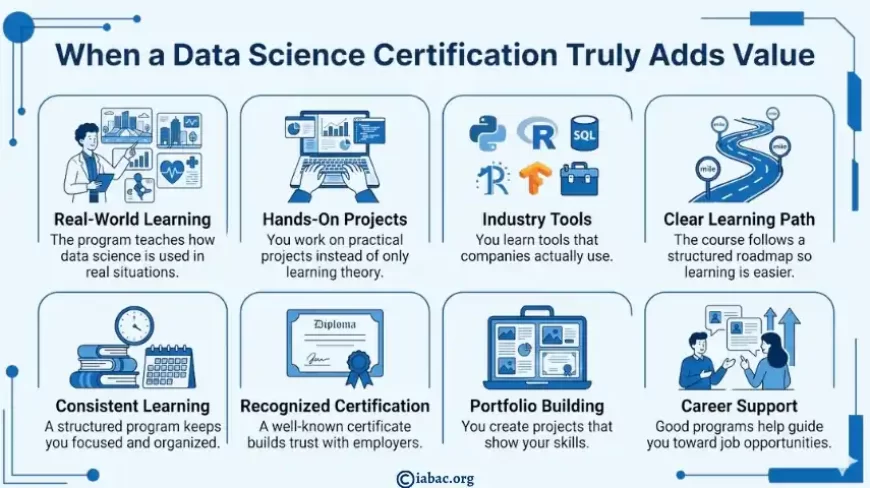
1. Real Skills, Not Just Content
A good program teaches you how to:
- Work with real datasets
- Build models
- Solve business problems
If your course is mostly slides and theory, that’s a red flag.
2. A Clear Learning Path
Strong data science certificate programs don’t throw everything at you at once.
They guide you step-by-step:
- Basics → Intermediate → Advanced
Without structure, learning becomes overwhelming.
3. Industry Relevance
The field of Data Science is constantly evolving.
Your certification should include:
- Python and SQL
- Machine learning techniques
- Data visualization tools
- Real-world case studies
If the content feels outdated, it probably is.
4. Career Alignment
Ask yourself this honestly:
Is this course helping me get closer to my career goal?
Whether you want to become:
- A Data Analyst
- A Data Scientist
- Or even a data science manager
Your certification should match that path.
Signs You Might Be in the Wrong Certification
Let’s be real for a moment.
Sometimes, we stick with a course just because we already paid for it.
But here are some warning signs you shouldn’t ignore:
You’re only watching, not doing: If you’re not practicing, you’re not learning.
- You don’t feel confident: After weeks of learning, you should feel some progress.
- No real projects: Projects are what employers actually care about.
- No clarity on career direction: A good course should guide you, not confuse you more.
If this sounds familiar, don’t panic—but don’t ignore it either.
What a Strong Learning Experience Should Feel Like
A high-quality Data Science Certification program feels different.
You’ll notice:
- You start understanding how data works
- You can write basic code confidently
- You begin solving small problems on your own
- You feel challenged—but not lost
Learning should stretch you, not frustrate you endlessly.
The Role of Practical Learning in Data Science
Here’s something many people underestimate:
Data Science is not a theory-based field. It’s a practice-based field.
You can watch 100 hours of tutorials and still struggle if you don’t apply what you learn.
That’s why the best data science certificate programs focus heavily on:
- Hands-on projects
- Case studies
- Real datasets
Because in interviews, no one asks:
Which videos did you watch?
They ask:
What have you built?
Are You Learning What Companies Actually Need?
Let’s connect this to the real world.
Companies hiring in Data Science are looking for people who can:
- Analyze messy data
- Build predictive models
- Communicate insights clearly
They’re not just looking for certificates—they’re looking for capability.
So ask yourself:
Does my certification prepare me for real job tasks?
If not, it may not be the best fit.
The Importance of Structured Certification Paths
One major difference between average and strong programs is structure.
A well-designed path usually includes:
- Beginner-level concepts
- Intermediate-level tools
- Advanced-level applications
Platforms like IABAC (www.iabac.org) follow structured frameworks that align with industry expectations, helping learners progress without confusion.
Instead of guessing what to learn next, you follow a clear roadmap.
Can the Certification Help You Grow Long-Term?
Another important factor people forget:
A certification is not just about getting your first job.
It’s about building a long-term career in Data Science.
Think beyond today:
- Will this help you move into senior roles?
- Can it support your journey toward becoming a data science manager?
- Does it build a strong foundation?
If the answer is no, it’s worth reconsidering your path.
Common Mistakes When Choosing a Certification
Let’s quickly go through some common traps:
Choosing based on trends: Just because a course is popular doesn’t mean it’s right for you.
Ignoring your current level: Jumping into advanced topics too early leads to frustration.
Not checking course depth: Some courses look detailed—but are actually very basic.
Following others blindly: Your career path is unique. Your learning path should be too.
What Should You Do If You Chose the Wrong One?
First—don’t stress.
Many people switch paths during their journey in Data Science.
Here’s what you can do:
Step 1: Evaluate your current course
Understand what’s missing.
Step 2: Fill the gaps
You don’t always need to start from zero.
Step 3: Consider upgrading
Look for a better Data Science Certification that offers:
- Practical learning
- Structured modules
- Industry relevance
Step 4: Focus on projects
Even if your course isn’t perfect, your projects can still make a big difference.
The Confidence Factor
Here’s something rarely talked about:
The right certification doesn’t just teach you skills—it builds confidence.
You start believing that:
- You can solve problems
- You can understand data
- You belong in this field
And that mindset shift is powerful.
It’s Not About Perfect—It’s About Progress
So, is the certification you chose really the best for Data Science?
Maybe yes.
Maybe not.
But the real question is:
Is it helping you grow?
If it is—keep going.
If it isn’t, you now know what to look for.
The world of data science certificate programs is vast, but the right one will always stand out—not by promises, but by results.
At the end of the day, your success in Data Science doesn’t depend on just the certification you choose.
It depends on how you use it.
So take a step back, evaluate honestly, and move forward with clarity.
Because the right choice isn’t the one everyone recommends—
It’s the one that works for you.