

















































Do Certifications Actually Help You Become a Marketing Data Scientist?
Learn whether data science certifications build real skills for marketing analytics roles. Understand value hands on learning industry demand and growth.

Be honest with yourself for a moment. When you first heard the phrase "data scientist in marketing," did it feel exciting — or did it feel like something meant for other, more technical people? And when someone said "just get a certification," did you wonder if that would actually make a difference? You are not alone. This blog is for you — and we are going to answer that question honestly, clearly, and in plain language.
Marketing has changed. Have you?
Not long ago, marketing was mostly about creativity — a great campaign idea, strong copywriting, or a memorable visual. Today, it still needs creativity. But it also needs something more. It needs people who can read numbers, spot patterns in customer behavior, and make decisions based on what the data actually says — not just what feels right.
This is where data science and marketing come together. And the professionals who sit at that crossroads — people who understand both the creative side and the analytical side of marketing — are among the most wanted people in business today, all over the world.
Companies are not just looking for marketers anymore. They are looking for marketers who think like scientists. That is what a data scientist in marketing does.
- 6×: Higher returns for teams that use data to guide marketing decisions
- 38%: Now, marketing job postings ask for some level of data skills
- 1: A marketing data scientist is one of the fastest-growing roles worldwide
What does "Data Scientist in Marketing" actually mean?
Let's keep this simple. A data scientist in marketing is someone who uses data to help a business make smarter marketing decisions. They do not just pull reports from a dashboard and send them in an email. They ask deeper questions — and they know how to find the answers.
For example, they might look at why certain customers stop buying after a few months, or which type of email subject line gets more clicks from people in a specific city. They use tools like Python or R to work with large amounts of customer information, and they build models that can predict what a customer is likely to do next. That is the real meaning of a data scientist in a marketing context. It is part analyst, part strategist, and part curious thinker. And it is a role that nearly every company in the world is trying to fill right now.
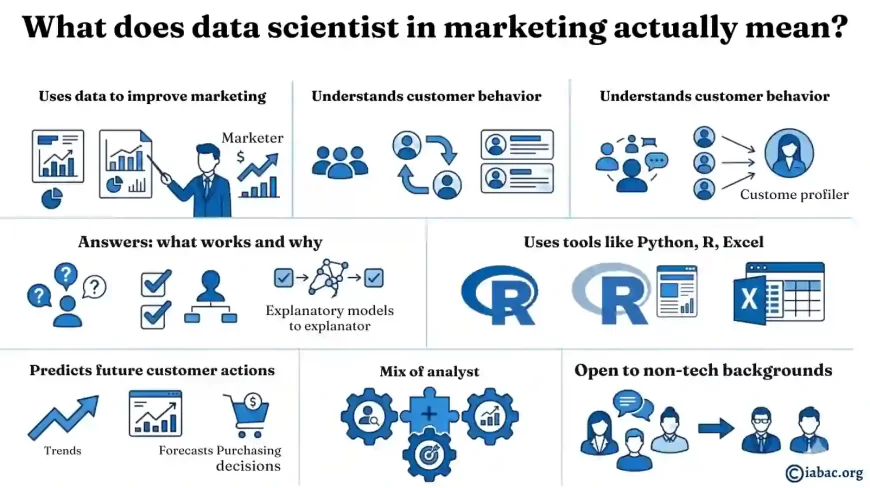
You do not need to be a computer science graduate to become a marketing data scientist. Many people in these roles started their careers in marketing, communications, or business — and built their data skills over time, step by step.
So, do data science certifications actually help?
Here is the honest answer: yes, they do. But not in the way most people expect. A certification is not a magic pass. It will not land you a job the day you finish it. But when you use it the right way, it can genuinely change your career path.
Let's look at what a good Data Science Certification can actually do for you.
It gives your career shift a real structure
One of the hardest parts of learning something new on your own is knowing where to start and what comes next. A well-designed certification program solves that problem. It gives you a clear path — from basics to advanced topics — so you are always moving forward, not going in circles.
For someone moving from a traditional marketing role into data science marketing, this structure is incredibly valuable. You do not waste months watching random YouTube videos. You follow a path built by people who know what the job actually requires.
It shows employers you are serious
When a hiring manager sees hundreds of resumes, they look for signals. A recognized certification from a trusted organization is a strong signal. It tells them: this person took the time to learn, they passed a real assessment, and someone credible verified that.
In data science and marketing roles, especially, where the skills are still new to many companies, a certification can be the thing that gets you a first interview.
It fills the gaps without going back to college
Not everyone has the time or money for a full university degree. And honestly, for many roles in data science marketing, you do not need one. What you need is a focused set of practical skills — things like customer segmentation, campaign analysis, predictive modeling, and working with marketing data sets.
A good certification covers exactly these things, in a way that fits around your current work life.
It works for professionals all over the world
This is especially important for a worldwide audience. If you are in India, Nigeria, Brazil, the Philippines, or anywhere else, a globally recognized certification gives you something that travels. It speaks the same professional language, whether you are applying to a company in your city or across the world.
It helps you believe in yourself
This one does not get talked about enough. Many marketing professionals already have strong instincts about customers, campaigns, and brand strategy. But when it comes to data, they hold back because they feel like they are not "technical enough." A certification helps break that feeling. You go through the material, you complete the projects, and suddenly you realize — you actually can do this. That confidence is worth a lot.
The certification did not just teach me tools. It made me stop thinking of myself as someone who was bad at numbers. That shift changed everything.
What a certification cannot do on its own
Let's be fair here, too. A certificate sitting in a folder will not move your career forward by itself. Here is what you still need to bring:
- You need to practice what you learn on real data — even if it is your own company's marketing data or a free public dataset
- You need to show your work — build small projects, write about what you did, and share it on LinkedIn or a portfolio
- You need patience — career transitions take time, usually months, sometimes over a year
- You need to keep learning even after you finish the certification, because the tools and techniques in data science keep getting better
The certification opens the door. What you do after that determines whether you walk through it.
The fear that holds most people back
Let's talk about the thoughts that stop people from getting started. You might have had some of these:
- "I am too old to start learning data science now."
- "I am not a math person — this is not for me."
- "What if I spend money on a course and nothing changes?"
- "My colleagues will think it is strange that I am suddenly learning to code."
These thoughts are completely normal. And they are also not true — not for the thousands of marketing professionals who have already made this shift successfully.
The people who hold back are not less talented. They are just waiting for the right moment, the right sign, or the right push. If you are reading this, maybe this is it. The future of work in marketing belongs to people who are willing to grow. Not to people who already know everything — but to people who are willing to learn.
Who should seriously think about getting certified?
You are a strong fit for a Data Science Certification in marketing if you are:
- A digital marketer who wants to move beyond basic reporting into real analysis and prediction
- A marketing manager who wants to lead smarter, more informed team decisions
- A business analyst who wants to focus on the marketing side of a business
- A recent graduate in marketing who wants to stand out from the crowd
- An entrepreneur who wants to use marketing and data science to grow their business with less guesswork
- Anyone in any industry who wants to move into a marketing analytics or growth role
A real example of how this plays out
Picture someone who has spent five years working in email marketing. They are good at their job — they write well, they know their audience, and their campaigns perform reasonably well. But they keep noticing something: the companies paying the most, and offering the most interesting roles, want people who can do more than write emails. They want people who can explain why the open rates went up last month, predict which customers are about to leave, or build a model that personalizes content automatically. This person decides to complete a Data Science Certification focused on marketing. It takes them about six months, studying a few hours a week alongside their current job. By the end, they have built a small portfolio of projects — a customer churn analysis, a campaign performance model, a simple dashboard for their team.
Within eight months, they get promoted. Within a year and a half, they are leading a growth analytics team. The certification did not do all of that. Their curiosity, their practice, and their commitment did. But the certification gave them the starting point, the structure, and the confidence to begin.
This kind of story plays out regularly across the world when people combine the right learning with consistent effort.
IABAC: Built for people who want real results
Why IABAC is trusted by professionals in 50+ countries
When it comes to certifications in data science and marketing, IABAC — the International Association of Business Analytics Certifications — has built a strong reputation among working professionals around the world. IABAC is not a platform built for students sitting in classrooms. It is built for people like you — professionals who are already working, already busy, and looking for something that actually helps them grow.
- Certifications recognized by employers and institutions across the globe
- Programs developed with input from real industry practitioners
- Specific tracks for data science marketing career paths
- Learning formats that work around your schedule — not the other way around
- A real community of learners, mentors, and professionals you can connect with
- Focus on practical, job-ready skills — not just theory
IABAC is not just giving people a piece of paper. It is helping professionals build careers that are ready for what the world of marketing actually looks like today — and tomorrow.
Not sure which program is right for you? Take the IABAC Data Science Marketing Eligibility Test at iabac.org/eligibility to find out which learning path matches your current background and career goals.
How to actually make your certification count
Getting the certification is step one. Here is a simple plan to make it work for your career:
|
Step 1 Apply what you learn immediately — even in small ways at your current job or on a side project |
Step 2 Build a portfolio of 2 to 3 projects that show the real marketing analysis you have done |
Step 3 Talk about your learning publicly on LinkedIn — share updates, insights, and project results |
|
Step 4 Connect with others in the IABAC community — learning with others accelerates your growth The professionals who get the most out of their certifications are not the ones who study the hardest. They are the ones who start using the knowledge as soon as possible, even when they do not feel fully ready yet. |
The opportunity in front of you right now
Here is something worth sitting with for a moment. Right now, every company — from small startups to large global brands — is trying to figure out how to use data science and marketing together more effectively. They are hiring people who can do this work. They are paying well for it. And there are not enough qualified people to fill all the roles available.
That gap is your opportunity.
You do not need to become a full-time programmer or get a PhD in statistics. You need to understand enough about data science marketing to work with data confidently, ask the right questions, and communicate findings to your team clearly. A focused certification gets you there faster than almost any other path.
The most valuable marketing professionals in the next ten years will not just be creative thinkers. They will be people who can think creatively AND use data to test, refine, and prove what works. That combination is rare — and it is learnable.
Your next step starts today
So, do Data Science Certifications actually help you become a data scientist in marketing? Yes — when you choose the right one, take it seriously, and put in the work to apply what you learn. They speed up your learning. They give you a clear path. They make you more credible to employers. And they give you the confidence to take on work you might have previously avoided because it felt too technical.
IABAC has helped thousands of professionals across more than 50 countries take exactly this step. Its programs are built around real skills, real careers, and real outcomes — not just certificates that sit on a shelf. You already have the curiosity. You already have the marketing experience. Now it is time to add the skills that will take you further than you imagined.
Start your journey with IABAC today.