























































Is IABAC Certification Worth It in 2026? Full Analysis
Is IABAC certification worth it in 2026? Explore its benefits, career value, industry recognition, and a complete analysis for professionals.

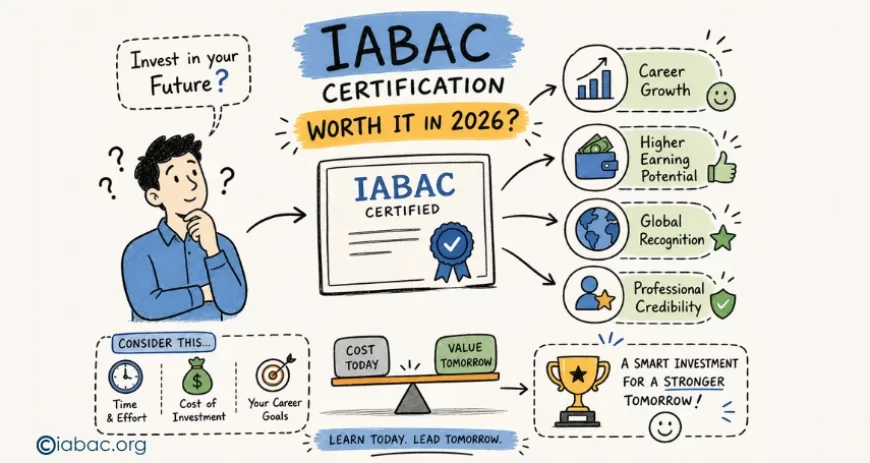
Is IABAC certification worth it in 2026? If you've seen it appear in a job search, a LinkedIn post, or a peer's credentials section, you want a straight answer before committing time and money. This isn't going to be another vague "it depends" piece. The International Association of Business Analytics Certification (IABAC) is a specific credential with a specific structure, and it deserves a specific verdict. This analysis covers what the certification actually costs, who recognizes it, how it stacks up against Google and IBM alternatives, and which professional profile gets the clearest return on investment this year.
The stakes are real. A certification that doesn't move the needle in your target industry is money and months you don't get back. The goal here is to give you enough information to make the call confidently, whether that's enrolling, choosing something else, or building a complementary credential stack.
What actually makes IABAC different from generic online certificates
Most professionals assume IABAC is another platform-issued badge in the vein of Coursera or LinkedIn Learning. That assumption is worth correcting before anything else. IABAC's certifications are structured around the EDISON® Data Science Framework, an EU-linked competency taxonomy developed under European Commission initiatives that defines what data professionals at each level should know and be able to do. That's not a self-defined syllabus built by a company's marketing team; it's an externally anchored standard with roots in the European e-Competence Framework.
The EDISON framework organizes competencies into five core areas: Data Analytics, Data Science Engineering, Domain Knowledge, Data Management, and Scientific or Business Process Methods. It maps to the European e-Competence Framework and defines five proficiency levels, from foundational awareness through to strategic leadership capability. For employers, an IABAC credential maps to a defined, externally auditable skill standard rather than a completion record from a private course catalog.
This is the detail that separates IABAC from vendor-issued credentials like those from Google, AWS, or IBM. Vendor certifications reflect a company's platform preferences and proprietary tool ecosystems. They're useful, but they're not neutral. IABAC's EDISON® alignment gives its credentials a structural backbone tied to European competency standards, a form of external anchoring that many US-based certification providers do not offer. For professionals who work across organizations or need credentials that travel across industries and borders, that distinction matters.
The assessment format reinforces the credential's weight. IABAC uses proctored, identity-verified online exams rather than self-paced completion quizzes. The remote proctoring involves webcam monitoring and identity verification throughout the session, making the process meaningfully different from clicking through multiple-choice questions with unlimited retries. A credential earned through a monitored performance assessment signals competency in a way that passive completion badges simply don't.
Salary impact and career outcomes: what the numbers show
IABAC doesn't publish a proprietary salary outcomes report, so the most honest framing here is market-rate benchmarking by job title. Professionals who complete IABAC certifications typically move into roles such as Business Analyst, Data Scientist, Analytics Manager, HR Data Analyst, Workforce Analyst, and People Analytics Associate. Entry-level salaries for these titles in the US range from approximately $65,000 for HRIS Analyst roles to $72,000 for People Analytics Associates, according to platforms such as Glassdoor and LinkedIn Salary Insights, with meaningful upside as experience accumulates. For formal labor-market projections, see the Bureau of Labor Statistics' data scientist outlook.
Across the broader data science and analytics market, professionals who earn a recognized certification report salary increases in the range of 10 to 20 percent, with the typical outcome landing near 15 percent, a figure consistent with industry surveys from organizations like the Global Knowledge IT Skills and Salary Report. That's not an IABAC-specific guarantee; it's the general market signal for credentialed professionals moving into formalized roles. The certification tends to help at two specific moments: the application stage, where automated screening tools filter for credentials, and the salary negotiation stage, where documented competency justifies a title or compensation upgrade. For additional salary outlook context, see the data scientist salary outlook for 2026.
For mid-career professionals already working in analytics or adjacent fields, the ROI calculation shifts. The certification isn't primarily about landing a first job; it's about converting informal expertise into a verifiable, internationally recognized credential. A hiring manager or salary committee can't audit your past projects, but they can verify an IABAC certification number in seconds. That's the practical value of IABAC certification for someone who already has the skills but lacks the formal documentation.
Employer recognition: how broadly is IABAC accepted in 2026
IABAC reports recognition across 50+ countries, though that figure is self-reported. The more useful question is where IABAC carries meaningful weight in practice. The evidence points clearly toward data science, business analytics, AI and ML roles, finance, healthcare analytics, HR analytics, consulting, and retail operations, sectors where employers explicitly value industry-aligned, internationally benchmarked credentials and where decision-makers need to evaluate applied analytics competency rather than general data literacy. When assessing IABAC certification value in 2026, that sector fit is the most relevant frame. Learn more on the About IABAC page.
IABAC carries less weight in environments where hiring managers default exclusively to cloud vendor certifications from AWS, Azure, or Google Cloud, or in government-regulated roles where licensed professional qualifications are required. That's not a failure of the credential; it's a mismatch of context. Knowing where it fits is part of evaluating whether it fits your specific situation.
The most practical check is a three-step process before you invest. First, scan job postings for your target roles and note which certifications are mentioned or preferred. Second, search for IABAC-certified professionals in your target industry on LinkedIn and reach out to ask about employer reception. Third, if your target employer is large enough to maintain a preferred vendor list or a specified certification body, verify whether IABAC appears on it. That self-directed due diligence gives you a more reliable signal than any certification body's own claims. For more on evaluating options, see Choosing the Right Data Analytics Certification.
IABAC vs. Google, IBM, and Coursera: an honest comparison
Google's data analytics certificates have strong brand recognition among early-career recruiters. The structured, beginner-friendly format makes Google a reasonable choice for professionals entering the field for the first time, and the name carries familiarity in volume hiring environments. IBM's certificates offer solid practical AI and data science lab exercises, with hands-on notebook-based work that builds tool familiarity. Both are legitimate credentials for specific audiences, and acknowledging that directly is more useful than dismissing them to inflate IABAC's standing by comparison.
Where IABAC differentiates itself is in breadth and standardization. Based on published IABAC track syllabi, the curriculum spans Python, SQL, statistics, data visualization with Tableau and Power BI, machine learning from foundational to advanced, deployment, and ethical AI, with some advanced tracks covering tools such as AWS SageMaker and XGBoost. That cross-platform scope is something vendor-specific certifications can't replicate without bias toward their own ecosystem. For professionals who need to demonstrate full analytics fluency across tools and methodologies, IABAC's curriculum covers more professionally relevant ground than a single-vendor credential can.
Coursera is a mixed picture because it's a marketplace, not a single credential. Some Coursera programs from strong universities carry genuine academic rigor. Others are light-touch completions with minimal assessment standards. That variability makes comparison difficult. IABAC's structural advantage over Coursera as a category is consistency: the EDISON® framework provides a coherent competency backbone across IABAC certifications regardless of which partner or track delivers the preparation. Employers trying to interpret what a credential actually means benefit from that standardization in a way that the Coursera catalog doesn't always support. For context on how certificates compare, see Dataquest's analysis of data science certificates.
On cost, Coursera-style pricing typically runs $49 per month or $399 annually. IABAC certifications generally fall in the $1,000 to $3,000 range depending on level, region, and Authorized Training Partner access, treat that as an approximate benchmark rather than a fixed published fee, since pricing varies by partner and geography. That's a meaningful difference, and it belongs in your ROI calculation alongside salary outcomes and recognition factors. For broader job-market context, review the data scientist job outlook for 2025.
Cost breakdown, exam format, and what renewal actually costs you
Cost and ATP options
IABAC certification costs vary by level and region. Indian education platforms list certifications in the ₹15,000 to ₹22,000 range, and international pricing referenced in IABAC's own content places serious career-focused certifications between $1,000 and $3,000. Authorized Training Partner (ATP) programs may reduce direct costs and bundle structured preparation support, though discounts and inclusions vary by partner and region, so it's worth verifying directly with any ATP before you enroll. The relevant comparison for your ROI calculation is total learning investment, not just the exam fee.
Exam format
The exam is fully online and remotely proctored. You need a stable internet connection, a webcam with audio and video enabled, and valid identification for identity verification. Results timelines vary by track, some online assessments return scores immediately after submission, while others may take up to several business days depending on the specific exam format. Check the relevant IABAC track page or your ATP's guidance (see Careers, Certification & Learning) for the exact timeline. The proctored format is a meaningful quality signal: a monitored assessment with identity verification is substantively different from an unmonitored self-paced quiz, and hiring managers evaluating candidates side by side can make that distinction.
Renewal requirements
Renewal is annual and free of charge, but it requires earning 30 CPD (Continuing Professional Development) credits per year. That's a real commitment, not a box-checking exercise. Read it in both directions: as an ongoing obligation that requires active effort, and as a signal to hiring managers that IABAC-certified professionals are held to a continuing competency standard. An IABAC credential from 2026, renewed in 2027 and 2028, signals active professional development, not a one-time badge that's been sitting untouched on a résumé. That's a strategic implication worth factoring in over a five-year career horizon.
Who should get IABAC certified in 2026
The ROI is clearest for mid-level professionals who want to formalize skills they already use on the job. If you're a working data analyst, business analyst, or ML practitioner who lacks a structured, internationally recognized credential, IABAC converts demonstrated competency into a verifiable professional designation. The EDISON® framework alignment means your credential maps to a defined global standard, which matters for career portability across organizations and geographies.
Domain specialists in finance, healthcare, HR, marketing, or retail analytics represent another strong-fit profile. IABAC offers vertical-specific certifications that validate applied expertise in a candidate's actual industry, not just generic data literacy. A healthcare analytics credential or an HR analytics certification signals role-contextualized competency that a general data science certificate doesn't convey, and for professionals in those verticals, that specificity is a direct advantage in hiring conversations. IABAC alumni in domain-specific roles frequently cite that contextual alignment as the credential's most practical differentiator.
Early-career candidates who want a rigorous, project-backed qualification that goes beyond a course completion badge are also well-served by IABAC, particularly when they pair the certification with a strong portfolio. The capstone and project emphasis within IABAC's curriculum supports portfolio development in a way that passive completion programs don't, giving early-career candidates something concrete to show alongside the credential itself.
IABAC is a weaker fit for absolute beginners who need a structured, guided ramp-up from zero. Google's data analytics certificate is the more appropriate starting point for someone with no analytics background, more accessible, more scaffolded for beginners, and more familiar to entry-level recruiters at high-volume employers. IABAC can follow as a more advanced, internationally benchmarked credential once the foundation is in place. Similarly, if your target employer is a cloud-first tech company where AWS, Azure, or GCP certifications are the de facto currency, lead with the vendor credential. IABAC complements those credentials at the next level; it doesn't replace them in that specific context.
The verdict: is IABAC certification worth it in 2026
For the right professional profile, yes, IABAC certification is worth it in 2026. The EDISON® framework alignment is the structural advantage that justifies the investment over cheaper, unstructured alternatives. The proctored assessment format, multi-tool curriculum breadth, domain-specific specializations, and free annual renewal combine to make it a substantively credible credential for analytics and data science professionals who need documented, internationally benchmarked competency.
The clearest fit is the mid-career professional converting real-world expertise into a verifiable, portable designation, someone whose skills are already there but whose credentials haven't caught up. Domain specialists and early-career candidates with portfolio ambitions round out the strong-fit profile. If you're starting from zero or targeting cloud-first employers, begin with the credential your target market already recognizes, then build toward IABAC as your career advances.
If you fit that profile, explore IABAC's certification catalog at iabac.org and identify the specialization aligned to your domain. Work backward from your target job postings: note the credentials they mention, map your skill gaps to the relevant IABAC pathway, and build from there. The EDISON® framework and the accredited AI and data science certification structure already exist. The question is whether you're ready to put them to work.