





















































Why Are AI Models Important?
Why are AI models important? Discover how AI is transforming business, healthcare, education, and creativity in everyday life.

Let's be honest. A couple of years ago, most people had never heard of a "large language model." Today, they're arguing over which one writes better emails. That's how fast things have moved.
AI models from ChatGPT to Gemini to Claude are no longer science fiction or corporate Popular terms. They're showing up in hospitals, classrooms, law firms, small businesses, and on your smartphone. But here's the question that actually matters: why are AI models important, and what does that really mean for you?
This guide breaks it all down in plain language, no jargon. Whether you're a student, a business owner, a curious professional, or just someone trying to understand what all the fuss is about, this article is for you.
What Exactly Is an AI Model?
Before we talk about why they matter, a quick, simple answer to what they are.
An AI model is a computer program trained on enormous amounts of data — text, images, code, audio — to recognize patterns and generate responses. Think of it like a very sophisticated autocomplete that's read millions of books, articles, and conversations.
The most well-known type right now is the large language model (LLM) — the kind that powers ChatGPT (OpenAI), Gemini (Google), Claude (Anthropic), Llama (Meta), and others. These models can hold conversations, write essays, debug code, analyze legal documents, and much more.
But AI models go beyond text. There are also:
-
Image generation models like DALL-E and Midjourney
-
Code models like GitHub Copilot
-
Medical AI models used for diagnosing diseases from scans
-
Forecasting models used in finance and logistics
-
Open-source models like Mistral and LLaMA that anyone can build on
Now, with that foundation set — let's get into the real question.
Why Are AI Models Important?
Here's the short answer: AI models are important because they dramatically expand what's possible — for individuals, businesses, and society as a whole.
They allow one person to do the work of five. They allow a small clinic to offer diagnostic support that previously required a team of specialists. They give a student in a rural area access to the kind of personalized tutoring that used to cost thousands of dollars per hour.
To put it in numbers: AI model usage in cloud environments jumped from 56% of organizations in 2024 to 84% in 2025. Global spending on generative AI is projected to hit $644 billion in 2025 alone. This isn't a passing trend — it's a structural shift.
Let's look at what that shift actually looks like, sector by sector.
6 Reasons AI Models Are Transforming the World Right Now
1. They Make Businesses Significantly More Productive
If you work in any kind of knowledge-based job, AI models are already affecting your industry — or they will be soon.
Employees using AI tools report an average 40% productivity boost, with some studies showing 25–55% improvements depending on the type of work. Sales professionals using AI are 47% more productive and save roughly 12 hours a week. That's not a minor edge — that's a competitive transformation.
Real-world example: A marketing team that used to spend three days producing a campaign brief can now produce a polished draft in a few hours using an AI model, then spend their time on strategy, creativity, and client relationships instead.
McKinsey estimates that AI could add $2.6 to $4.4 trillion in annual economic value globally — most of it from customer operations, marketing, software engineering, and R&D.
That said, the results aren't automatic. Companies that layer AI onto old workflows see modest gains. Those that redesign how they work around AI capabilities? They see compounding advantages. The lesson: the tool matters, but the strategy matters more.
2. They're Revolutionizing Healthcare
This one arguably matters most. AI models are having a direct impact on human health outcomes — and that's not an exaggeration.
Here's what's happening in hospitals and clinics right now:
-
AI models analyze patient data to identify candidates for clinical trials faster and more accurately than human reviewers alone
-
Diagnostic AI can detect polyps in colonoscopy images, interpret EKG results, and flag anomalies in CT scans
-
Models like IBM's Watson for Oncology help oncologists personalize cancer treatment plans based on a patient's specific data
-
Remote monitoring tools powered by AI can track vital signs and alert clinicians before a crisis develops
-
AI helps reduce physician burnout by handling documentation — converting patient-clinician conversations into structured clinical notes automatically
For patients in underserved or remote areas, AI-powered virtual consultations are reducing the barriers to care that geography and cost once created.
Importantly, researchers and ethicists are clear that these tools work best as aids to clinicians, not replacements. The human judgment of a doctor remains essential. But when paired with the right AI support, that doctor can do more, catch more, and serve more patients.
3. They're Making Education More Personal and Accessible
Here's something that would've seemed impossible a decade ago: a student in a small town can now have an on-demand AI tutor that adapts to their learning pace, explains concepts multiple ways, gives instant feedback, and never gets impatient.
60% of K-12 teachers used AI tools during the 2024–2025 school year. AI models are being used to:
-
Adapt course content to individual learning styles
-
Identify gaps in student understanding early
-
Reduce the administrative burden on teachers (grading, lesson planning, communications)
-
Help medical and professional schools design up-to-date curricula
Beyond school, AI models are democratizing access to expertise. You don't need to pay a lawyer for a first-pass review of a contract, or spend hours searching for answers to complex tax questions. You can ask an AI model, get a useful starting point, and then decide when you need a professional.
This doesn't replace expertise — it lowers the barrier to accessing it.
4. They Enable Creators to Do More, Faster
Writers, designers, developers, musicians — AI models are becoming creative collaborators for people across every creative field.
A novelist can use an AI model to overcome writer's block, develop character backstories, or research historical settings. A graphic designer can use image generation models to rapidly prototype visual concepts before committing to final production. A solo developer can use AI coding assistants to write boilerplate, catch bugs, and document their code — effectively giving themselves a junior developer on demand.
This matters because it removes friction. The distance between "I have an idea" and "I made a thing" gets shorter. And that unlocks creativity in people who previously couldn't act on their ideas due to lack of technical skills, time, or resources.
5. They Help Tackle Problems at a Scale Humans Can't Alone
Some of the world's most complex challenges involve data at a scale that is simply beyond what human teams can process — climate modeling, drug discovery, materials science, financial risk, supply chain optimization.
AI models are uniquely suited to these problems. Consider:
-
Drug discovery: AI models can analyze molecular structures and predict how compounds will interact with proteins, dramatically compressing timelines for identifying drug candidates
-
Climate modeling: AI-powered weather forecasting, like WindBorne's WeatherMesh model, is producing high-resolution predictions faster and with greater accuracy than traditional physics-based methods
-
Scientific research: AI models like AlphaFold changed biology by solving the protein folding problem — a 50-year grand challenge in the field, solved in months once the model was trained
These breakthroughs are why the Nobel Prize committee recognized AI-related work in both physics and chemistry in recent years. The impact is real, documented, and peer-reviewed.
6. They're Powering a New Wave of Automation for Small Businesses
It's easy to think AI models are mostly for big tech companies. The reality is that they're leveling the playing field for small and medium-sized businesses in a way that's genuinely exciting.
53% of small business owners report noticeable improvements in customer experience after implementing AI solutions. With AI models, a small business can now:
-
Run 24/7 customer support without hiring a full-time team
-
Generate marketing copy, product descriptions, and social media content
-
Analyze sales data and identify trends without a data analyst
-
Automate email responses, appointment scheduling, and follow-ups
This is access to capabilities that once required enterprise-scale budgets. That's a meaningful shift in who gets to compete.
A Quick Look at the Major AI Models in 2025
Not all AI models are the same. Here's a simple overview of the major players and what they're known for:
|
AI Model |
Created By |
Best Known For |
|
ChatGPT |
OpenAI |
Versatile assistant; multimodal (text, images, voice, code); custom GPT building |
|
Claude |
Anthropic |
Accuracy, safety, long document analysis, compliance-focused tasks |
|
Gemini |
|
Deep Google ecosystem integration, multimodal capabilities, real-time search |
|
Llama |
Meta |
Open-source foundation; widely used for custom enterprise deployments |
|
Mistral |
Mistral AI |
Lightweight, efficient open-source alternative; strong at coding |
|
Copilot |
Microsoft |
Embedded in Office 365 and developer tools; workplace productivity |
Each of these models reflects a different design philosophy and set of strengths. The right model for you depends on your use case, your privacy requirements, and how you're integrating AI into your workflow.
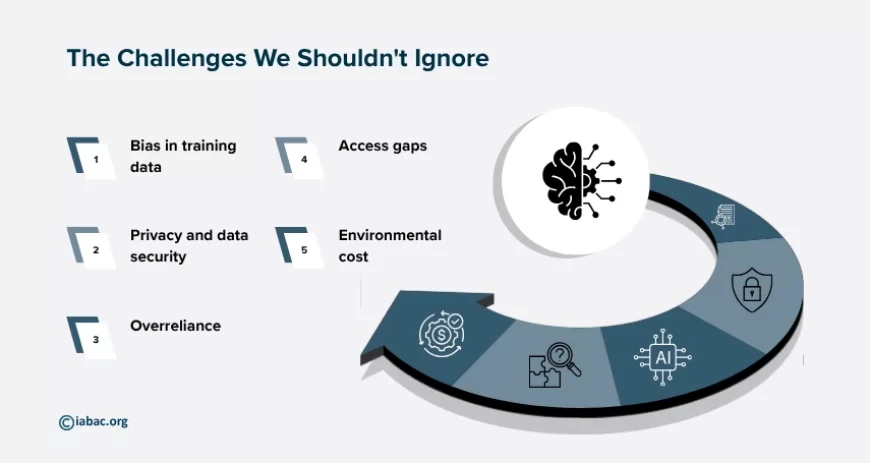
The Challenges We Shouldn't Ignore
A clear-eyed look at why AI models are important also means being honest about the challenges. This isn't about fear — it's about using these tools responsibly.
Bias in training data. AI models learn from human-generated data, which means they can absorb and reproduce human biases. This is a serious concern in hiring, lending, and healthcare contexts.
Privacy and data security. Many AI models require access to sensitive data to be most useful. How that data is handled, stored, and protected is a critical governance issue.
Overreliance. There's a real risk of becoming dependent on AI outputs without maintaining the human judgment needed to evaluate them. AI models make mistakes — sometimes confidently. Blind trust is dangerous.
Access gaps. Not everyone has equal access to these tools. If AI advantages compound over time, they could widen existing inequalities rather than reduce them.
Environmental cost. Training large AI models requires enormous compute resources. The energy consumption of this industry is a genuine environmental consideration.
These challenges don't make AI models less important — they make thoughtful use of them more important.
What the Future of AI Models Looks Like
We're still in the early innings. The capabilities of AI models are improving rapidly — training compute is doubling approximately every five months, and the gap between the top models and the rest is narrowing, meaning more options at higher quality.
A few directions worth watching:
-
Agentic AI: Models that don't just respond to prompts but autonomously plan and execute multi-step tasks. 23% of businesses are already scaling AI agents.
-
Multimodal models: AI that seamlessly handles text, images, audio, and video in a single workflow.
-
Smaller, specialized models: Instead of one giant model for everything, we're seeing purpose-built models that are more efficient and easier to deploy in specific industries.
-
Open-source growth: The open-source AI ecosystem is maturing fast, giving developers and researchers the ability to build, customize, and audit models independently.
By 2035, experts project that AI adoption could lift productivity in developed economies by over 40%.
So, why are AI models important? Because they change the ratio of what's possible to what's difficult.
They give a solo creator the leverage of a team. They give a small clinic access to specialist-level diagnostic support. They give a student a tutor that's always available. They give a researcher tools to accelerate discovery. And they give businesses the ability to operate faster and smarter than ever before.
That doesn't mean everything is solved, or that there aren't serious questions to work through. But the trajectory is clear: AI models are becoming foundational infrastructure — like electricity or the internet — something that touches virtually every aspect of how we work, learn, create, and communicate.
The question isn't really whether AI models matter. The question is how to engage with them thoughtfully, strategically, and with clear eyes about both their power and their limits.
Start small. Stay curious. And don't let the hype — in either direction — distract you from actually using these tools to solve real problems.