



























































10 AI Automation Examples That Save Time and Money?
AI automation examples businesses use to save time and reduce costs. Learn how AI improves customer support, marketing, finance, and workflow efficiency.


Many businesses spend a large part of their day handling repetitive tasks. Customer queries, invoice processing, email management, document reviews, and data analysis often require significant manual effort. While these tasks are necessary, they can slow down productivity and increase operational costs when handled entirely by human teams.
AI automation offers a practical solution. By combining artificial intelligence with workflow automation, businesses can reduce manual work and allow teams to focus on tasks that require human thinking and creativity. AI systems can analyze data, understand requests, and complete routine processes much faster than traditional methods.
Companies across industries are already using AI to simplify everyday operations. From customer service chatbots to automated financial processing, AI is helping organizations improve efficiency and manage workloads more effectively. Many organizations also work with AI consulting experts to identify the best automation opportunities and implement AI-driven workflows successfully.
Below are ten real examples of how businesses are using AI automation to save time and reduce costs.
What Is AI Automation in Business?
AI automation refers to the use of artificial intelligence to handle tasks that normally require human effort. Unlike traditional automation, which follows fixed rules, AI systems can analyze data, recognize patterns, and make decisions based on the information they process.
In a business environment, AI automation is often used to manage repetitive processes such as responding to customer inquiries, sorting emails, processing documents, or analyzing large sets of data. Instead of employees performing these tasks manually, AI tools can complete them faster and with fewer errors.
For example, a customer support chatbot can answer common questions instantly, while an AI-powered system can scan invoices and extract important information for accounting teams. By automating routine work, businesses can improve efficiency and allow employees to focus on more strategic tasks that require human judgment and creativity.
Why Businesses Are Investing in AI Automation
Businesses are always looking for ways to improve efficiency and reduce operational costs. Many everyday tasks such as responding to customer inquiries, managing emails, processing invoices, and analyzing data can take a significant amount of time when handled manually. AI automation helps companies manage these tasks more efficiently.
By using AI-powered tools, organizations can automate repetitive processes and allow employees to focus on higher-value work. This not only improves productivity but also reduces the chances of human error in routine operations.
Another reason companies are adopting AI automation is scalability. As businesses grow, manual processes become harder to manage. AI systems can handle larger workloads without increasing operational complexity.
Because of these benefits, companies across industries are using AI automation to streamline workflows, improve decision-making, and deliver better customer experiences.
10 AI Automation Examples That Save Time and Money
1. AI Customer Support Chatbots
Customer support teams receive many repetitive questions every day. Customers frequently ask about product details, order status, delivery timelines, or refund policies. Handling these requests manually can quickly overwhelm support staff.
AI chatbots help businesses manage these interactions more efficiently. These systems can understand customer questions and provide immediate responses. They can be integrated into websites, mobile apps, and messaging platforms to offer assistance at any time.
For example, when a customer asks about the delivery status of an order, an AI chatbot can retrieve the information from the system and provide an instant response. If the request is more complex, the chatbot can transfer the conversation to a human agent.
This approach reduces response time and allows customer support teams to focus on more complex issues.
2. AI Email Response Automation
Email management is another time-consuming task for many businesses. Teams often receive hundreds of emails daily, including customer inquiries, internal communication, and service requests.
AI email automation tools can analyze incoming messages, categorize them, and suggest appropriate responses. Some systems can even generate automatic replies for common requests.
For instance, if a customer sends an email asking for pricing details, the AI system can recognize the request and send the relevant information automatically. Emails that require human attention can be routed to the appropriate department.
This reduces the time employees spend sorting and replying to emails while improving communication efficiency.
3. AI Invoice Processing
Finance teams often spend considerable time reviewing invoices, entering data into accounting systems, and verifying financial records. This manual process can be slow and prone to errors.
AI automation tools can scan invoices, extract important information such as vendor names, payment amounts, and due dates, and automatically transfer the data into accounting systems.
For example, when a new invoice arrives, the AI system reads the document, identifies key details, and updates the company’s financial records without manual input.
This significantly reduces administrative work and speeds up financial operations.
4. AI Resume Screening
Recruitment teams often receive hundreds of applications for a single job opening. Reviewing each resume manually can be extremely time-consuming.
AI recruitment systems can analyze resumes and identify candidates whose skills and experience match the job requirements. These systems scan applications, evaluate qualifications, and shortlist suitable candidates for further review.
As a result, HR teams spend less time sorting through applications and more time focusing on interviews and candidate engagement.
5. AI Marketing Campaign Automation
Marketing teams manage multiple campaigns across different channels, including email marketing, social media, and digital advertising. AI tools can help automate many of these processes.
AI marketing systems analyze customer behavior and segment audiences based on their interests and interactions. This allows businesses to send personalized messages and targeted offers automatically.
For example, if a customer frequently browses a specific product category, the system can send personalized promotions related to those products.
This improves marketing effectiveness while reducing manual campaign management.
6. AI Lead Scoring and Sales Automation
Sales teams often need to evaluate large numbers of potential leads. Determining which leads are most likely to convert can be challenging.
AI lead scoring systems analyze customer data, website activity, and engagement history to determine which prospects show strong purchase intent.
High-quality leads can then be prioritized for follow-up by sales representatives. This helps sales teams focus their efforts on the most promising opportunities.
7. AI Document Processing
Many organizations handle large volumes of documents, including contracts, forms, and reports. Reviewing these documents manually can take significant time.
AI document processing systems can read documents, extract relevant information, and organize data automatically.
For example, insurance companies use AI to review claims documents and extract policy information quickly. This speeds up processing and improves operational efficiency.
8. AI Fraud Detection
Financial institutions and online platforms must constantly monitor transactions to prevent fraudulent activities.
AI fraud detection systems analyze transaction patterns and identify unusual behavior that may indicate fraud. These systems evaluate factors such as transaction location, spending patterns, and account activity.
If suspicious activity is detected, the system can trigger alerts or temporarily block transactions until verification is completed.
9. AI Predictive Maintenance
Manufacturing companies rely on equipment and machinery to maintain production. Unexpected equipment failures can lead to costly downtime.
AI predictive maintenance systems monitor machine performance using sensors and historical data. By analyzing patterns, AI can predict when equipment is likely to fail.
Maintenance teams can then schedule repairs before problems occur, preventing disruptions in production.
10. AI Content Generation
Content creation is essential for marketing, customer communication, and internal reporting. AI tools can help generate various types of content quickly.
Businesses use AI to create product descriptions, summarize reports, and draft marketing materials. These systems analyze available data and generate written content automatically.
While human review is still important, AI tools significantly reduce the time required to produce large volumes of content.
Benefits of AI Automation for Businesses
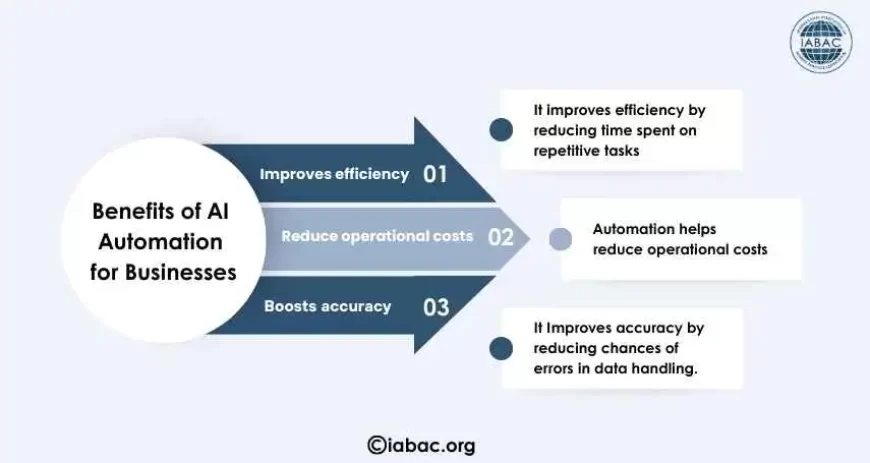
AI automation provides several advantages for organizations across industries.
First, it improves efficiency by reducing time spent on repetitive tasks. Employees can focus on activities that require problem-solving and creativity.
Second, automation helps reduce operational costs. When routine processes are automated, businesses require fewer resources to complete them.
Third, AI improves accuracy. Automated systems follow structured processes, reducing the chances of errors in data handling.
Finally, automation allows businesses to scale operations more easily. As workloads increase, AI systems can handle additional tasks without requiring large increases in staffing.
How Businesses Can Start Using AI Automation
Companies interested in adopting AI automation should begin by identifying repetitive tasks that consume significant time and resources. These tasks are usually the best candidates for automation.
Next, businesses should explore AI tools that match their operational needs. Many automation platforms provide solutions for customer support, marketing, finance, and HR workflows.
However, many organizations find it challenging to select the right technologies and integrate automation into their existing systems. This is where AI consulting services can help. Experienced consultants can analyze business workflows, recommend suitable automation tools, and guide companies through the implementation process.
Starting with small automation projects often allows businesses to see measurable improvements before expanding automation across other areas.
When Businesses Need AI Consulting for Automation
While many AI tools are available today, implementing automation across business processes can be complex. Companies often need guidance to identify the right opportunities, select appropriate technologies, and integrate automation into existing systems.
AI consulting services help businesses evaluate their workflows, design automation strategies, and implement solutions that align with long-term goals. Consultants also help organizations measure the return on investment and ensure that automation initiatives deliver measurable improvements in efficiency and productivity.
For companies planning large-scale automation projects, working with experienced AI consultants can simplify adoption and reduce implementation risks.
AI automation is becoming an important part of modern business operations. By automating routine tasks such as customer support, document processing, marketing campaigns, and financial workflows, organizations can improve efficiency and reduce operational costs.
The examples discussed above show how businesses across different industries are already using AI to streamline everyday processes. As AI technologies continue to evolve, automation will likely become even more integrated into business systems.
Companies that begin exploring AI automation today can create more efficient workflows, improve productivity, and position themselves for long-term growth.