
















































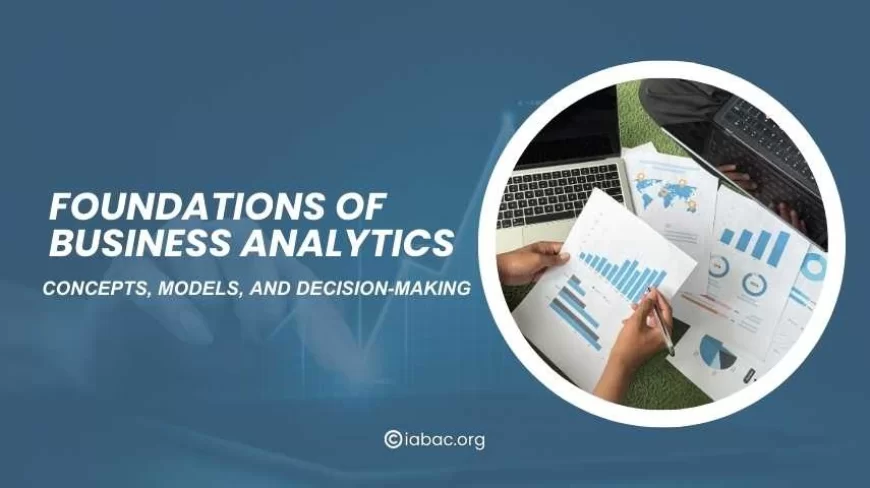
Business analytics is a key capability for organizations that want to succeed in a data-driven world. Every business creates large amounts of data every day—from sales, customers, operations, and digital platforms. Business analytics turns this raw data into clear insights that help leaders make better decisions, improve results, and reduce risks.
This guide explains business analytics in a simple and practical way. It covers what business analytics is, how it works, why it matters, and how it is used in real organizations. It also explains the skills, tools, challenges, and future trends that shape modern business analytics.
What Is Business Analytics?
Business analytics means using data and simple thinking to make better business decisions. It is about collecting information from places like sales, websites, or customer feedback, and then studying that information to find patterns and answers. Instead of guessing, a person uses facts from data to decide what to do next.
Business analytics is not only about hard numbers or machines. It mixes data tools with business sense. For example, seeing many customers cancel subscriptions tells you a problem exists. Analysing churn drivers, pricing, onboarding, and which fixes reduce cancellations is business analytics. The aim is to retain customers, increase lifetime value, and run smarter experiments.
Why Business Analytics Is Important
Today, every business gets a lot of data every day. But data by itself does nothing. Business analytics converts that data into useful ideas. That is why it is important.
When a company uses business analytics well, it can:
-
Find what worked and what did not in the past.
-
Spot problems early and fix them.
-
Predict what might happen in the near future.
-
Make processes faster and cheaper.
-
Improve how customers feel about the brand.
-
Reduce risk when making big decisions.
For students and beginners, this means that learning business analytics gives you a skill that companies want. Employers prefer people who can use data to explain things and suggest steps. If you can do that, you become useful quickly.
Core Components of Business Analytics
Business analytics works through a set of simple steps. Each step is important and leads to the next.
Data collection and integration: First, data is collected from different places. This can be from a company’s website, sales system, or even public sources like weather or market reports. Integration means joining these different data pieces so they can be analyzed together.
Data preparation: Raw data often has mistakes. It can be incomplete, duplicated, or in the wrong format. Preparation involves cleaning the data, fixing errors, and making sure it is ready to use. This step takes a lot of time but is very important.
Data analysis: In this step, we use basic maths, charts, and sometimes models to find patterns. For a beginner, this could be looking at monthly sales and finding which months did better and why.
Visualisation and reporting: We show the important findings using charts or dashboards. A good visual helps managers understand the story quickly and act on it.
Decision support: The final step is using the results to make decisions. This could be a simple change like changing a price, or a bigger plan like launching a new product. Business analytics helps make these choices more confident.
Types of Business Analytics
Business analytics has four main types. Each type answers a different question and uses different methods.
Descriptive analytics: This answers “what happened?” It looks at past data and tells the story. Examples are monthly sales reports or a dashboard showing website traffic.
Diagnostic analytics: This answers “why did it happen?” It digs deeper to find reasons. For example, if sales dropped, diagnostic analytics tries to find if it was because of fewer ads, stock-out, or seasonal decline.
Predictive analytics: This answers “what could happen next?” It uses patterns in past data to forecast future outcomes. For instance, it can predict how many units might sell next month.
Prescriptive analytics: This answers “what should we do?” It recommends actions. For example, it might suggest raising stock for a hot product or offering a discount to clear old inventory.
Together, these types help a business go from knowing the past to taking better actions for the future.
Key Business Analytics Models and Frameworks
Models and frameworks make analytics work easier and repeatable. They give a clear path to follow, especially when projects are big.
Analytics lifecycle model: This shows steps from defining the business problem to delivering results and monitoring them. It helps teams not to miss any stage.
CRISP-DM framework: This is a simple and popular approach that breaks analytics work into phases like business understanding, data understanding, modeling, and deployment. Students often learn CRISP-DM because it is easy to remember.
Decision-making models: These help leaders compare options and understand trade-offs. For example, a decision matrix may show the cost and benefit of two strategies.
Performance measurement models: These are about choosing the right metrics (KPIs) to measure success. For example, customer retention rate or average order value are metrics that show business health.
Using these frameworks keeps the work structured and makes it easier to show results to managers.
Role of Business Analytics in Decision-Making
Business analytics supports decisions at different levels in a company.
Strategic decisions: These are big, long-term choices like entering a new market or launching a new product. Analytics helps by showing market trends and expected returns.
Tactical decisions: These are shorter-term plans, such as changing the sales target for the quarter or planning a marketing campaign. Analytics helps set realistic goals and allocate budget.
Operational decisions: These are day-to-day choices like how much stock to order today or which customers to contact. Real-time dashboards and alerts help in such decisions.
When analytics is used at all levels, decisions are consistent and backed by data. This reduces waste and increases the chance of success.
Key Skills Behind Business Analytics
Business analytics needs a mix of technical and soft skills. As a student, you should focus on building both.
Analytical thinking: This means thinking clearly about problems and finding logical ways to solve them. It helps you ask the right questions.
Data understanding: You should know how to read a dataset, spot errors, and understand what a number means in business terms.
Basic statistics: This helps you understand averages, trends, and how likely things are to happen.
Business knowledge: Knowing how businesses work—like how sales, finance, and supply chain function—helps you make useful suggestions.
Problem-solving: This skill helps you move from a data problem to a business solution.
Communication and storytelling: Data on a sheet is useless unless you can explain it simply. You should learn to present insights in clear words and visuals.
These skills together let you turn raw data into useful actions that managers can trust.
Business Analytics vs Related Fields
The world of data has many roles, and they sometimes look similar. Here is how business analytics differs from related fields in simple words.
Business analytics vs data analytics: Data analytics often focuses on technical tasks like cleaning data and doing calculations. Business analytics focuses more on using those results to make business decisions.
Business analytics vs data science: Data science is more focused on building complex models and algorithms. Business analytics uses models too, but its main goal is to apply the results to business problems.
Business analytics vs business intelligence: Business intelligence (BI) is about reporting and dashboards that show the current status. Business analytics goes a step further—predicting the future and suggesting actions.
Knowing these differences helps students choose which path to follow, depending on what they like: coding and models versus business strategy and decisions.
Challenges in Business Analytics
Many companies face real problems when they try to use analytics. Knowing these helps you prepare.
Poor data quality: If the data has errors, insights will be wrong. Fixing data quality is often the first job.
Data silos: Different teams may keep data in separate places. Integrating such data is hard but necessary.
Lack of skills: Many companies need people who can both analyse data and understand business. This skill gap is a big challenge.
Weak analytics culture: If leaders do not trust data or fail to act on insights, analytics work has little impact.
Misalignment with business goals: Sometimes analytics teams focus on fancy models instead of practical business needs. This wastes time.
Resistance to change: Staff may resist changing old ways of working even when data suggests a better method.
Being aware of these challenges helps students learn not only tools but also how to work with people and processes.
Ethical Considerations in Business Analytics
Working with data needs care. Ethics are about doing the right thing with data and models.
Privacy and consent: Always respect people’s privacy. Use data only when you have the right permission. For students building projects, anonymise personal data.
Fair use of data: Avoid using data in ways that harm people. For example, do not use loan history to unfairly exclude a group of people.
Bias in analysis: Models can be biased if the data itself is biased. Check your models for unfair outcomes.
Transparency: Be clear about how you made a decision. Managers should understand what a model does and what its limits are.
Responsible use: Use analytics to make fair and helpful business choices. Unethical use can harm customers and the company’s reputation.
Learning ethical practices early makes you a trusted analyst in future jobs.
Business Analytics in the Modern Enterprise
Business analytics is not just a single team’s job. It is used across many departments.
Marketing and sales: Analytics helps in targeting customers, measuring campaign success, and finding the best channels to sell.
Finance and accounting: Analysts use data to track budgets, find cost leaks, and forecast cash flow.
Operations and supply chain: Analytics helps schedule production, manage inventory, and reduce delays.
Human resources: Analytics is used for hiring, measuring employee performance, and reducing attrition.
Customer experience: By analysing feedback and support logs, companies improve service and product design.
Strategy and leadership: Executives use analytics to set long-term priorities and measure progress.
In small companies, one person or team may handle many of these areas. In larger firms, there will be specialised analytics teams for each function.