



























































Best Tools Learned in a Business Analyst Qualification
Learn the essential tools taught in a Business Analyst Qualification, like practical techniques and software skills that help strengthen real-world analysis.


A Business Analyst Qualification introduces learners to basic tools, structured plans, and practical techniques that support clear decision-making in organisations. Whether someone is starting their career in business analytics or shifting from another field, the tools taught in this qualification help them quickly understand data, identify problems, and recommend solutions with confidence. This guide walks through essential tools in a simple, connected flow so that readers can understand how each tool improves business analysis skills.
Throughout the course, learners also gain exposure to industry-recognised standards, project methods, and communication practices. While different training providers may vary in teaching styles, the foundation remains the same: learning tools that help analysts gather requirements, study processes, work with data, and communicate insights that support business improvement. This structured development is what makes a Business Analyst Qualification valuable from beginners to skilled professionals like Managers.
1. Requirement Gathering Tools
Requirement gathering is one of the first skills highlighted in any Business Analyst Qualification. Businesses often struggle because teams misunderstand what needs to be built or improved. Learning the right tools helps analysts ask better questions and prevent confusion later.
Common Tools and Techniques
- Interviews: Direct conversations with customers to understand needs and expectations.
- Workshops: Group discussions that bring different departments together to discuss goals.
- Surveys and Forms: Helpful for collecting input from many people at once.
- Observation: Studying how people work to find hidden problems or inefficiency.
- Document Analysis: Reviewing existing reports, manuals, and policies to identify gaps.
These tools help analysts describe problems clearly, avoid miscommunication, and form a complete picture before suggesting solutions. Many learners join Business Analyst Certifications later to strengthen these skills with practical case studies.
2. Process Mapping and Workflow Tools
Analysts must be able to explain how things currently work inside an organisation. A Business Analyst Qualification includes tools that help visualise processes in a simple and structured way.
Tools You Learn
- Flowcharts: Used to map step-by-step activities in a process.
- Business Process Model and Notation (BPMN): A standard method for creating detailed process diagrams.
- Swimlane Diagrams: These help show how different teams interact during a process.
- Value Stream Mapping: Useful for identifying delays, waste, and bottlenecks.
Learning these tools helps students identify inefficiencies, understand delays, and propose improvements that save time and cost. Even large companies like Google and Microsoft depend on strong process mapping to streamline operations.
3. Data Analysis and Spreadsheet Tools
Data skills are a major part of the Business Analyst Qualification, especially as organisations rely heavily on data for decisions. Students learn how to use spreadsheets, basic formulas, and simple analytical functions.
Key Spreadsheet Skills
- Sorting and filtering large datasets
- Formulas such as SUM, IF, and VLOOKUP
- Pivot tables for pattern identification
- Basic charts and graphs
- Conditional formatting to highlight important values
These spreadsheet tools help analysts understand trends, compare numbers, and support decisions with evidence. While the work may get more advanced in real business environments, the foundation from this qualification prepares students to handle typical data tasks with ease.
4. Data Visualisation Tools
Being able to explain findings clearly is as important as analysing data. A Business Analyst Qualification introduces visualisation tools that help convert data into easy-to-understand visuals.
Common Tools Introduced
- Microsoft Excel Charts: Bar graphs, line charts, pie charts, and combo charts.
- Google Data Studio: Commonly used for interactive dashboards and simple reporting.
- Basic diagramming tools: To present business ideas, comparisons, and summaries.
Students learn to choose visuals that match the data, reduce distractions, and communicate clearly so that decision-makers understand the message in seconds. This skill becomes essential when presenting to managers or clients.
5. Project and Task Management Tools
Projects often fail because tasks are unclear or progress is not tracked well. That is why task-management tools are a part of the Business Analyst Qualification.
Tools Usually Covered
- Kanban Boards: Help track to-do, ongoing, and completed tasks.
- Gantt Charts: Useful for planning a project timeline.
- Requirement Traceability Matrix (RTM): Helps track how each requirement is being met throughout the project.
- Backlog Tracking: Ensures that planned improvements are prioritised properly.
These tools help analysts manage work in a structured manner and maintain smooth communication between departments such as IT, operations, and management.
6. Documentation and Reporting Tools
Analysts prepare many documents, such as requirement documents, change requests, functional specifications, and reports. A Business Analyst Qualification helps students learn how to structure documents professionally.
Key Documentation Tools
- Microsoft Word: For requirement documents and reports.
- Microsoft PowerPoint: For presentations to stakeholders.
- Shared document systems: To maintain updated files and revisions.
Students also learn how to write clearly, present facts, define project goals, and summarise findings in a way that everyone understands.
7. Communication and Collaboration Tools
A major challenge for many beginners is communicating their ideas effectively. The qualification includes tools and techniques that improve coordination with project teams and customers.
Tools and Skills Built
- Email communication standards
- Presentation skills
- Meeting note templates
- Basic stakeholder-engagement strategies
- Collaboration platforms for sharing files and updates
These tools help analysts work smoothly with technical teams, leadership groups, and customers. Strong communication is often what separates a good analyst from an average one.
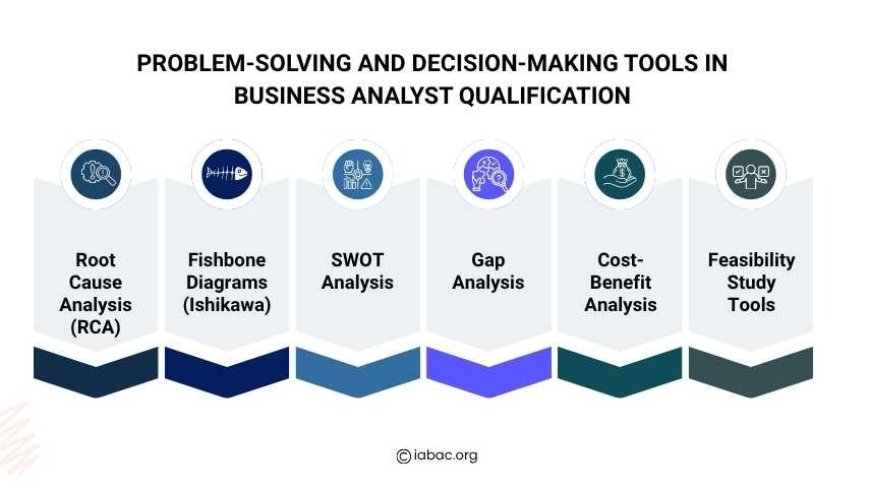
8. Problem-Solving and Decision-Making Tools
Businesses often need clear, logical reasoning to solve issues. A Business Analyst Qualification introduces classic structures that help students break down problems and evaluate options.
Popular Tools Learned
- Root Cause Analysis (RCA)
- Fishbone Diagrams (Ishikawa)
- SWOT Analysis
- Gap Analysis
- Cost-Benefit Analysis
- Feasibility Study Tools
These tools help students think structurally instead of guessing solutions. Once students understand these models, they can apply them in many real-world situations.
9. Modelling Tools for Requirements and Systems
Some Business Analyst roles involve working closely with technical teams. A Business Analyst Qualification briefly introduces tools that help in structuring system requirements.
Common Modelling Tools
- Use Case Diagrams
- Entity-Relationship Diagrams (ERDs)
- Data Flow Diagrams (DFDs)
- Unified Modeling Language (UML) basics
These diagrams help teams understand user roles, data structures, and system behaviour.
10. Tools That Build Professional Confidence
Along with technical skills, a Business Analyst Qualification also builds competencies related to professionalism. These include time management, documenting assumptions, balancing conflicting requirements, and presenting insights using simple, clear visuals.
Learners also understand how tools integrate during a typical project. For example:
- Process maps help identify what needs improvement.
- Requirement tools help define what needs to change.
- Data tools help validate the impact of the change.
- Project tools help implement the change.
- Reporting tools help communicate the final result.
This step-by-step development builds confidence and prepares learners for real projects.
The Role of IABAC and Industry-Recognised Certifications
While the focus of this article is on the essential tools within a Business Analyst Qualification, many learners eventually move toward Business Analyst Certifications to strengthen their credibility. IABAC, as a global certification body, supports candidates through structured assessments and skill-development pathways. Through IABAC Authorized Training Provider (ATP) service partners, learners gain guided support, training resources, and exam preparation assistance that help them apply what they learned in real roles.
The goal is not just completing a course but ensuring that learners gain practical skills that support long-term career growth. With recognised certifications, candidates stand out to employers and feel more confident stepping into business analysis roles.
A Business Analyst Qualification equips learners with a balanced mix of analytical, technical, and communication tools. These tools help them study business problems, understand stakeholder needs, analyse data, and guide decision-making with clarity. Whether someone is preparing for entry-level roles or planning a career shift, these foundational tools strengthen their ability to work across departments and contribute meaningfully.
If you’re planning to deepen your skills further, recognised learning pathways create opportunities for faster professional growth. Start your journey with IABAC today and take the next step toward building strong business analysis capabilities.