























































Business Analytics for Everyone – Learn It the Easy Way?
Learn how business analytics transforms supply chains, driving efficiency, reducing costs, and improving decision-making for smarter operations.


Every day, people create data without even thinking about it. Each online search, product purchase, message sent, and form filled stores information. This information grows at a very fast pace. On its own, this data does not mean much. But when it is studied carefully, it becomes useful. This is where business analytics plays an important role.
What Is Business Analytics?
Business analytics is the process of studying data to understand patterns, trends, and results, helping companies make better decisions. It uses numbers, charts, reports, and tools to answer important business problems. Instead of guessing what might work, companies use real information to plan their next steps.
Think of business analytics certification as a guide. It shows where a business is right now, what happened in the past, and what might happen next. This helps leaders choose the right direction for future action.
Today, almost every industry uses analytics: retail, healthcare, banking, education, marketing, transport, and many more. From small local businesses to large global companies, data is now part of daily planning and strategy.
Understanding Business Analytics in Simple Words
Let’s break it down into simple terms.
Business Analytics uses:
- Past data
- Present data
- Statistical methods
- Software tools
It turns this into:
- Reports
- Predictions
- Suggestions for action
This process helps businesses answer questions like:
- Why did sales go up or go down?
- What products are people buying the most?
- Which marketing campaign worked better?
- When should more stock be ordered?
- Which customers are most likely to return?
Business analytics is not only for analysts. It helps managers, marketers, finance teams, and even customer support departments understand what is happening and what should be done next.
Business Analytics vs Business Intelligence vs Data Science
These three terms are often used together, but they have different purposes.

Business Intelligence (BI) mainly focuses on reports and dashboards. It shows what has already happened. It answers questions such as:
- What were last month’s sales?
- How many customers visited the website?
- Which product had the highest revenue?
Business Analytics (BA) goes one step ahead. It tries to explain why something happened and what to do next. It answers questions like
- Why did sales drop in one region?
- What can be done to increase customer engagement?
- How can costs be reduced next quarter?
Data science focuses more on building models and writing complex algorithms. It often involves advanced programming and large datasets. Data scientists develop systems that can automatically predict or classify information.
In simple words:
- BI = What happened
- BA = Why it happened and what to do
- Data Science = How to build smart systems using data
All three work together to help businesses make better plans and improve performance.
Why Business Analytics Is Important
Business analytics has become an essential part of modern companies. It offers several strong benefits:
1. Better Decision-Making
Instead of relying on opinions, businesses use real facts. This leads to smarter and clearer decisions. Leaders can support their ideas with proof from data.
2. Higher Efficiency
Analytics helps companies find slow or wasteful processes. Once identified, these can be improved or removed. This saves time and resources.
3. Profit Improvement
With better planning and customer insight, companies can increase revenue. They can offer what customers actually want and reduce unnecessary spending.
4. Cost Control
By tracking expenses and performance, analytics helps identify areas where money is being wasted. Making small improvements can result in large savings over time.
5. Stronger Customer Understanding
Companies learn more about customer behavior, likes, dislikes, and habits. This helps in creating better products, better services, and more personal communication.
6. Staying Ahead of Competitors
Organizations that use data wisely respond faster to changes in the market. This gives them an advantage over businesses that still depend only on guesswork.
Business analytics improves planning, saves money, and leads to smarter growth.
Types of Business Analytics
There are four main types of business analytics. Each one answers a different kind of question.
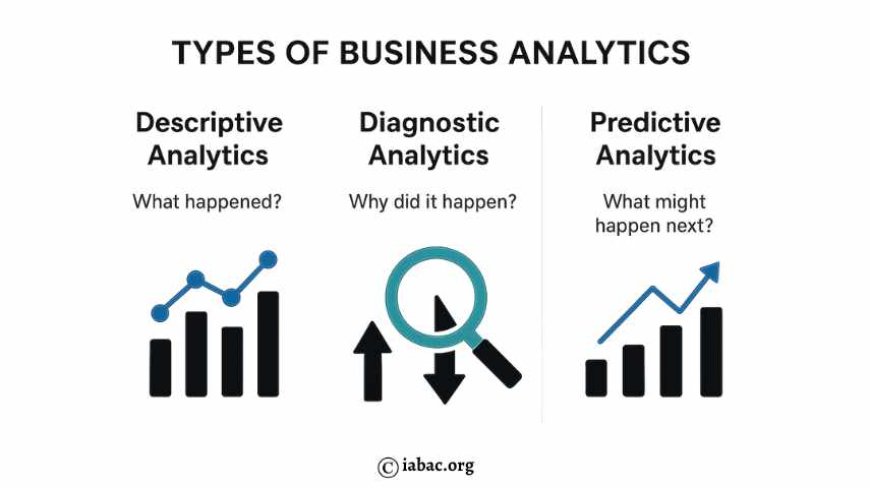
1. Descriptive Analytics – What happened?
This type looks at past data. It organizes and presents it in charts, tables, and reports.
Example:
- Monthly sales reports
- Yearly profit charts
- Website traffic summary
It helps businesses understand their past performance.
2. Diagnostic Analytics – Why did it happen?
This type focuses on the reason behind the results.
Example:
- Why did sales fall last month?
- Why did customer complaints increase?
It studies patterns and connections in data to find causes.
3. Predictive Analytics – What might happen next?
This type uses past data to estimate future outcomes.
Example:
- Predicting future sales
- Estimating customer demand
- Forecasting stock requirements
It helps businesses prepare for future events.
4. Prescriptive Analytics – What should we do?
This type suggests what actions to take.
Example:
- Increase advertising in specific regions
- Offer discount programs to selected customers
- Change product pricing strategies
It provides recommendations to improve results.
By using all four types together, businesses get a full view of past, present, and future actions. These concepts are part of the foundations of business analytics that guide how organizations interpret and act on data
Uses of Business Analytics
Business analytics is part of many services people use every day.
E-commerce
Online stores study customer browsing and purchase data to suggest related products and improve the shopping experience.
Streaming Platforms
Entertainment platforms analyze what users watch to recommend shows and movies according to interest.
Banking and Finance
Banks use analytics to find unusual transactions and reduce fraud. It also helps in credit risk assessments.
Healthcare
Hospitals use data to improve patient care, plan staff schedules, and manage medical supplies.
Transportation
Ride services and delivery companies use data to decide the best routes, reduce waiting time, and improve customer experience.
Retail
Stores use analytics to plan stock levels based on customer demand. This reduces overstock and shortages.
These examples show how analytics plays a major role in daily life without most people even noticing it.
Skills Needed for Business Analytics
A business analyst needs a mix of technical and thinking skills.
Technical Skills
- Excel for calculations and reports
- SQL to work with databases
- Python or R for deeper analysis
- Data visualization tools like Tableau or Power BI
- Basic statistics knowledge
Soft Skills
- Critical thinking
- Problem-solving
- Clear communication
- Business understanding
- Attention to detail
You do not have to start with strong coding skills. Many analysts begin with spreadsheets and slowly move toward advanced tools. The key skill is being able to understand data and explain it clearly.
Popular Tools Used in Business Analytics
Some commonly used tools include:
- Excel – For reports and analysis
- SQL – To retrieve data from databases
- Python / R – For data processing and modeling
- Tableau / Power BI – For charts and dashboards
- Google Analytics – For website data tracking
- Cloud platforms – For handling large data storage
These tools help convert raw data into clear insights that support planning and strategy.
Common Career Roles in Business Analytics
Learning business analytics opens doors to many career paths:
- Business Analyst
- Data Analyst
- Marketing Analyst
- Operations Analyst
- Financial Analyst
- Product Analyst
- BI Developer
- Data Scientist (advanced level)
These roles exist across many industries, such as:
- Finance
- Healthcare
- E-commerce
- Education
- Government
- Technology
- Retail
This field offers strong job stability and long-term growth opportunities.
Salary Overview
Salaries in business analytics depend on location, experience, and industry.
- Entry-level professionals earn competitive starting salaries.
- Mid-level analysts with 3–5 years of experience receive higher packages.
- Senior analysts and managers earn premium pay due to decision-making responsibilities.
Countries like the United States, Canada, the UK, Australia, and the UAE provide good pay for skilled analysts. Tech and finance industries usually offer higher compensation packages.
Overall, Business Analytics is a financially rewarding career choice.
Future of Business Analytics
The future of business analytics looks promising because more data is being created every day.
Real-Time Data Use
Companies are moving towards analyzing data as it is generated. This helps in making fast decisions, such as route changes, price changes, or stock updates.
Machine Learning and Automation
Smart systems can now find patterns on their own. This reduces manual work and improves accuracy.
Cloud Technology
More companies are storing and processing data in the cloud. This makes it easier to scale services and reduce costs.
Self-Service Analytics
Even non-technical employees can now use basic dashboards and tools. This builds a data-focused work culture.
Big Data Handling
As data continues to grow, better systems are being created to process massive amounts of information quickly.
These improvements will make business analytics more efficient, easier to use, and more powerful in decision-making.
For students, professionals, and business owners, learning analytics is a smart investment for the future. It provides useful skills that are needed across almost every industry.