














































Which Is Better for Your Career: Data Science vs Statistics?
Compare data science vs statistics to understand skills, career paths, salaries, and job opportunities. Choose the right path for your goals in 2026.

Many students and professionals get confused when they hear the terms Data Science and Statistics. Since both involve working with data, it is easy to think they are the same. However, while they are closely connected, they focus on different skills and career goals.
Choosing between Data Science vs Statistics is an important decision, especially if you are planning a career in analytics, artificial intelligence, machine learning, or research. Understanding the difference can help you choose the learning path that matches your interests and future goals. In this guide, we'll explain what data science and statistics are, how they work together, where they differ, and the types of careers each field offers. By the end of this article, you'll have a clear understanding of both fields and be able to decide which path is the best fit for your skills and career aspirations.
First, Let's Get the Definitions Right
Statistics is the older sibling — disciplined, methodical, and deeply mathematical. It is the science of collecting, analyzing, interpreting, and presenting data. Statistics gives us tools like hypothesis testing, regression analysis, confidence intervals, and probability distributions. It has been powering research in medicine, economics, psychology, and government policy for well over a century. Data science, on the other hand, is the ambitious younger sibling who arrived at the party with a laptop, three cloud subscriptions, and a bold claim that they could predict your next Netflix binge. Data science is an interdisciplinary field that combines statistics, computer science, domain expertise, and machine learning to extract insights and build predictive systems from large volumes of data.
Here is a simple mental model to hold onto:
Statistics asks "what happened and why?" Data science asks "what will happen next — and can we automate that prediction?"
That distinction matters enormously when you are planning a career.
What a Statistician Actually Does
A statistician designs studies, collects data carefully, applies rigorous mathematical frameworks, and draws conclusions that hold up to scrutiny. If a pharmaceutical company wants to know whether a new drug works better than a placebo, they call a statistician. If a government needs to estimate unemployment from a sample of 50,000 households, they call a statistician.
Core skills include:
- Probability theory and distributions (normal, binomial, Poisson, etc.)
- Hypothesis testing (t-tests, chi-square tests, ANOVA)
- Regression modeling (linear, logistic, generalized linear models)
- Bayesian inference
- Experimental design and sampling theory
The math runs deep. A practicing statistician often holds a master's or PhD in statistics or mathematics, and they are extremely comfortable in environments where data quality and theoretical rigor are paramount.
What a Data Scientist Actually Does
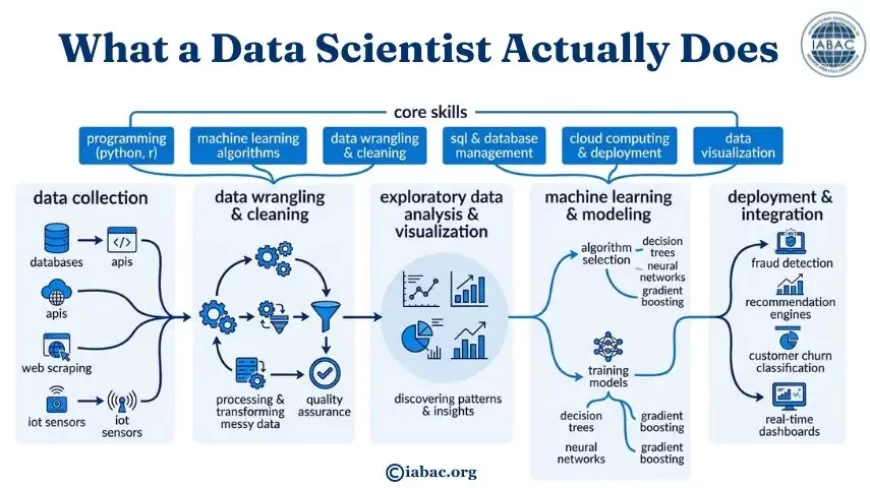
A data scientist takes large, messy, real-world data — often from databases, APIs, web scraping, or IoT sensors — and builds systems to extract value from it. This might mean training a machine learning model to classify customer churn, building a recommendation engine, creating a fraud detection system, or designing a dashboard that updates in real time.
Core skills include:
- Programming (Python and R being the dominant languages)
- Machine learning algorithms (decision trees, neural networks, gradient boosting)
- Data wrangling and cleaning (a huge part of the job)
- SQL and database management
- Cloud computing and deployment
- Data visualization
A data science project does not always begin with clean, survey-ready data. It begins with chaos — raw logs, unstructured text, duplicate records — and the data scientist's job is to wrestle that chaos into something useful.
The Numbers Behind the Debate
Let me give you some concrete metrics to ground this conversation.
According to the U.S. Bureau of Labor Statistics, the employment of data scientists is projected to grow 35% between 2022 and 2032 — far outpacing the average across all occupations. The median annual salary for a data scientist in the United States sits around $108,000 to $130,000, depending on industry and location. Statisticians, by comparison, are projected to grow at 31% over the same period, with a median salary around $99,000 to $115,000. That is still exceptional — but the gap in both growth rate and salary reflects the broader market's appetite for applied machine learning and engineering capability.
Here is a simplified comparison in plain numbers:
Data Scientist (Global Median)
- Entry-level: $70,000 – $90,000
- Mid-level: $100,000 – $130,000
- Senior level: $140,000 – $200,000+
Statistician (Global Median)
- Entry-level: $60,000 – $80,000
- Mid-level: $85,000 – $110,000
- Senior level: $120,000 – $160,000
These are approximate global figures from platforms like Glassdoor, LinkedIn, and Indeed as of 2024–2025. Numbers vary significantly by region, company size, and industry.
Where They Overlap (And Why That Actually Matters)
Here is what nobody tells you at the beginning: the best data scientists are statistically literate, and the best statisticians are increasingly learning to code. The fields are converging.
Think about what goes into a machine learning model. Before you choose an algorithm, you need to understand your data distribution. Before you deploy, you need to evaluate performance using metrics like precision, recall, F1-score, AUC-ROC — all statistical concepts. When your model behaves unexpectedly, understanding bias-variance tradeoff (a deeply statistical idea) is what helps you debug it. Similarly, modern statisticians are not living in SPSS or SAS alone anymore. Many are using R or Python, building reproducible pipelines, and working with datasets that would have been unimaginable to previous generations.
The overlap is not a weakness — it is a strength. And if you want to be elite in either field, you need fluency in both directions.
A Real-World Example: The Credit Risk Story
Let me walk you through a practical scenario. Imagine a bank wants to reduce loan defaults.
A statistician would approach this by designing a rigorous study. They would define variables carefully — income, credit history, debt-to-income ratio — build a logistic regression model, validate assumptions (linearity, independence, no multicollinearity), and report results with confidence intervals and p-values. The output is interpretable, auditable, and defensible in regulatory environments. A data scientist would approach this with a broader toolkit. They might start with the same logistic regression but then try gradient boosting (XGBoost), a random forest, and maybe a neural network. They would use cross-validation and hyperparameter tuning. They would build a pipeline that runs automatically when new applicant data comes in. They would deploy the model to a production API that the bank's loan officers can query in real time.
Both approaches have value. The statistician's output is more explainable and regulatory-friendly. The data scientist's output might be more accurate and scalable.
In most real organizations, you need both.
The Career Paths: Where Do They Lead?
Statistics Career Paths
- Academic researcher or professor
- Government statistician (census bureaus, health agencies)
- Biostatistician in pharma or clinical trials
- Actuary (with additional exams)
- Economist or policy analyst
- Market research analyst
Data Science Career Paths
- Machine learning engineer
- Data scientist (applied, research, or product-focused)
- AI/ML product manager
- Data engineer
- Business intelligence analyst
- NLP or computer vision specialist
The data science track tends to offer more industry variety — finance, healthcare, e-commerce, logistics, entertainment, gaming, and virtually every sector now has active data science teams. The statistics track tends to go deeper into specific, high-rigor domains where theoretical correctness is non-negotiable.
The Certification Angle: Why It Matters More Than You Think
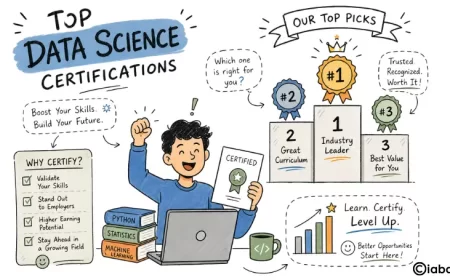
Here is something that often gets glossed over in these comparisons: formal credentials matter enormously in both fields, especially when you are entering the job market or making a career transition. For data science, certification programs have become one of the fastest and most effective ways to build credibility and structured knowledge — especially for professionals who are transitioning from other fields or want to validate their skills globally.
This is where platforms like IABAC (International Association of Business Analytics Certifications) become genuinely relevant. IABAC offers globally recognized Data Science Certifications that cover the full spectrum from foundational statistical thinking to applied machine learning and real-world project execution. Their certification framework is designed to align with industry demand, which means what you learn maps directly to what employers are actually hiring for. You can explore their offerings at https://iabac.org/data-science-certification — and if you want a broader view of all certification options available, IABAC Certifications gives a complete catalog spanning analytics, AI, and business intelligence.
What I appreciate about internationally recognized certifications in data science is that they force structured learning. A certification program makes you actually complete a data science project, grapple with real datasets, and demonstrate competence under evaluation — not just watch videos passively and feel vaguely knowledgeable.
The "Data to Data" Reality of a Modern Career
One phrase I keep coming back to is data to data — the idea that in a modern career, your journey is about moving from raw, untouched, chaotic data to structured, interpreted, actionable insight. That journey requires both statistical thinking and data science execution.
If statistics is the compass, data science is the vehicle. You need to know where you are going and how to get there.
The professionals who thrive are those who stop treating these as competing identities and start treating them as complementary skills. The statistician who learns Python becomes dramatically more employable. The data scientist who truly understands probability distributions and experimental design builds models that actually work in production — not just on benchmark datasets.
Which One Should You Choose?
Here is my honest framework:
Choose statistics if:
- You love mathematical rigor and theoretical depth
- You want to work in healthcare, pharma, academia, or government
- You are drawn to research environments where precision matters more than speed
- You enjoy designing experiments and drawing causal conclusions
Choose data science if:
- You want to build things — models, systems, pipelines, applications
- You are drawn to fast-paced, high-impact industry roles
- You are comfortable with ambiguity and enjoy working with messy, real-world data
- You want exposure to machine learning, AI, and emerging technology
Choose both (the smart move) if:
- You want to be genuinely excellent rather than just employable
- You are building a long-term career and willing to invest the time
- You understand that the lines are blurring, and the future belongs to people who can think statistically and execute computationally
The Math You Cannot Avoid (A Quick Glimpse)
Whether you go statistics or data science, some mathematical concepts are simply unavoidable. Here are three you will use constantly:
1. Bayes' Theorem
P(A|B) = [P(B|A) × P(A)] / P(B)
This underpins everything from spam filters to medical diagnosis to the posterior updates in Bayesian machine learning.
2. The Normal Distribution
f(x) = (1 / σ√2π) × e^(−(x−μ)² / 2σ²)
Understanding this distribution — and knowing when data does not follow it — is fundamental to both statistical inference and machine learning model evaluation.
3. Mean Squared Error (MSE)
MSE = (1/n) × Σ(yᵢ − ŷᵢ)²
This is one of the most common loss functions in regression and machine learning. Whether you are a statistician evaluating a model or a data scientist tuning one, MSE is part of the conversation.
A Rough Demand Map: Industries Hiring Right Now
Here is a sense of where demand concentrates globally:
- Finance and Banking — heavy on both statistics (risk modeling, actuarial) and data science (fraud detection, algorithmic trading, customer analytics)
- Healthcare and Pharma — statistics dominates in clinical trials; data science is growing fast in medical imaging, genomics, and hospital operations
- E-commerce and Tech — almost entirely data science, with ML at the center of product decisions
- Government and Public Sector — strong demand for statisticians; growing interest in data science for public services and policy simulation
- Manufacturing and Supply Chain — data science for predictive maintenance and demand forecasting; statistics for quality control
- Media and Entertainment — data science for recommendation systems, audience analytics, and content optimization
Final Thoughts: Don't Wait for Permission
Look, the world is not short of data. According to IBM, we generate roughly 2.5 quintillion bytes of data every single day. That number is growing. Businesses are drowning in data and desperate for people who can make sense of it. Whether you come from a statistics background or a computer science background, whether you are building your first data science project or finishing a graduate degree, the market wants you — provided you have the skills and the credentials to prove it.
And here is what I will leave you with: the debate between data science vs statistics is ultimately less important than the action you take today. Every professional in this space started somewhere. Every expert was once confused about where to begin. If you want a structured, globally recognized path to build credibility fast, explore what IABAC has built at Data Science Certification. Their Data Science Certifications are designed precisely for the kind of professional who wants to stop wondering and start doing. The data is waiting. The opportunity is real. And the only question left is what you are going to do with it. Interested in exploring certifications across analytics, AI, and data science? Visit https://iabac.org/certifications for a full overview of globally recognized programs.