




















































Why Are Data Science and Artificial Intelligence So Important in 2026?
Data science and artificial intelligence are important in 2026 for automation, analytics, predictive insights, and business innovation.

Artificial Intelligence and Data Science are often spoken about as though they are the same thing, but in reality, they are two different fields that work incredibly well together. One helps us understand data, and the other helps us build systems that can act on that understanding. When they are combined correctly, they create some of the most powerful technologies in the world today.
I often describe it this way: Data Science is the engine room that processes and prepares the fuel, while AI is the smart driving system that uses that fuel to move forward and make decisions. Without data, AI has nothing to learn from. Without AI, data science would stop at insights and would not always move into automation. That is why the connection between Data Science and Artificial Intelligence is so important for modern business, research, technology, and career growth.
In this blog, I will explain the relationship between artificial intelligence and data science in a clear, practical, and global way. I will also show how both fields support each other, where they differ, how they are used in real life, and why learning both can be a strong career move. If you are exploring the IABAC domain name and looking at the IABAC data science page, this topic is especially useful because it shows how the subject fits into the broader world of AI, Data Science, and modern analytics.
Understanding Data Science and Artificial Intelligence
Before comparing them, it is important to define them properly.
Data Science is the field that focuses on collecting, cleaning, organizing, analyzing, and interpreting data to find useful insights. It answers questions such as:
- What happened?
- Why did it happen?
- What patterns exist?
- What might happen next?
A data science project may involve structured data like spreadsheets or unstructured data like text, images, logs, or social media content. The aim is to convert raw information into meaningful knowledge. In simple words, data science turns data to data into business value, knowledge, and action.
Artificial Intelligence, on the other hand, is the field that focuses on creating intelligent systems that can perform tasks usually requiring human intelligence. These tasks may include learning, reasoning, decision-making, understanding language, recognizing images, or predicting outcomes. AI is often powered by machine learning, deep learning, and neural networks.
So, while Data Science looks for patterns in data, AI uses those patterns to create intelligent behavior.
The Core Connection Between Data Science and Artificial Intelligence
The connection between these two fields is deep and practical. In many cases, one cannot function properly without the other.
1. Data Science provides the foundation for AI
AI systems are only as good as the data they learn from. Before an AI model can predict, classify, recommend, or automate anything, it needs clean and relevant data. That is where Data Science comes in.
A data scientist collects the data, removes errors, handles missing values, transforms the data, and prepares it for model training. This step is extremely important because poor-quality data usually leads to poor-quality AI performance.
For example, if an AI system is being trained to identify spam emails, the dataset must contain a wide variety of real spam and non-spam messages. If the data is incomplete or biased, the AI model may make bad decisions. That is why Data Science acts like the groundwork for almost every AI application.
2. AI turns data insights into intelligent action
Data Science often ends with analysis, prediction, or visualization. AI goes one step further. It uses the patterns discovered through data science to build systems that can make decisions automatically.
For example, a data scientist may discover that customers who buy one product are also likely to buy another. An AI system can use that information to recommend the second product in real time. In this way, AI takes the insight and converts it into intelligent action.
3. AI improves data science workflows
The relationship is not one-way. AI also supports Data Science. AI tools can help automate repetitive work such as data cleaning, feature extraction, exploratory analysis, and anomaly detection. This saves time and allows data professionals to focus on deeper interpretation and strategy.
So in practice, data science and artificial intelligence work together in a loop:
Collect data → clean data → analyze data → build AI models → make predictions → improve decisions → gather new data → repeat
That cycle is where modern digital intelligence lives.
A Simple Comparison: Data Science vs Artificial Intelligence
Although they are connected, they serve different purposes.
|
Feature |
Data Science |
Artificial Intelligence |
|
Main goal |
Find insights from data |
Build intelligent systems |
|
Focus |
Analysis, statistics, interpretation |
Learning, reasoning, automation |
|
Output |
Reports, dashboards, predictions |
Smart systems, chatbots, recommendations, |
|
Main tools |
Python, R, SQL, Pandas, Tableau |
TensorFlow, PyTorch, OpenCV, NLP frameworks |
|
Main question |
What does the data say? |
What should the system do next? |
This comparison shows that Data Science is more focused on understanding, while AI is more focused on acting.
How Data Flows from Data Science into AI
A useful way to understand this relationship is to think of the journey of data.
Step 1: Data collection
The process begins with raw data. This can come from websites, sensors, mobile apps, business systems, surveys, social media platforms, or transaction records. At this stage, the data is often messy and incomplete.
Step 2: Data cleaning and preparation
This is where Data Science plays a major role. Data scientists remove duplicates, handle missing values, standardize formats, and correct inconsistencies. A machine learning model cannot learn well from broken data.
Step 3: Feature engineering
Features are the useful parts of the data that help the model learn. For example, in a banking dataset, features may include income, age, credit history, and spending pattern. Data Science helps identify which variables are actually meaningful.
Step 4: Model building
Now AI and machine learning enter the picture. The prepared data is used to train a model. That model learns patterns and relationships in the data.
Step 5: Prediction and automation
Once trained, the AI model can make predictions or decisions without being manually coded for every case. This is where AI becomes highly valuable in real-world systems.
Step 6: Monitoring and improvement
The model must be checked regularly. As new data arrives, the system may need retraining. Data Science helps monitor model quality, while AI helps continue intelligent operations.
Examples of Data Science and Artificial Intelligence Working Together
Example 1: Recommendation systems
When you watch a movie, shop online, or listen to music, recommendation systems suggest content based on your behavior. Data Science analyzes your past actions, preferences, and similarities with other users. AI then uses this information to recommend what you might like next.
Example 2: Healthcare diagnosis
In healthcare, Data Science studies patient records, symptoms, test results, and clinical trends. AI uses that knowledge to support diagnosis, detect disease earlier, and help doctors make better decisions.
Example 3: Fraud detection
Banks and payment systems use Data Science to study transaction behavior. AI then watches for unusual patterns and flags suspicious activity in real time.
Example 4: Virtual assistants and chatbots
Natural language data is analyzed through Data Science techniques. AI then powers the chatbot’s ability to understand user questions and respond intelligently.
Example 5: Predictive maintenance
In manufacturing, data from machines is collected and analyzed. AI systems use those patterns to predict when equipment might fail, saving time, money, and stress. Machines do not usually enjoy surprise breakdowns, and neither do operations teams.
Why This Connection Matters for a Career
If you are building a future in technology, understanding both fields gives you a major advantage. The modern job market values people who can understand data and also use intelligent systems effectively.
Data Science roles may include:
- Data Scientist
- Data Analyst
- Data Engineer
- Business Intelligence Analyst
AI-related roles may include:
- AI Engineer
- Machine Learning Engineer
- Deep Learning Engineer
- Research Scientist
These roles are not isolated. In many organizations, professionals work across both domains. A data scientist may prepare datasets for an AI model, while an AI engineer may use those datasets to train production systems.
This is one reason many learners explore Data Science Certifications. A strong certification path can help build confidence, structure, and practical understanding. The IABAC data science page is relevant here because it connects learning with industry-oriented skill development in a globally recognized way.
A Mathematical View of the Connection
Let us make this more concrete with a simple example.
Imagine a company wants to predict whether a customer will buy a product.
A data scientist may analyze the following variables:
- Age
- Previous purchases
- Time spent on the website
- Number of clicks
- Discount response
A model may assign weights to these variables:
Purchase Score = 0.4(Age) + 0.7(Previous Purchases) + 1.2(Time on Website) + 0.9(Clicks) + 1.5(Discount Response)
This is a simplified example, but it shows the logic clearly. Data Science identifies which variables matter. AI uses the relationship to predict behavior.
If the score crosses a certain threshold, say 75, the system may classify the customer as likely to buy. That means a company can show the right offer at the right time.
This is the power of combining Data Science and Artificial Intelligence: one creates understanding, the other creates action.
What Makes Data Science So Important to AI?
AI systems need several things to perform well, and Data Science supports all of them.
- Better data quality: Clean data improves accuracy.
- Better model performance: Well-prepared data helps AI learn faster and more effectively.
- Better fairness: Careful data analysis can reduce bias and improve trust.
- Better interpretation: Data Science helps explain what is happening inside the model.
Without this support, AI can become unreliable, confusing, or even harmful. That is why data work is often the hidden hero behind impressive AI results.
What Makes AI So Valuable to Data Science?
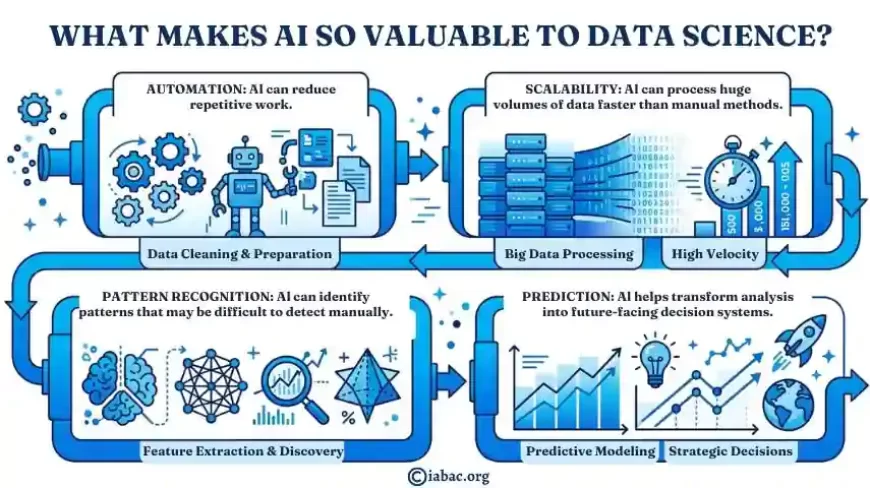
AI also adds major value to the Data Science workflow.
- Automation: AI can reduce repetitive work.
- Scalability: AI can process huge volumes of data faster than manual methods.
- Pattern recognition: AI can identify patterns that may be difficult to detect manually.
- Prediction: AI helps transform analysis into future-facing decision systems.
In many organizations, data teams no longer stop at dashboards. They use AI to build systems that recommend, predict, and adapt.
The Role of Certifications and Structured Learning
For many learners around the world, certifications provide direction. A structured learning path helps people move from theory to practical skill. This is where Data Science Certifications can be especially useful.
A good certification journey usually covers:
- Python or another programming language
- Statistics and probability
- SQL and databases
- Data cleaning and preprocessing
- Machine learning basics
- Model evaluation
- Business understanding
- Ethical use of data
These are useful for both Data Science and AI careers. If you are exploring the IABAC data science page, you will see that the learning path is aligned with practical industry needs and modern analytics expectations.
Global Demand for Data Science and AI Skills
Across the world, organizations are trying to use data more intelligently. Businesses want better forecasting. Hospitals want better diagnosis support. Retail companies want smarter recommendations. Financial institutions want better fraud detection. Governments want stronger public decision-making. Education platforms want personalized learning. The list keeps growing.
This is why datascience skills and AI knowledge are in demand globally. The people who understand both can work across industries and adapt more easily to new tools and roles.
In the modern economy, data is not just information. It is a strategic asset. AI is not just technology. It is a decision-making layer built on that asset.
Common Misunderstandings About Data Science and AI
Many people think AI and Data Science are identical. They are not.
Another common misunderstanding is that AI can work without human input. In reality, AI systems depend heavily on human-designed data pipelines, model choices, validation methods, and ethical oversight.
Some also believe that Data Science is only about charts and reports. That is too limited. Data Science includes prediction, experimentation, modeling, and business strategy.
A better understanding is this:
- Data Science helps us understand what the data is saying.
- AI helps us use that understanding to make intelligent decisions at scale.
Why This Topic Matters for Learners Everywhere
No matter where you live, the connection between Data Science and Artificial Intelligence matters because it shapes the future of work. Companies worldwide want people who can think analytically and work intelligently with data-driven systems.
Learning both does not mean becoming everything at once. It means understanding how the pieces fit together. Once you see that connection clearly, the field becomes much easier to navigate.
For learners considering a data science project, this relationship is especially valuable. A strong project may start with analysis and end with an AI-powered outcome. That journey teaches practical thinking, technical skill, and problem-solving all at once.
Data Science and Artificial Intelligence are deeply connected, but they are not the same. Data Science finds meaning in data. AI turns that meaning into intelligent action. Together, they shape the tools, systems, and experiences that define our digital world.For anyone exploring artificial intelligence and data science, the best approach is not to choose one blindly and ignore the other. Instead, learn how they connect, where they differ, and how they support each other. That knowledge creates stronger career options, smarter projects, and a deeper understanding of how modern technology works.
Whether you are reading the IABAC data science page, comparing Data Science Certifications, or planning your next data science project, this connection will keep appearing again and again. And that is a good thing. It means you are learning the language of the future—one where AI, Data Science, and human judgment work together instead of separately. If you understand this connection well, you are not just learning technology. You are learning how the world makes decisions.