




























































IABAC ATP Approval: The Complete Process, Requirements, and Timeline (2026)
A complete guide to IABAC ATP approval — eligibility, required documents, the review process, timelines, common rejection reasons, and what happens after you're approved.

If you're researching IABAC ATP approval, you've likely already decided you want it — now you just need to know what to submit, how long it takes, and what could go wrong. This guide covers all of that: eligibility, required documents, the review process, the timeline, common rejection reasons, and what changes once you're approved.
If you're still deciding whether an Authorized Training Provider (ATP) program is worth pursuing in the first place, our in-depth look at why institutes become an IABAC ATP is a better starting point. This post picks up from there and focuses on getting through the approval process itself.
What Is IABAC ATP Approval?
IABAC ATP approval is the formal authorization that lets an institute, university, EdTech company, or corporate training center deliver IABAC-certified courses and register learners for IABAC certification exams. It isn't a one-time badge — it's a license tied to a specific, approved curriculum, and it comes with ongoing obligations, not just a certificate to hang on the wall.
Approval means IABAC has reviewed your organization's legal standing, your curriculum's alignment with the EDISON Data Science Framework, your trainers' credentials, and your delivery infrastructure — and confirmed all four meet its standards.
Who Grants ATP Approval
IABAC reviews and approves ATP applications. Since January 2023, G-CREDO (Global Credentialing Office) has managed the institutional side of the relationship post-approval — exam booking, certification issuance, and licensing administration — but the approval decision itself sits with IABAC.
What ATP Status Actually Authorizes You to Do
Once approved, you can register learners for IABAC certifications, use the IABAC Accreditation Badge and related marks on your website and marketing (under the terms of the Accreditation Terms and Conditions), and access the partner dashboard for enrollment and exam management. It does not mean IABAC delivers training on your behalf — you remain the training provider; IABAC is the certifying body.
Who Is Eligible for IABAC ATP Approval?
Eligibility is checked first, before any curriculum review happens, so it's worth confirming you meet these before you invest time preparing documentation.
Legal and Business Requirements
-
Your organization must be a legally registered entity, with proof of incorporation you can submit.
-
You need at least one year of business activity — brand-new organizations without an operating history won't pass the initial eligibility check.
Quality Management System (QMS) Requirement
IABAC requires evidence of a documented Quality Management System. This doesn't need to be a certified ISO system, but it does need to show how you monitor training quality, handle learner feedback, and evaluate trainers. Institutes that try to build this from scratch during the application tend to slow their own timeline down — have it ready before you start.
Organization Types That Qualify
The ATP program is open to EdTech companies, training institutes, universities and academic institutions, and corporate training centers — provided each can demonstrate curriculum-development capability, qualified trainers, and real delivery infrastructure (online, in-person, or hybrid).
If your organization is a university specifically, note that IABAC also runs a separate Accredited Academic Institution (AAI) program, and corporates evaluating internal upskilling rather than public training delivery should look at the Accredited Corporate Partner (ACP) program instead.
Documents and Prerequisites You'll Need Before Applying
Legal and Registration Documents
-
Certificate/proof of incorporation matching your organization's exact legal name
-
Evidence of business activity spanning at least one year
Curriculum and Trainer Documentation
-
Course syllabus, mapped to IABAC's EDISON-based standards
-
Trainer profiles: qualifications, teaching experience, and any prior accreditation
-
A description of your training methodology
Infrastructure and Delivery-Capability Evidence
-
Details of your delivery setup — LMS, classroom facilities, or hybrid delivery model
-
Your documented Quality Management System
Quick-Reference Checklist
|
Document |
Why it's needed |
|
Proof of incorporation |
Confirms you're a legally registered entity |
|
Business activity evidence (1+ year) |
Meets the minimum operating-history requirement |
|
QMS documentation |
Shows how you monitor and maintain training quality |
|
Course syllabus |
Reviewed against the EDISON framework |
|
Trainer profiles |
Verifies trainer credentials and experience |
|
Infrastructure/delivery details |
Confirms you can actually deliver the courses you're proposing |
The IABAC ATP Approval Process, Step by Step
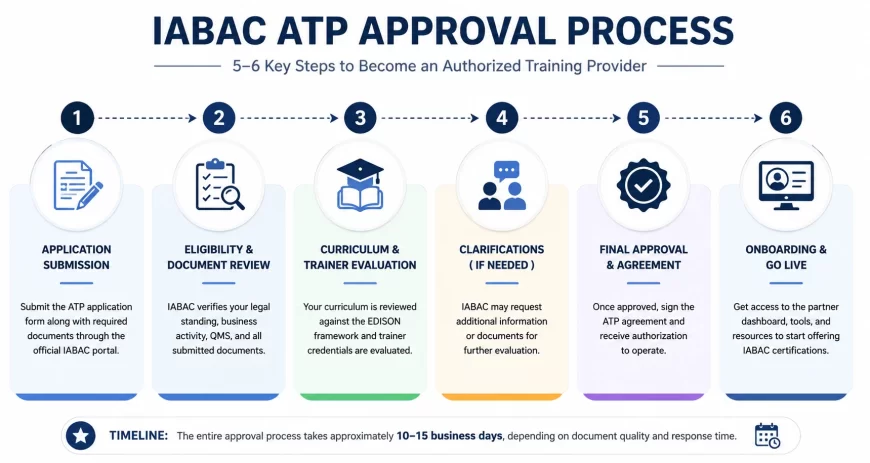
IABAC's own materials describe this process slightly differently in two places — the partner page's 6-step version and the blog's 7-step version. Here's the reconciled, canonical sequence, with the timing that's actually published.
Step 1 — Eligibility Check
You submit the online application form via the ATP application portal. IABAC confirms basic eligibility — legal registration, business history, QMS presence — within 2–3 working days.
Step 2 — Application Initiation
Once eligibility is confirmed, your filled application is routed internally to the relevant review department.
Step 3 — Review and Evaluation
Your curriculum, trainer documentation, QMS evidence, and infrastructure details are scrutinized in detail. This is the longest and most substantive step — see the next section for exactly what's checked. It takes a minimum of 5 and maximum of 7 working days.
Step 4 — Decision and Clarification
IABAC issues a decision. If anything in your submission needs clarification, you'll receive a specific request rather than an outright rejection at this stage.
Step 5 — Agreement
You sign the partnership agreement, which sets out your certification licensing terms and the scope of the approved curriculum.
Step 6 — Onboarding
You get access to the partner portal, branding assets, and exam-booking setup managed through G-CREDO. You're now live as an IABAC ATP.
Timeline at a Glance
|
Stage |
Duration |
|
Eligibility check |
2–3 working days |
|
Review & evaluation |
5–7 working days |
|
Total (submission → onboarding) |
10–15 working days |
How the Review and Evaluation Process Works
This is the step applicants ask the most questions about, and the one IABAC's public materials describe the least. Based on what's published, review covers three areas:
Curriculum Alignment Check
Your syllabus is checked against the EDISON Data Science Framework — specifically the Competence Framework (CF-DS), the Body of Knowledge (DS-BoK), and the Model Curriculum (MC-DS). IABAC states it "thoroughly examines the syllabus before approval," so treat this as a genuine content review, not a formality.
Trainer Credential Verification
Trainer profiles are checked for relevant qualifications and teaching experience. Institutes planning to onboard trainers later, after approval, should still submit their current trainer roster — trainer accreditation itself runs through the separate Trainer Accreditation Program (TAP) once your institute is approved.
Infrastructure and Delivery Review
Reviewers confirm you can actually deliver what you're proposing — that your LMS, classrooms, or hybrid setup match the scale and format of the courses in your application.
Common Reasons ATP Applications Are Rejected or Delayed
IABAC hasn't published rejection statistics, so treat this section as practical guidance drawn from the stated eligibility and review criteria — not as official rejection data.
|
Likely reason |
How to avoid it |
|
Incomplete or mismatched registration proof |
Submit documents that match your applying entity's exact legal name — a subsidiary or trading name mismatch is an easy, avoidable delay |
|
Curriculum not aligned to EDISON standards |
Map your syllabus against the Body of Knowledge and Model Curriculum before submission, not after a clarification request |
|
No documented QMS |
Draft your QMS in advance — trying to build it during the review adds days you don't need to lose |
|
Trainer credentials not verifiable |
Attach certificates, teaching history, and any prior accreditation directly, rather than summarizing them |
|
Missing infrastructure detail |
Document your delivery setup clearly even if you're online-only — reviewers can't confirm capacity they can't see |
Benefits of Becoming an IABAC Authorized Training Provider
Approval isn't just a compliance exercise — it changes what you can offer:
-
Global recognition and accreditation — your institute is authorized to register candidates for internationally accepted certifications.
-
Industry-aligned courseware — access to curriculum mapped to the EDISON framework, updated as standards evolve.
-
Accredited trainers — your teaching staff gain formal accreditation once they complete the Trainer Accreditation Program.
-
Marketing and branding support — the ATP badge, co-branded assets, and a partner dashboard for managing enrollments and exam bookings.
Want a deeper look at the enrollment and credibility impact institutes typically see? Our post on why partnering with IABAC boosts institute credibility covers that side in more detail.
Responsibilities After ATP Approval
Approval comes with ongoing obligations, not just ongoing perks:
-
Course offering compliance — you must deliver courses consistent with your approved Application Information, and notify IABAC of any changes to content or delivery method within 30 days.
-
Maintaining trainer accreditation — trainers need to stay current with TAP requirements.
-
Displaying the Accreditation Badge correctly — with a link to your IABAC Accredited Profile, on your website and professional networking profiles.
Logo Usage and Branding Guidelines for Approved ATPs
Once approved, you're licensed to use IABAC Marks — badges, logos, and trademarked symbols — under the IABAC Marks Usage Policy, set out fully in the Accreditation Terms and Conditions. The essentials:
-
You must display the Accreditation Badge and link to your IABAC Accredited Profile while accredited.
-
If your accreditation expires or is terminated, you must immediately stop using all IABAC Marks and stop implying any continuing relationship with IABAC.
-
IABAC treats unauthorized continued use after termination as a serious breach, with grounds for injunctive relief — this isn't a soft guideline, it's enforced.
For the full legal terms, refer directly to the Accreditation Terms and Conditions page rather than relying on a summary.
Renewal and Continued Compliance
Your ATP status is tied to the specific curriculum and organizational information IABAC approved. Two things keep it valid:
-
Report changes promptly — any deviation in course content, delivery method, or program structure needs to reach IABAC within 30 days of the change.
-
Maintain your standing — the legal, QMS, and trainer-quality conditions that got you approved need to remain true, not just be true at the moment of application.
If accreditation lapses or is terminated, the Marks-usage restrictions above apply immediately.
Real Examples: How Institutes Have Used ATP Approval
A university partner in Asia integrated IABAC certifications into its existing programs and reported a meaningful improvement in graduate employability and internship placement with AI-focused employers — a useful illustration of how academic validation translates into market outcomes.
A corporate training provider used its ATP status to upskill employees internally, seeing higher certification pass rates and clearer internal career-advancement paths as a result — a direct illustration of ATP status paying off inside a single organization rather than through public enrollment.
(Note: these examples are described at the level of detail IABAC has published publicly. If you'd like this section to carry a named case study with specific numbers, that requires a confirmed, on-record example from the IABAC partner network.)
Frequently Asked Questions About IABAC ATP Approval
How long does IABAC ATP approval take? Typically 10–15 working days from submission to onboarding — 2–3 days for the eligibility check plus 5–7 days for review.
What documents are required for ATP approval? Proof of incorporation, evidence of at least one year of business activity, QMS documentation, course syllabus, trainer profiles, and infrastructure/delivery details.
Who reviews an ATP application? IABAC's internal review team evaluates the application; G-CREDO manages institutional licensing and exam administration once you're approved.
Can a new institute with less than a year of operation apply? No — at least one year of business activity is a stated eligibility requirement before an application proceeds.
What happens after ATP approval is granted? You sign a partnership agreement, receive partner portal access, and can begin delivering IABAC-aligned courses and registering learners for certification exams.
Can ATP status be revoked? Yes. Non-compliance with the Accreditation Terms and Conditions — including undisclosed curriculum changes — can lead to termination, after which all IABAC Marks usage must stop immediately.
Do trainers need separate accreditation after the institute becomes an ATP? Yes — individual trainers are accredited through the Trainer Accreditation Program, separate from institute-level ATP approval.
Is there a cost associated with the ATP application? Application fees and licensing costs aren't published on the public partner pages — confirm current terms directly via Enquire Now or the application form.
What's the difference between ATP, AAI, and ACP approval? ATP is for training institutes and EdTech providers delivering public certification courses. AAI is the equivalent track for universities and academic institutions. ACP is for corporates certifying their own workforce rather than external learners.
What logo/branding rules apply once approved? Use is governed by the IABAC Marks Usage Policy — badge and profile-link display is required while accredited, and all usage must stop immediately if accreditation lapses.
How to Apply for IABAC ATP Approval
If your institute meets the eligibility criteria and you have your documentation ready, the fastest way to start the clock is to apply directly.
Apply Now for IABAC ATP Approval →
Have questions before you apply, or want your documentation reviewed informally first? Enquire with the IABAC partnerships team →