




















































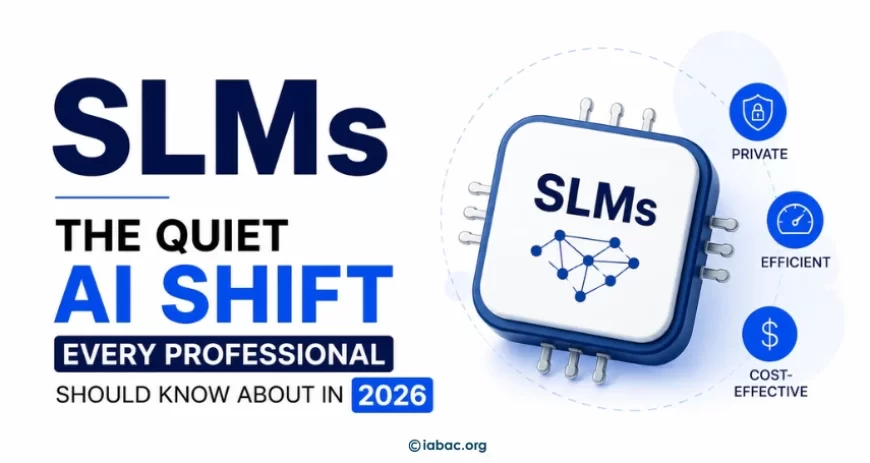
Small Language Models: The Quiet AI Shift Every Professional Should Know About in 2026
Why Small Language Models (SLMs) are transforming AI in 2026 with faster performance, lower costs, and smarter enterprise adoption.

Everyone's watching the headline AI models. GPT-5.5, Claude, Gemini — the frontier race gets all the attention. But underneath that race, a quieter shift is happening inside companies, and it's moving fast.
Gartner projects that by 2027, organizations will run small language models at roughly three times the usage volume of general-purpose LLMs. Not because small models are smarter. Because for most of what businesses actually do with AI day to day, smaller is simply better.
If you work anywhere near AI — building it, buying it, or just trying to stay relevant in your job — this is a trend worth understanding now, before it becomes the default assumption everyone else already has.
For the last few years, the AI conversation has been almost entirely about scale. Bigger models, more parameters, more compute, more capability. That race isn't over. But a second, quieter race has started alongside it, and it runs in the opposite direction: how small can a model get while still doing its job well? The answer, it turns out, is smaller than most people assume — and the businesses figuring this out first are gaining a real cost and speed advantage over the ones still defaulting to the biggest model available.
What Is a Small Language Model?
A small language model, or SLM, is an AI model built to do one job well instead of many jobs adequately.
Think of the difference between a family doctor and a specialist surgeon. A large language model is the family doctor — broad knowledge, able to handle almost anything you bring to it, but not built to go deep on one narrow problem. A small language model is the specialist — trained on a focused dataset, tuned for a specific task, and often faster and cheaper because it isn't trying to know everything.
SLMs typically run from a few hundred million to around 10 billion parameters, compared to the tens or hundreds of billions in a frontier LLM. Popular examples in 2026 include Microsoft's Phi models, Google's Gemma, and Mistral's Ministral line. Many are actually distilled from larger models — trained by learning from an LLM "teacher" until they capture most of its useful knowledge in a much smaller package.
This distillation process matters because it explains why SLMs aren't simply "worse" versions of big models. A well-distilled small model inherits the patterns and judgment of a much larger one, then strips away the parts it doesn't need for its specific job. The result is a model that can feel surprisingly capable within its lane, even though it's a fraction of the size. What it gives up is breadth — the ability to handle a completely unfamiliar question with no relevant training behind it. For a narrow, well-defined task, that trade-off often doesn't matter at all.
Why Are Companies Quietly Switching to SLMs?
Companies are switching for three practical reasons: cost, speed, and control over sensitive data.
Cost. Running a large model at scale adds up quickly. A narrow, high-volume task — like routing customer support tickets or classifying internal documents — can cost tens of thousands of dollars a month through a frontier LLM API. A fine-tuned SLM handling the same workload, hosted on a company's own infrastructure, can run at a fraction of that cost. For repetitive, well-defined tasks, that gap is hard to ignore.
Speed. Calling a cloud-based LLM means a round-trip over the internet plus processing time. An SLM running locally can respond in a fraction of a second, which matters for anything interactive — a coding assistant, a live chat tool, a device that needs to react in real time.
Privacy and compliance. When a company sends data to a third-party AI service, that data leaves its walls. For regulated industries — finance, healthcare, government — that's a real risk, even with enterprise agreements in place. An SLM can run entirely on a company's own hardware, so sensitive information never has to leave the building. In sectors where data residency and audit trails are legal requirements, not just best practice, this alone can decide which approach a company is even allowed to use.
There's a fourth factor that often gets overlooked: reliability at scale. A large model called through an external API is subject to rate limits, provider outages, and pricing changes outside a company's control. An SLM hosted internally removes that dependency. Teams running high-volume, business-critical workflows increasingly see this as a resilience question as much as a cost one — they don't want a core process going down because a third-party API had a bad day.
None of this means large models are going away. It means companies are getting more deliberate about which tool fits which job, and increasingly building AI systems around several models of different sizes instead of one model doing everything.
The Cost Math, in Real Numbers
The gap between SLM and LLM costs isn't a rounding error — it's often an order of magnitude. Here's roughly how the math plays out at enterprise scale, based on 2026 industry cost analyses:
|
Metric |
Frontier LLM (via API) |
Fine-Tuned SLM (self-hosted) |
Typical Ratio |
|
Cost per 1M conversations/month |
$15,000 – $75,000 |
$150 – $800 |
~20x – 100x cheaper |
|
Fine-tuning cost (7B parameter model) |
Not applicable (pre-trained only) |
Often well under $5,000 |
— |
|
Typical response latency |
Hundreds of milliseconds (cloud round-trip) |
50 – 200 milliseconds (on-device/local) |
2x – 5x faster |
|
Infrastructure cost reduction (self-hosted SLM vs. equivalent LLM) |
Baseline |
Up to 75% lower |
3x – 4x |
These are ranges, not guarantees — actual savings depend heavily on query volume, task complexity, and how much fine-tuning work goes in upfront. But even at the conservative end, the ratio is large enough that it changes the ROI conversation for any high-volume, narrow AI workload.
Real-World Case Studies: SLMs in Production
The numbers above aren't theoretical. A few examples from 2026 industry reporting show how this plays out in practice.
Financial services — fraud and risk detection. Capital One fine-tuned open-source small models for internal security work and reported more than a 50% improvement in attack detection rates compared to its previous approach. For a task that's narrow, repetitive, and highly sensitive, a specialized in-house model outperformed relying on an external general-purpose one.
Healthcare — reducing hallucinations in clinical support. A radiology-focused deployment combining a smaller Llama-based model with retrieval-augmented generation (RAG) — where the model pulls from a verified knowledge base instead of relying purely on memorized training data — brought hallucination rates down from around 8% to effectively 0% on the specific task it was tuned for. Separately, healthcare organizations deploying task-specific SLMs for administrative workflows have reported admin workload reductions of around 60%.
Enterprise operations — cost and speed at scale. Analysis of production deployments (including a widely cited case from Boosted.ai) found that moving from general-purpose LLM APIs to fine-tuned, self-hosted small models cut inference costs by roughly 90% while improving response speed by around 10x. A broader review of nearly 300 published enterprise case studies found companies across finance, logistics, and tech replacing frontier models with smaller 7–14 billion parameter models at 5x to 150x lower cost, often with equal or better results on the specific task.
The common thread across all three: none of these are companies replacing AI wholesale with something weaker. They're matching a smaller, purpose-built model to a well-defined task, and getting better economics — sometimes better accuracy too — as a result.
SLM vs LLM: When Does Each Make Sense?
|
Task Type |
Better Fit |
Why |
|
Narrow, repetitive, high-volume (support routing, document tagging) |
SLM |
Cheaper at scale, faster response, easier to control |
|
Broad reasoning, unpredictable questions, multi-domain analysis |
LLM |
Needs wide general knowledge and flexible reasoning |
|
Sensitive data, on-device or regulated environments |
SLM |
Keeps data in-house, meets compliance needs |
|
Strategic, high-stakes, one-off complex tasks |
LLM |
Depth and reasoning matter more than cost per query |
In practice, the most effective setups aren't choosing one over the other. Many companies now route simple, predictable requests to an SLM and send anything complex or unfamiliar up to a larger model — a hybrid approach that keeps costs down without sacrificing capability where it actually matters.
This same logic is already showing up in agentic AI systems, where a small task-specific agent might handle routine steps in a workflow while a larger model manages the reasoning-heavy parts.
The Trade-Offs: What SLMs Do Well, and Where They Fall Short
No AI decision is free of trade-offs, and SLMs are no exception. A balanced look at both sides:
Where SLMs win:
-
Cost at scale. As the numbers above show, the savings on high-volume, narrow tasks are large and consistent across industries.
-
Speed. Local or on-device inference removes network round-trips, which matters for anything real-time.
-
Data control. Running a model entirely in-house removes the compliance question of sending sensitive data to a third party.
-
Focused accuracy. A well-tuned SLM can match or beat a general-purpose LLM on the narrow task it was trained for, since it isn't spending "effort" covering unrelated domains.
-
Lower barrier to fine-tuning. Adjusting an SLM for a specific use case is now inexpensive and fast enough that smaller teams can do it without a dedicated ML research group.
Where SLMs fall short:
-
Limited general knowledge. An SLM tuned for one task will typically perform poorly outside that task. It isn't a substitute for a model that needs to handle open-ended, unpredictable questions.
-
Weaker complex reasoning. Multi-step reasoning, nuanced judgment calls, and tasks that require broad context still tend to favor larger models.
-
Upfront setup cost. While running costs are lower, getting an SLM production-ready still requires quality training data, fine-tuning work, and ongoing monitoring — this isn't a zero-effort swap.
-
Hidden operational costs. Self-hosting shifts spending from API fees to infrastructure and personnel — ML engineering talent, monitoring, and 24/7 operational support all carry real costs that can offset some of the savings if not planned for.
-
Fragmentation risk. Running many small, specialized models instead of one general model can add architectural complexity — more models to maintain, version, and monitor over time.
The realistic picture is that SLMs solve a specific set of problems very well, not every AI problem. Businesses that treat this as a total replacement for large models, rather than a complementary tool, tend to run into the limitations faster than the ones using a hybrid approach.
What This Means for Your Career
This shift is creating a skill that barely existed two years ago: knowing how to fit the right-sized model to the right task, and how to fine-tune, deploy, and evaluate smaller models responsibly.
For a long time, AI career advice has focused almost entirely on working with the biggest, most capable models. That's still valuable. But as SLM adoption grows, companies increasingly need people who understand efficient deployment, not just frontier capability — professionals who can look at a business problem and know it doesn't need a trillion-parameter model to solve it.
This fits into a broader pattern already reshaping data science and AI career paths in 2026: specialization is starting to matter as much as raw technical scale. Teams don't just want someone who can call an API. They want someone who understands trade-offs — cost, latency, privacy, and when a smaller, well-tuned model beats a bigger, more expensive one.
If you're already building toward an AI or data science role, this is a good area to add to your learning path early, before it becomes an expected baseline skill rather than a differentiator. It's also worth understanding alongside broader questions of how AI skills and certifications affect salary potential — efficient, cost-aware AI deployment is quickly becoming one of the traits employers screen for.
The Bottom Line
Small language models aren't the flashy side of AI, and that's exactly why this shift is easy to miss. There's no single headline moment like a new model launch — just a steady, practical move by companies toward using the smallest model that gets the job done well.
Real numbers back that move: Gartner's forecast of SLMs tripling LLM usage volume by 2027, cost differences that can run into the tens of times cheaper for the right workload, and a growing list of regulated industries that need AI to stay in-house. None of that is hype. It's businesses making a practical trade-off, over and over, at scale.
For professionals, the takeaway isn't that you need to master SLMs overnight. It's that "bigger model" is no longer the only skill worth having. Knowing when a smaller, cheaper, faster model is the right call — and being able to fine-tune and deploy one — is quickly becoming its own valuable competency inside AI and data science roles. Understanding this shift now puts you ahead of the curve rather than catching up to it later, once it's simply assumed knowledge.
Frequently Asked Questions
What is a small language model in simple terms?
A small language model is an AI system trained to handle a specific, narrower set of tasks well, using far fewer parameters than a large language model. It trades some general knowledge for speed, lower cost, and easier deployment.
Are small language models replacing LLMs?
No. SLMs are handling more of the narrow, repetitive, high-volume work, while LLMs remain the choice for broad reasoning and unpredictable tasks. Most organizations are using both together rather than replacing one with the other.
What are examples of small language models?
Widely used examples in 2026 include Microsoft's Phi models, Google's Gemma, and Mistral's Ministral models — all designed to run efficiently on limited hardware, including edge devices.
Do I need to learn about SLMs for an AI career?
It's becoming increasingly useful. As companies adopt SLMs for cost and compliance reasons, understanding when and how to use them is turning into a practical skill alongside general AI and machine learning knowledge.
Is fine-tuning a small language model difficult?
It's more accessible than most people expect. Fine-tuning an SLM typically takes hours rather than days and can be done with modest hardware, using widely available tools — a much lower barrier to entry than training a large model from scratch.
What are the biggest downsides of small language models?
The main trade-offs are narrower general knowledge and weaker performance on complex, multi-step reasoning tasks. SLMs also still require quality training data and ongoing monitoring, so they aren't a zero-effort or zero-cost alternative to using a large model.