





















































LLM Explained: What Are Large Language Models & How Do They Work?
Learn what Large Language Models (LLMs) are, how they work, and how AI systems use them to understand, generate, and process human language.


Artificial intelligence has moved far beyond simple automation. Today, AI tools can write articles, answer complex questions, summarize research papers, generate code, translate languages, and even hold natural conversations that feel surprisingly human. At the center of this shift are Large Language Models (LLMs) , one of the most important breakthroughs in modern AI.
Over the last few years, businesses, educators, developers, and researchers have started integrating AI language models into everyday workflows. From customer support systems and search engines to healthcare research and enterprise automation, LLMs are rapidly becoming part of how digital systems interact with humans.
But despite their growing popularity, many people still wonder:
- What exactly are Large Language Models?
- How do they understand language?
- Why are they suddenly so powerful?
- And where are they being used in the real world?
This guide breaks down Large Language Models in a simple, practical way. Whether you are completely new to AI or trying to understand the technology shaping the future of software, this article will help you understand how LLMs work, why they matter, and where they are headed next.
What Are Large Language Models?
Large Language Models are advanced AI systems trained to understand and generate human language. They learn patterns from massive amounts of text data and use those patterns to predict, create, and respond with meaningful language.
In simple terms, an LLM is a system designed to predict the next word in a sentence based on context. While that sounds basic, scaling this process across billions of words and parameters allows these models to perform tasks that appear intelligent.
The word “large” refers to two things:
- The enormous amount of training data used
- The huge number of parameters inside the model
Parameters are internal values the model adjusts during training to learn language patterns, grammar, reasoning structures, and relationships between words.
Unlike traditional software, which follows fixed rules written by programmers, machine learning language models learn patterns from examples. Instead of being manually told every rule of language, they discover those rules through exposure to data.
For example, if a model reads millions of examples of questions and answers, it gradually learns how humans communicate, explain ideas, and structure information.
Modern LLMs are also known as foundation models because they serve as a base for multiple AI applications, including:
- AI chat systems
- Content generation tools
- Translation platforms
- Coding assistants
- Search systems
- Research tools
These Natural Language Processing (NLP) models are built using deep learning techniques that allow them to process language at scale.
How Do Large Language Models Work?
Understanding how LLMs work becomes easier when you break the process into stages.
Training on Massive Datasets
Large Language Models are trained using enormous datasets collected from books, articles, websites, research papers, forums, and public online content.
The goal of training is not memorization. Instead, the model learns patterns in language:
- Sentence structure
- Word relationships
- Contextual meaning
- Writing styles
- Logical sequences
During training, the model repeatedly predicts missing or next words in sentences. Over time, it improves its predictions by adjusting internal parameters.
For example:
“The sky is ___”
The model learns that “blue” is statistically more likely than unrelated words in that context.
After billions of training iterations, the model develops the ability to generate human-like responses.
Understanding Tokens and Tokenization
Before a model processes language, text is broken into smaller units called tokens.
A token can be:
- A word
- Part of a word
- A punctuation mark
- Or even a symbol
For example:
“Artificial intelligence is growing”
Could become:
- Artificial
- intelligence
- is
- growing
This process is called tokenization.
LLMs analyze relationships between tokens rather than entire paragraphs at once. The more context available within a token window, the better the model understands meaning.
This is why modern AI systems can maintain context across long conversations and documents.
Neural Networks and Deep Learning
Large Language Models are built using deep neural networks.
A neural network is inspired by the structure of the human brain, although much simpler in reality. It consists of layers that process information and identify patterns.
When a model trains on text, these layers gradually learn:
- Grammar
- Facts
- Language structures
- Semantic relationships
- Writing patterns
Deep learning allows models to recognize highly complex relationships between words and contexts.
For example, humans understand that:
“Apple” could mean a fruit or a technology company.
LLMs learn this distinction through context.
This ability to understand meaning rather than only keywords is what makes modern AI language models significantly more advanced than older NLP systems.
The Transformer Architecture
One of the biggest breakthroughs in AI came with the introduction of the Transformer architecture.
Transformers changed how machines process language by introducing something called the attention mechanism.
Instead of reading words one at a time, transformers analyze relationships between all words in a sentence simultaneously.
This improves:
- Context understanding
- Long-form text processing
- Language coherence
- Response quality
For example, in the sentence:
“The animal didn’t cross the road because it was tired.”
The model understands that “it” refers to the animal, not the road.
This contextual understanding is possible because transformers evaluate word relationships dynamically.
The transformer architecture also enables:
- Faster training
- Better scalability
- Improved reasoning patterns
- More natural conversations
Today, nearly every major generative AI system relies on transformer-based models.
Why Are LLMs So Powerful?
Large Language Models are powerful because they combine scale, pattern recognition, and contextual understanding.
Unlike earlier AI systems that could only perform narrow tasks, LLMs can handle multiple language-based activities within a single system.
They can:
- Write articles
- Summarize documents
- Translate languages
- Generate code
- Answer questions
- Brainstorm ideas
- Analyze text
- Assist with research
- One major advantage is their ability to generate human-like responses. Instead of retrieving fixed answers, LLMs create responses dynamically based on context.
They also perform well because they understand semantic relationships between words and concepts. This enables conversational AI systems to respond more naturally and intelligently.
Another reason for their success is scalability. As training data and computing power increase, model capabilities improve dramatically.
This is why newer AI assistants appear significantly more capable than earlier chatbot systems.
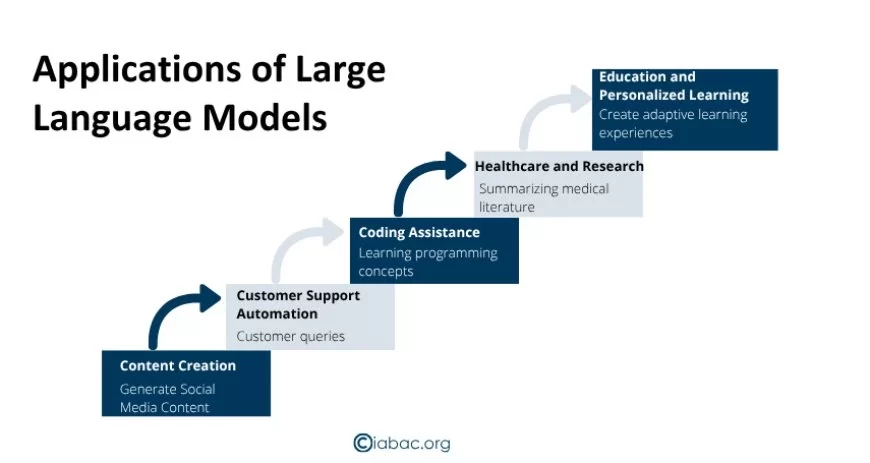
Real-World Applications of Large Language Models
LLMs are no longer experimental technologies. They are actively transforming industries across the world.
1) Content Creation
Content teams use AI language models to:
- Draft blogs
- Create product descriptions
- Generate social media content
- Summarize articles
- Brainstorm ideas
While human editing remains important, AI significantly speeds up the content creation process.
2) Customer Support Automation
Businesses use conversational AI systems to handle:
- FAQs
- Customer queries
- Ticket routing
- Basic troubleshooting
This improves response speed while reducing operational costs.
Modern AI support systems can understand intent rather than relying only on keyword matching.
3) Coding Assistance
Developers use LLM-based tools for:
- Code generation
- Debugging
- Documentation
- Learning programming concepts
These systems help improve productivity and reduce repetitive coding tasks.
4) Healthcare and Research
AI models assist researchers by:
- Summarizing medical literature
- Organizing research data
- Supporting diagnostics
- Accelerating drug discovery research
Healthcare organizations are also exploring AI-powered automation for administrative tasks.
5) Education and Personalized Learning
Educational platforms use AI systems to:
- Create adaptive learning experiences
- Generate quizzes
- Explain difficult topics
- Provide language learning support
- Students can receive personalized guidance based on their learning pace and interests.
Challenges and Limitations of LLMs
Despite their capabilities, Large Language Models still have important limitations.
Hallucinations and Incorrect Information
- One of the biggest challenges is AI hallucination.
- Sometimes models generate responses that sound accurate but contain incorrect or fabricated information.
- This happens because LLMs predict language patterns rather than verify facts like humans do.
- For critical industries such as healthcare or finance, human review remains essential.
Bias in AI Models
LLMs learn from internet-scale datasets, which may contain:
- Social biases
- Inaccurate information
- Harmful stereotypes
As a result, AI systems can unintentionally reflect those biases.
Researchers continue working on safer and more responsible AI systems.
Privacy and Data Concerns
Training AI models requires enormous amounts of data.
This raises concerns around:
- User privacy
- Data security
- Copyright usage
- Sensitive information handling
Organizations deploying AI systems must establish clear governance and compliance policies.
High Computing Costs
Training modern Large Language Models requires:
- Massive computing infrastructure
- Advanced GPUs
- Significant electricity consumption
This makes advanced AI development expensive and resource-intensive.
Ethical Concerns in AI
As AI systems become more powerful, ethical questions continue growing around:
- Misinformation
- Deepfakes
- Job displacement
- Decision transparency
- Responsible AI development
Balancing innovation with accountability will remain one of the biggest challenges in the AI industry.
Open-Source vs Closed Large Language Models
LLMs generally fall into two categories: open-source and closed models.
Open-Source Models:
Open-source LLMs allow developers to:
- Access model weights
- Customize behavior
- Fine-tune systems
- Deploy privately
These models encourage innovation and experimentation.
However, they may require technical expertise and infrastructure to manage effectively.
Closed Models
Closed AI models are typically controlled by organizations that manage:
- Infrastructure
- Training
- Updates
- Security layers
These systems are often easier to use and optimized for performance but provide less transparency.
Businesses choose between open and closed models based on:
- Budget
- Security needs
- Scalability
- Customization requirements
The Future of Large Language Models
The future of LLMs is moving toward more capable, efficient, and personalized AI systems.
Several trends are shaping the next phase of AI development.
Multimodal AI
Future AI systems will increasingly process:
- Text
- Images
- Audio
- Video
- Documents
This allows AI to understand information across multiple formats simultaneously.
Smaller and Efficient Models
Researchers are developing compact AI models that require fewer computing resources while maintaining strong performance.
This could make AI more accessible for smaller businesses and local devices.
AI Agents and Automation
AI systems are evolving from simple assistants into autonomous agents capable of:
- Completing workflows
- Using software tools
- Conducting research
- Managing tasks independently
This may reshape productivity across industries.
Personalized AI Systems
Future AI assistants will likely become more personalized, context-aware, and adaptive to individual user preferences.
This could significantly improve learning, productivity, and digital experiences.
Conclusion
Large Language Models are changing how humans interact with technology. What once required complex programming can now be achieved through natural language conversations and intelligent automation.
From content generation and customer support to healthcare research and enterprise workflows, LLMs are rapidly becoming part of modern digital infrastructure. At the same time, understanding their limitations, ethical concerns, and practical applications is becoming increasingly important for professionals across industries.
As AI adoption continues to grow, learning the fundamentals of generative AI, Natural Language Processing, and machine learning is no longer limited to technical experts alone. Businesses, educators, marketers, analysts, and developers are all beginning to explore how these systems can improve productivity and decision-making.
Organizations like IABAC are also contributing to this growing ecosystem by helping professionals build structured knowledge around AI technologies, practical applications, and emerging industry standards.
The technology behind Large Language Models will continue evolving, but one thing is already clear: AI literacy is becoming an essential skill in the modern digital world.