






















































What Is a Large Language Model?
Learn what a Large Language Model (LLM) is, how it works, and how it powers AI tools like chatbots, translators, and content generators.


A clear guide for people who build, market, or use AI
Large Language Models — often called LLMs — power the chatbots, writing assistants, and smart tools you use every day. But what are they, how do they work, and what should teams know before they start using them?
This guide explains LLMs in plain language, shows where they shine, points out common gaps in online explainers, and gives practical next steps you can use right away.
A short definition
A Large Language Model (LLM) is a type of AI trained on vast amounts of text to predict and generate language. It learns patterns — grammar, facts, tone, and common phrasing — so it can answer questions, draft text, summarize documents, translate, and more. LLMs do not “think” or have beliefs; they predict likely words and sentences based on what they learned during training.
How LLMs actually work — in plain terms
-
They read lots of text. During training, an LLM is fed huge collections of text (books, articles, web pages). The model sees billions of token sequences and learns which words follow which others.
-
They break text into tokens. Text is split into small pieces called tokens (words, parts of words, or punctuation). The model processes tokens, not whole sentences.
-
They learn by prediction. The training task is simple: predict the next token. Each time it guesses, it adjusts internal numbers (parameters) to reduce error. Over many cycles, the model captures patterns in language.
-
The transformer changed everything. Modern LLMs use the transformer architecture, introduced in 2017. Transformers use an attention mechanism that looks at the whole sentence (or paragraph) at once, rather than reading word by word. That lets models handle long-range context and produce fluent replies.
-
Fine-tuning and specialization. After base training, LLMs can be fine-tuned on specific data (customer support logs, legal text, marketing copy) to make them better at a particular job.
What LLMs do well — real examples
-
Drafting and editing content: blog outlines, social posts, product descriptions.
-
Summaries and research: pull key points from long reports.
-
Conversational agents: customer support, sales assistants, internal help desks.
-
Coding help: auto-complete, generate code snippets, explain logic.
-
Search + answer: combine search results into short answers when supported by retrieval systems.
These are not predictions — they’re already in practice across organizations.
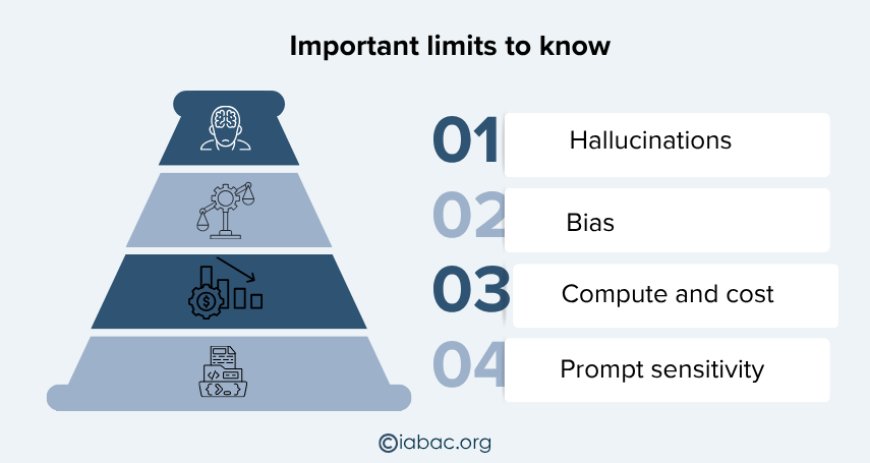
Important limits to know
-
Hallucinations: models sometimes state incorrect facts confidently because they predict plausible text, not verified facts. This is a common and critical limitation.
-
Bias: models reflect biases present in their training data; careful testing and mitigation are required.
-
Compute and cost: training and running large models can be expensive and energy intensive. Many teams use hosted APIs instead of training from scratch.
-
Prompt sensitivity: output quality depends a lot on how you prompt the model. Better prompts usually produce better results.
Key Areas to Understand When Working with LLMs
When you start exploring or building with Large Language Models, it helps to go beyond the basics. These core areas make the biggest difference in how effective, reliable, and scalable your use of LLMs can be.
1. Practical prompt patterns and examples
Most people know how to ask a model a question, but well-structured prompts produce better results.
Simple frameworks save time and improve consistency.
Try formats like:
-
“Summarize this document in five key points.”
-
“Rewrite this text in a professional but friendly tone.”
-
“Generate a blog outline for a product launch email.”
These prompt templates help teams work faster without constant trial and error.
2. Retrieval-Augmented Generation (RAG) and grounding
LLMs don’t always have the latest information. Retrieval-Augmented Generation fixes this by letting the model pull in relevant, verified documents before answering.
For example, a customer support bot can fetch the current return policy first, then generate a response based on it.
This makes replies more accurate, traceable, and easier to trust—especially in customer service or regulated fields.
3. Agent architectures and memory
Modern AI systems often go beyond a single response. They act as agents that can use tools, remember earlier steps, or call APIs.
An agent might plan tasks, fetch live data, and return results in one workflow.
To design such systems safely, consider authentication, rate limits, and memory management so interactions stay secure and efficient.
4. Evaluation and performance checks
Before deploying an LLM, it’s important to know how well it performs.
Create simple evaluation tests for factual accuracy, bias, and reliability.
Track metrics such as hallucination rate (wrong answers), response speed, and cost.
Consistent testing helps teams trust model outputs and improve them over time.
5. Open vs proprietary models and model documentation
Different models come with trade-offs.
Open-source models offer flexibility and control but require more setup. Proprietary ones like GPT or Claude may be easier to use but include data-sharing or licensing considerations.
Whichever you choose, keep a model card—a short document describing training data, intended uses, and known limitations.
This supports compliance, transparency, and good governance.
6. Cost, sustainability, and efficiency
Running large models can be expensive and energy-intensive.
Track inference costs, compute use, and carbon footprint.
Techniques like fine-tuning smaller models, caching frequent queries, or using RAG can reduce both costs and environmental impact.
Practical Checklist for Teams
If you’re planning to use LLMs in your product or content workflow, use this quick checklist as a guide:
-
Start with the problem, not the model. Define clear goals (e.g., reduce support time by 30%).
-
Use grounding for accuracy. Apply RAG or similar methods for verifiable, current answers.
-
Design evaluation tests. Measure factual accuracy, bias, and hallucination rates on real examples.
-
Plan for cost and latency. Estimate compute needs and explore optimizations like smaller fine-tuned models.
-
Document your model. Keep records of training data, intended uses, and safety notes.
-
Audit for bias and compliance. Check fairness and create protection plans for sensitive data.
-
Keep humans in the loop. Include reviewers for high-risk outputs and define when to escalate to human judgment.
A practical example — using RAG to improve answers
Imagine a customer support chatbot that needs to answer questions about a company’s return policy.
If it uses only an LLM, it might make up an answer or share an old policy by mistake.
With RAG (Retrieval-Augmented Generation), the system first looks up the latest return policy from the company’s database.
Then, it uses that information to write a clear and correct reply.
This method helps the bot give faster, more accurate answers — and it’s already being used by many businesses today.
Key technical concept: the Transformer (very short)
The reason LLMs can handle long context is the Transformer architecture (2017). Instead of processing words in order, transformers use attention to compare all words in a sentence at once. That makes training faster and allows the model to connect ideas across long text — the foundation for today’s LLMs. If you want the original technical paper, it’s “Attention Is All You Need” (Vaswani et al., 2017).
Ethics and safety — practical steps
-
Be explicit about AI use in customer-facing content.
-
Log queries and outputs (with privacy safeguards) so you can audit failures.
-
Use conservative settings for high-risk tasks (limit creative generation).
-
Add citations or document provenance when answers rely on external sources (RAG systems can track which doc provided each fact).
When not to use an LLM
-
For critical factual verification where mistakes have major consequences (legal judgments, medical diagnosis) without human expert oversight.
-
When the data is highly confidential and you cannot guarantee data handling safety under a vendor’s terms.
-
When a simpler rule-based system would be more transparent and cheaper.
When you publish a guide called “What is a Large Language Model?”, add short practical sections that many high-ranking pages omit:
-
Prompt templates for common tasks (one-line templates for summary, rewrite, and Q&A).
-
A short RAG primer with architecture diagram (retriever → ranker → generator).
-
Example evaluation checklist (accuracy tests, bias checks, latency targets).
-
Tradeoff table: open vs proprietary models, cost, latency, privacy.
-
Governance starter: model card template and simple redaction rules.
These additions make your post not just explanatory but actionable — and that’s what readers remember.