













































Agentic AI Is Reshaping Jobs in India - Are You Prepared?
Agentic AI is reshaping jobs in India by automating workflows, redefining roles, and increasing demand for new skills, creating opportunities and career gaps

Agentic AI is slowly taking over jobs that used to be done by people, and it's changing the way work is done all over India. Automation is handling tasks, smart systems are helping people make decisions, and workflows are becoming more self-sufficient than ever.
The real question is, are you ready for this shift? Or are you still working the old way while expectations move forward?
This isn’t about fear; it’s about awareness. As roles change around you, being able to adapt, understand, and work with artificial intelligence could affect the next steps in your career.
What Agentic AI Means for the Indian Workforce
Agentic AI is a step forward from tools that only respond to what happens. These systems can plan, think, and do things in more than one step without needing help from people all the time.
In India, businesses are actively adding these features to their operations. Companies across IT services, banking, and retail are changing how they operate by integrating AI into their workflows.
This is not a temporary trend; it is a long-term transformation where intelligent systems become part of everyday operations.
For professionals, this means that instead of doing tasks, they are now managing results. The expectation is not only to carry out tasks, but also to learn how systems function and influence decision-making.
The Scale of Job Transformation in India
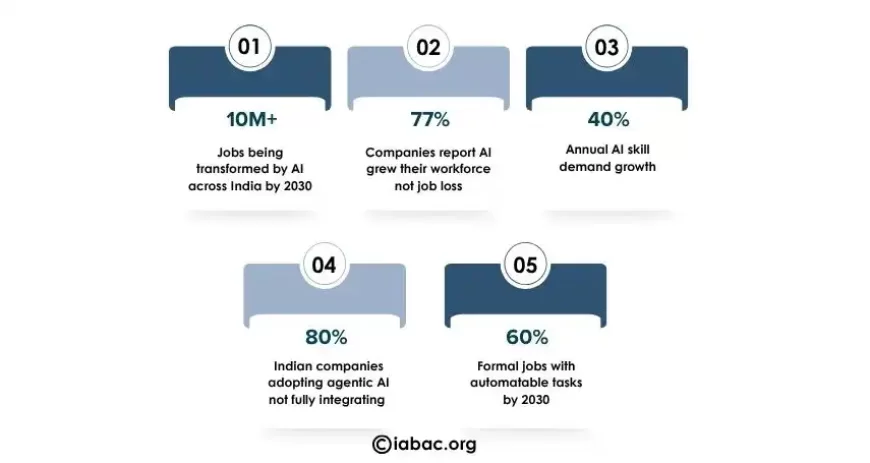
Agentic AI is not just influencing a few roles; it is transforming how work is structured across industries. The change is happening on a large scale, with millions of jobs being redefined instead of replaced.
This is creating a workforce that must collaborate with smart systems. This change is so big that AI is expected to change more than 10 million jobs in India by 2030.
-
A lot of jobs are changing into hybrid roles where AI does the work and people make decisions. 77% of companies say that adopting AI has helped their workforce grow instead of just losing jobs.
-
There is a huge shortage of people with AI-related skills, and demand for these skills is growing by 35–40% every year. This makes skilled professionals very valuable.
-
Companies are going from testing to fully integrating AI, and more than 80% of Indian companies are actively looking into autonomous AI systems.
-
Job transformation is happening at the task level. By 2030, more than 60% of formal sector jobs could be automated, so professionals need to change their responsibilities instead of changing careers completely.
Jobs That Are Changing the Fastest
Some jobs are changing quickly because of the nature of their work. Because these jobs involve structured and repeatable processes.
Customer service, data processing, operations, and entry-level IT roles are all being greatly affected. Agentic AI can handle these workflows quickly and easily, which means less work for people.
But this doesn't mean that these jobs are going away for good. They are changing instead. People who work in these roles are expected to:
-
Instead of doing things by hand, oversee processes that use AI.
-
Understand what AI systems produce.
-
Take care of exceptions and complicated situations that need human judgment.
At the same time, jobs like AI engineers, AI product managers, and AI governance specialists are growing quickly. These jobs are all about making, running, and making sure that AI systems are used in a responsible way.
From Job Replacement to Job Redesign
A lot of people think that AI takes over jobs completely. In reality, most jobs are being changed at the level of the tasks they do.
Instead of removing entire positions, AI is taking over specific tasks within those roles. This allows professionals to focus on higher-value activities such as strategy, decision-making, and innovation.
For example:
-
A business analyst is not just creating reports but interpreting AI-driven insights and influencing business decisions
-
A marketer is not just running campaigns but optimizing strategies using AI-generated predictions
-
An operations manager is not just managing processes but supervising autonomous systems
This shift is increasing the importance of skills that go beyond routine execution.
The Rise of Human + AI Collaboration
The future of work is not human versus AI; it is human+AI.
Agentic AI systems are capable of handling repetitive tasks, analyzing large volumes of data, and executing workflows efficiently. Humans, on the other hand, bring context, creativity, and critical thinking.
Professionals who can effectively collaborate with AI systems will have a clear advantage. This collaboration involves:
-
Understanding how AI systems make decisions
-
Validating outputs and ensuring accuracy
-
Using AI insights to drive business outcomes
Organizations are already seeing productivity improvements when teams integrate AI into their workflows effectively. This makes collaboration with AI a core skill rather than an optional one.
Industries in India Seeing the Biggest Shift
The impact of agentic AI is more visible in certain industries due to the nature of their operations.
-
Technology and IT services are seeing rapid adoption, with AI assisting in coding, testing, and deployment.
-
Banking and financial services are using AI for fraud detection, customer interaction, and risk analysis.
-
E-commerce and operations are leveraging AI for demand forecasting, logistics optimization, and personalized customer experiences.
-
Healthcare and FMCG sectors are using AI for predictive analytics and process improvements.
These shifts are creating new opportunities while also redefining existing roles within these industries.
Skills That Will Define Careers in the Agentic AI Era
As agentic AI becomes more common in workflows, the meaning of valuable skills is changing from doing things to understanding, interpreting, and making decisions. Professionals should do more than just learn how to use tools; they should also learn how to work in environments that are driven by AI.
-
Build a strong foundation in AI concepts, data handling, and how intelligent systems function in real-world scenarios
-
Develop critical thinking to evaluate AI outputs and make informed business decisions
-
Strengthen communication skills to translate AI-driven insights into actionable strategies
-
Focus on adaptability, as continuous learning becomes essential in a rapidly evolving technology landscape
Alongside these, there is increasing importance placed on understanding AI governance, ethics, and data privacy, as organizations prioritize responsible AI adoption.
How AI Certifications Help You Stay Relevant
While understanding this shift is important, the real advantage comes from building the right capabilities to adapt. AI certifications are becoming a practical way for professionals to align their skills with industry expectations. They provide structured learning that connects directly with how AI is being used across sectors.
-
Certifications help build a clear understanding of AI systems, enabling professionals to move beyond basic tool usage
-
They support career transitions by allowing individuals to combine domain knowledge with AI capabilities
-
Hands-on projects included in certifications provide exposure to real-world applications, improving confidence and readiness
-
Recognized certifications increase credibility, helping professionals stand out in competitive hiring environments
By bridging the gap between learning and application, certifications enable professionals to stay aligned with evolving job roles and industry demands.
The Salary and Opportunity Gap
One of the most noticeable outcomes of AI adoption is the increasing gap in opportunities and compensation.
People with AI skills are securing jobs and promotions faster, with higher earning potential than those without them. As more and more industries start using AI, this gap is likely to get bigger.
This highlights the importance of upskilling not just to remain employed but to stay competitive in a market where expectations are constantly evolving.
The Mindset Shift Professionals Need
The transition to agentic AI requires more than skill upgrades. It requires a mindset change.
-
From task execution to problem ownership: Professionals are expected to think beyond instructions and focus on outcomes.
-
From tools to systems thinking: Understanding how AI systems interact and make decisions becomes essential.
-
From job security to skill security: Relying on a role is risky. Building adaptable skills is critical.
Interestingly, while many professionals are excited about AI adoption, over 50% still worry about job security . This highlights the gap between awareness and readiness.
Challenges That Come with Agentic AI Adoption
While the opportunities are significant, there are challenges that professionals and organizations must address.
As AI systems deal with private information, worries about data security and privacy are becoming more important. In many organizations, there aren't clear governance frameworks, which can make things unclear.
The speed of change itself is a major challenge. It takes a lot of work to keep up with new tools, technologies, and ways of doing things. But these problems also give professionals who can solve them well a chance to shine.
What Being “Prepared” Actually Looks Like
When it comes to agentic AI, preparation means getting ready for how work is changing.
It involves building a combination of technical knowledge, business understanding, and adaptability. Professionals need to focus on how AI applies to their specific domain rather than trying to master everything at once.
Taking small, consistent steps such as learning AI basics, working on projects, and earning relevant certifications can make a significant difference over time.
The Future of Work in India with Agentic AI
India is in a strong position to benefit from this transformation due to its large talent pool and growing technology ecosystem.
The future workforce will be defined by individuals who can adapt to change, collaborate with intelligent systems, and create value beyond routine tasks.
Agentic AI is already influencing how companies hire, how roles are structured, and how careers grow. The question is not whether AI will impact your career, but how prepared you are to adapt to it.