
























































What is Artificial Intelligence in Healthcare?
What does artificial intelligence in healthcare mean? Its applications in diagnosis, treatment, patient care, and how it’s shaping the future of medicine.

Artificial intelligence (AI) is no longer only for tech experts. Today, it is being used in hospitals, clinics, and research centers to make healthcare better. From checking medical scans to helping with treatment choices, AI is becoming part of daily medical work.
But what does AI in healthcare actually mean? How is it used right now, and what could it bring in the future? This article explains the basics of AI in healthcare, its uses, benefits, challenges, and where it is heading.
What is Artificial Intelligence in Healthcare?
Artificial intelligence is the ability of machines or computer programs to perform tasks that usually require human intelligence. In healthcare, AI means using software and algorithms to help with medical tasks such as analyzing data, suggesting treatments, or automating routine work.
Several technologies form the base of AI in healthcare:
-
Machine learning (ML): Helps computers learn from large amounts of data and make predictions. For example, predicting the risk of a disease by analyzing patient history.
-
Natural language processing (NLP): Allows machines to understand and use human language. In healthcare, NLP can read and analyze doctors’ notes or research papers.
-
Computer vision: Enables computers to “see” and understand images, such as X-rays, MRIs, and CT scans, helping doctors identify problems more quickly.
-
Robotics: AI-powered robots support doctors in surgeries, assist in rehabilitation, and even deliver medical supplies inside hospitals.
AI in healthcare is not about replacing doctors but about giving them better tools to make decisions and improve patient care.
Where AI is Used in Healthcare
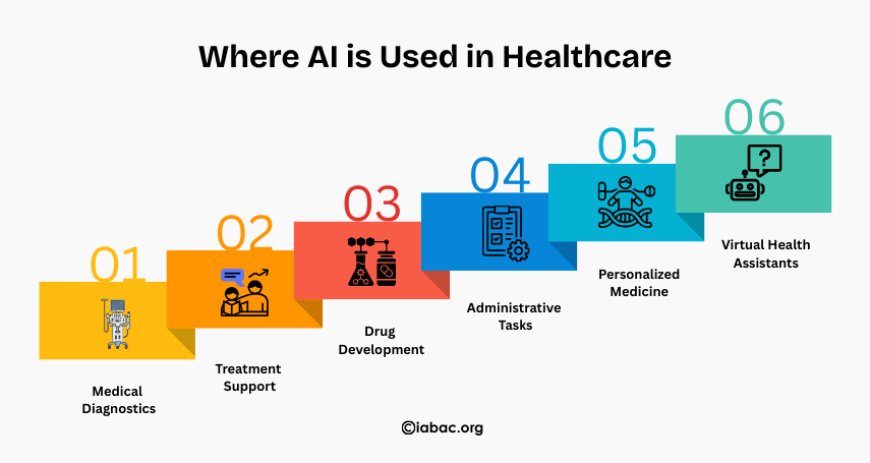
AI is already being used in many areas of healthcare. Some of the most common examples include:
1. Medical Diagnostics
AI systems help doctors analyze medical images like X-rays and MRIs. These systems can detect diseases such as cancer, fractures, or infections by spotting patterns that may be too subtle for the human eye.
2. Treatment Support
AI can compare a patient’s condition with a large amount of medical data to suggest possible treatment plans. Doctors still make the final call, but AI provides useful insights and evidence-based recommendations.
3. Drug Development
Developing new drugs is often slow and expensive. AI speeds up the process by predicting which compounds are most likely to work, saving both time and resources.
4. Administrative Tasks
AI tools can automate scheduling, billing, and updating patient records. By reducing paperwork, healthcare professionals can spend more time focusing on patients.
5. Personalized Medicine
Everyone’s body responds differently to treatment. AI can analyze genetic data and lifestyle information to create more personalized treatment plans, especially in cancer care.
6. Virtual Health Assistants
AI-powered chatbots and digital assistants give patients reminders to take medicine, answer basic health questions, or provide guidance for managing chronic conditions. These tools are also valuable in rural areas where access to doctors is limited.
Benefits of AI in Healthcare
The use of AI brings several advantages:
-
More accurate diagnoses: AI can find small details in scans or lab results that humans might miss, helping detect diseases earlier.
-
Faster data analysis: AI can go through huge amounts of medical data quickly, allowing faster decision-making.
-
Less administrative work: Automating routine tasks reduces the workload for doctors and nurses.
-
Better patient care: With AI-driven personalized plans and remote monitoring, patients get care suited to their specific needs.
-
Lower costs: By improving efficiency and speeding up research, AI can help reduce overall healthcare costs.
Challenges of Using AI in Healthcare
AI in healthcare is promising, but it also faces challenges that need careful attention:
1. Protecting Patient Data
AI systems require access to large amounts of patient data, which raises concerns about privacy and security. Safeguarding this information is a top priority.
2. Algorithm Bias
AI can only be as good as the data it is trained on. If the data does not include all patient groups, the system may give less accurate results for some populations.
3. High Costs of Implementation
Setting up AI systems can be expensive. Smaller hospitals or clinics may find it difficult to invest in the technology.
4. Ethical Questions
If an AI system makes a mistake, it is not always clear who is responsible—the developer, the hospital, or the doctor. This raises important ethical questions.
5. Regulatory Approval
Before AI systems can be used widely, they must meet safety and quality standards. Regulations are still developing in many countries, which can slow down adoption.
The Future of AI in Healthcare
AI has a strong future in healthcare, with many potential directions for growth:
-
Genomics: AI can study a person’s DNA to predict risks for certain diseases and suggest preventive measures.
-
Predictive healthcare: By analyzing patterns in patient data, AI can forecast the likelihood of hospital readmissions or disease outbreaks.
-
Remote healthcare: AI-powered telemedicine will continue to expand, helping patients in remote or underserved regions access quality care.
-
Human-AI teamwork: AI will not replace doctors. Instead, it will work alongside them, supporting clinical decisions and managing routine tasks.
-
Clear guidelines and standards: As AI adoption grows, there will be greater focus on making AI systems transparent, fair, and accountable.
Balancing Potential with Responsibility
AI in healthcare offers great opportunities, but it also comes with responsibilities. It can improve accuracy, efficiency, and patient experience. At the same time, it requires strong measures to protect data, ensure fairness, and establish trust between patients and providers.
The success of AI in healthcare depends on cooperation between technology companies, healthcare workers, policymakers, and patients. Used responsibly, AI can become a powerful partner in creating better healthcare systems.
Artificial intelligence is changing healthcare in important ways. It helps doctors diagnose diseases, supports treatment planning, speeds up drug discovery, and reduces routine administrative work. It also enables personalized medicine and makes healthcare more accessible through virtual assistants and remote monitoring.
Yet, challenges like privacy, bias, and ethical responsibility need to be addressed. AI should not be seen as a replacement for human expertise but as a tool that supports it.
The future of healthcare will likely be shaped by collaboration—where the strengths of human judgment and compassion are combined with the speed and accuracy of AI. For patients, this means better and more personalized care. For healthcare professionals, it means more time to focus on what matters most: improving lives.