





















































Top 10 AI Terms Every Beginner Should Know
Understand the top 10 AI terms in simple language. This beginner-friendly guide helps you learn AI basics & see how these concepts work together in real life.


AI adoption is already mainstream. According to McKinsey, over 50-70% of organizations use AI in at least one business function, and it’s built into many tools you interact with daily.
Yet most people get stuck trying to understand how it actually works.
The challenge isn’t coding - it’s the terminology. Terms like machine learning, neural networks, and generative AI are introduced early, but often without clear context or connection.
Without that clarity, everything feels more complicated than it needs to be. Get the fundamentals right, and learning AI becomes far more straightforward.
10 AI Terms You Must Know Before Learning AI
1. Artificial Intelligence (AI)
Artificial intelligence refers to machines designed to perform tasks that typically require human thinking, such as understanding, reasoning, or decision-making. Instead of following fixed instructions, these systems adapt based on the data they receive. Over time, they handle more complex tasks across different situations.
You experience this when apps suggest products based on your browsing behavior.
A report by International Data Corporation (IDC) states that AI could contribute up to $19.9 trillion to the global economy by 2030, accounting for nearly 3.5% of global GDP, highlighting its massive long-term impact.
2. Machine Learning (ML)
Machine learning is a way for AI systems to learn from data without being explicitly programmed for every step. Instead of relying on fixed rules, the system improves by identifying patterns as it processes more data. The more it learns, the more accurate its outputs become. This is why recommendations and spam filters improve over time.
Use Case: Email systems improving spam filtering over time.
3. Deep Learning
Deep learning is an advanced form of machine learning used to process complex data such as images, voice, or text. It uses multiple layers to break down information step by step, helping the system understand patterns at different levels. Because of this layered approach, deep learning models can handle tasks that simpler systems cannot. This is what enables technologies like facial recognition and voice assistants.
Use Case: Face recognition or voice processing in real time.
4. Neural Networks
Neural networks are the systems that make deep learning possible, processing data through interconnected layers. Each layer captures small patterns that combine into a broader understanding of the input. This helps machines detect relationships that basic methods often miss.
Use Case: Image recognition and speech processing systems.
5. Natural Language Processing (NLP)
Natural language processing in AI focuses on how machines understand and respond to human language. It allows systems to interpret not just words, but also meaning, context, and intent. This makes interactions feel more natural in text and speech. NLP is what enables chatbots, translation tools, and voice assistants to communicate effectively.
You see this when chatbots respond to queries or voice assistants follow commands.
6. Generative AI
Generative AI refers to systems that create new content based on patterns learned from existing data. Instead of just analyzing information, these models can generate text, images, code, and more. The output often resembles human-created content because it learns from large datasets. This shift from analysis to creation is what makes generative AI widely used in content and design workflows.
Use Case: Tools generating blog content, images, or code from prompts.
7. Algorithm
An algorithm is a set of instructions that tells a system how to process data and solve a problem. In AI, algorithms define how inputs are analyzed and how decisions or predictions are made. Different algorithms are used depending on the type of task and data involved. Search rankings and recommendations depend on how these algorithms are designed.
Use Case: Search engines ranking results or generating recommendations.
8. Training Data
Training data is the information used to teach an AI system how to recognize patterns and make decisions. The system learns by analyzing this data and adjusting its outputs based on what it finds. Data quality directly affects system accuracy. Poor or limited data can lead to unreliable results.
Use Case: Labeled image datasets used to train object recognition systems.
9. Model
A model is the result of training an AI system on data. It represents what the system has learned and is used to make predictions or decisions when new data is introduced. Once trained, the model can be applied in real-world scenarios without needing to start from scratch. This is the component that actually runs behind applications powered by AI.
Use Case: A system predicting what products a user might buy next.
10. Automation
Automation in AI refers to using systems to perform tasks without constant human input. It is commonly applied to repetitive or time-consuming processes where consistency and speed are important. It reduces manual effort and improves efficiency. AI automation is often one of the first practical uses of AI in everyday workflows.
Use Case: Chatbots handling customer queries without human support.
How These AI Terms Work Together
To understand how these terms connect, think about how a typical app works when you use it.
When you browse a shopping app, every click, search, and interaction becomes training data. This data is processed using algorithms to identify patterns in your behavior.
Based on these patterns, machine learning builds a model that predicts what you might be interested in next.
For more complex tasks - like recognizing images or understanding voice - deep learning and neural networks come into play, helping the system process information at a deeper level.
If you search using text or voice, natural language processing (NLP) helps the system understand your intent.
In some cases, generative AI is used to create personalized content, such as product descriptions or recommendations.
Finally, all of this is applied through automation, allowing the system to deliver results instantly without manual effort.
AI vs Machine Learning vs Deep Learning
As a beginner, understanding the difference between AI, machine learning, and deep learning makes everything easier to follow - because these terms come up in almost every AI concept you’ll learn next.
|
Aspect |
AI |
Machine Learning |
Deep Learning |
|
Core concept |
Broad concept of intelligent machines |
Subset of AI that learns from data |
Subset of ML using neural networks |
|
Complexity level |
Low to high (depends on system) |
Moderate |
High |
|
Use Cases |
General tasks |
Pattern-based predictions |
Complex tasks (vision, speech) |
|
Data Dependency |
Optional |
Requires data |
Requires large datasets |
|
Real-world examples |
Chatbots, recommendation systems |
Spam filters, product suggestions |
Image recognition, voice assistants |
Common Mistakes Beginners Make When Learning AI
Beginners often get stuck in AI because of a few common mistakes. Avoiding these early makes learning much clearer and more practical.
-
Assuming AI thinks like humans: AI does not actually understand meaning. It identifies patterns in data and predicts outcomes.
-
Believing AI improves on its own: Systems need continuous training, updated data, and human input to perform better.
-
Focusing only on algorithms: Data quality is just as important. Poor data leads to poor results, even with strong models.
-
Expecting instant results: AI systems require testing, tuning, and iteration before they become reliable.
-
Trusting AI outputs completely: Results are based on probability and can sometimes be incorrect.
-
Thinking AI replaces human roles: AI supports tasks, but human judgment and decision-making are still essential.
-
Jumping into tools without basics: Understanding core concepts matters more than using tools alone.
A Quick Recap
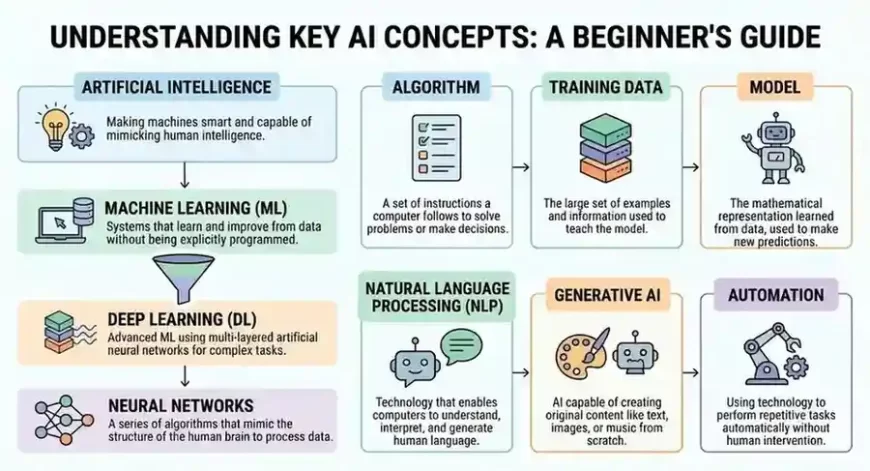
-
Artificial Intelligence (AI): The broader concept of machines performing tasks that require human-like thinking
-
Machine Learning (ML): Enables systems to learn from data and improve over time
-
Deep Learning: Handles complex tasks using layered neural networks
-
Neural Networks: The underlying systems that detect patterns and relationships in data
-
Natural Language Processing (NLP): Allows machines to understand and respond to human language
-
Generative AI: Creates new content such as text, images, or code based on learned patterns
-
Algorithm: The set of rules that determines how data is processed and decisions are made
-
Training Data: The data used to teach AI systems how to recognize patterns
-
Model: The trained system that makes predictions based on learned data
-
Automation: Applies AI to perform tasks with minimal human intervention
Understanding these core AI terms goes beyond definitions - it helps you see how AI systems actually work in real scenarios. Once this foundation is clear, exploring advanced concepts, tools, and applications becomes much easier to navigate.
If you want to take this further, the next step is applying these concepts in real situations—working with data, building models, and understanding how decisions are made. A structured AI certification from a global certification body like IABAC can help you bridge that gap with practical exposure and guided learning.
Move beyond understanding. Start building with AI. If you need guidance on where to begin or how to apply these concepts, the team at IABAC can help you take the next step.
FAQs
Why should beginners learn AI terms first?
Learning AI terms first helps you understand how different concepts connect. Without that clarity, it’s easy to get confused when topics like machine learning or models come up later.
Is AI difficult to learn?
The difficulty usually comes from unfamiliar terms, not the concepts themselves. Once you understand the key terms, the learning process becomes much more straightforward.
What is the difference between AI and machine learning?
AI is the overall goal — making machines perform intelligent tasks. Machine learning is one way to achieve that, where systems improve by learning from data instead of being manually programmed.
What is the difference between machine learning and deep learning?
Machine learning works well with structured data and simpler patterns, while deep learning is designed for complex data like images, audio, and language using neural networks.
Where are AI concepts used in real life?
You see them in everyday tools, recommendations on shopping or streaming apps, spam filters in email, voice assistants, chatbots, and even fraud detection in banking.