



















































Why Deep Learning Models Are So Powerful
Deep learning models are powerful because they learn complex patterns, handle massive data, and improve accuracy through layered neural networks.


Technology has quietly become part of our daily life. From unlocking a phone using face recognition to getting movie suggestions that feel surprisingly accurate, there is something smart working behind the scenes. That “something” is often Deep Learning, a powerful part of Artificial Intelligence that helps machines learn from data in a way that feels close to how humans learn.
At IABAC, learners often ask simple yet important questions:
- What do you mean by deep learning?
- Is ChatGPT deep learning?
- Why do we call it deep learning?
- What is machine learning vs deep learning?
This blog answers all of these questions clearly and calmly, without heavy technical language. By the end, you will understand why deep learning models are trusted across industries and why becoming a Certified Deep Learning Expert can be a strong career move.
What Do You Mean by Deep Learning?
Deep learning is a part of Artificial Intelligence that allows computers to learn from large amounts of data using layered structures called neural networks.
Think of it like teaching a child:
- First, the child learns simple things
- Then patterns
- Then meaning
- Then decision-making
Deep learning works in a similar way. It uses many layers of learning to understand:
- Images
- Text
- Speech
- Videos
- Numbers
Each layer learns something new and passes it forward. Over time, the system becomes better without being told every rule.
Simple Example
If you want a system to identify cats in photos:
- Traditional programs need rules like ear shape, eye size, tail length
- Deep learning learns these features on its own by seeing many images
That ability makes Deep Learning very powerful.
Why Do We Call It Deep Learning?
The word “deep” comes from the structure of the model.
A deep learning model has:
- An input layer (where data enters)
- Many hidden layers (where learning happens)
- An output layer (where results appear)
The more hidden layers a model has, the “deeper” it becomes.
Each layer learns something different:
- Early layers notice simple details
- Middle layers combine those details
- Later layers understand meaning
This layered learning is why deep learning can handle complex tasks like:
- Language translation
- Medical image analysis
- Voice assistants
- Fraud detection
Is ChatGPT Deep Learning?
Yes, ChatGPT is built using deep learning.
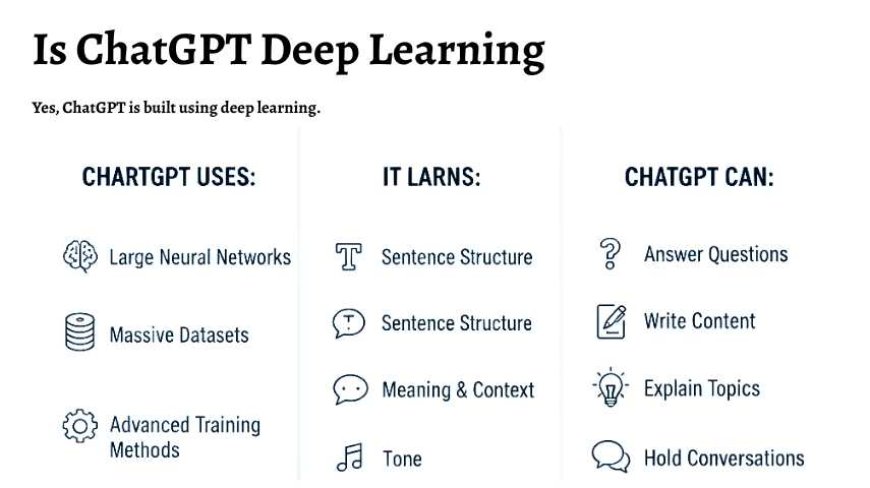
It is trained on huge amounts of text data from many sources, which teaches it how people write and communicate. With advanced training methods, ChatGPT learns by predicting words and sentences, improving its understanding over time.
Through training, ChatGPT learns:
-
How sentences are formed
-
What words and sentences mean
-
How to understand context in a conversation
-
How to recognize tone, such as formal or casual
Because of this, ChatGPT can:
-
Answer questions
-
Write different types of content
-
Explain topics in an easy way
-
Have natural conversations with people
This is what allows ChatGPT to respond in a helpful and human-like manner.
Behind every response is a deep learning model trained on text patterns. It does not think like humans, but it recognizes patterns extremely well.
This is a strong example of how Deep Learning supports modern Artificial Intelligence systems.
Why Deep Learning Models Are So Powerful
Deep learning models stand out because they can learn without constant instructions. Once trained, they improve by experience.
Here’s what gives them their strength:
1. Ability to Learn from Large Data
Deep learning performs better when more data is available. This makes it ideal for industries that generate huge datasets, such as healthcare, finance, and technology.
2. Automatic Feature Learning
Unlike older methods, deep learning does not rely heavily on manual rules. It learns patterns directly from data.
3. High Accuracy
When trained well, deep learning models deliver impressive accuracy in tasks like:
- Image detection
- Voice recognition
- Language understanding
4. Real-Time Decision Making
These models can process information quickly, making them suitable for live systems such as:
- Recommendation engines
- Chatbots
- Security systems
What Is Machine Learning vs Deep Learning?
Many beginners get confused between machine learning and deep learning. Let’s clear it up simply.
Machine Learning
Machine learning is a broader concept where systems learn from data using algorithms.
Key points:
- Needs structured data
- Often requires manual feature selection
- Works well with smaller datasets
Examples:
- Email spam filters
- Credit score prediction
- Product recommendations
Deep Learning
Deep learning is a part of machine learning.
Key points:
- Uses neural networks
- Learns features automatically
- Handles large and complex data
Examples:
- Face recognition
- Speech-to-text systems
- Language models like ChatGPT
Quick Comparison Table
|
Feature |
Machine Learning |
Deep Learning |
|
Data size |
Small to medium |
Large |
|
Feature selection |
Manual |
Automatic |
|
Complexity |
Moderate |
High |
|
Accuracy |
Good |
Very high |
|
Human effort |
More |
Less |
Both are important, but deep learning handles complex problems better.
How Deep Learning Is Used in Real Life
Deep learning is not limited to research labs. It plays a role in everyday experiences.
Healthcare
- Disease detection
- Medical image analysis
- Patient risk prediction
Finance
- Fraud detection
- Credit assessment
- Market trend analysis
Retail
- Personalized shopping suggestions
- Demand forecasting
- Customer behavior analysis
Education
- Smart learning platforms
- Performance tracking
- Skill recommendations
These uses explain why companies value professionals trained in Deep Learning and Artificial Intelligence.
Why Deep Learning Matters for Careers
Industries are changing fast, and skills decide growth.
Learning deep learning helps you:
- Work on advanced AI projects
- Handle real-world data problems
- Build intelligent systems
- Increase job opportunities
Roles related to deep learning include:
- AI Engineer
- Data Scientist
- Machine Learning Specialist
- AI Research Analyst
Having a recognized credential like Artificial Intelligence Certification from IABAC helps employers trust your skills.
Why Choose IABAC for Deep Learning and AI Certification
IABAC (International Association of Business Analytics Certifications) focuses on global standards and industry relevance.
What Makes IABAC Different
- Industry-aligned curriculum
- Practical skill focus
- Globally recognized certifications
- Career-oriented learning
Programs such as Certified Deep Learning Expert help learners gain confidence and job-ready knowledge.
IABAC certifications are designed for:
- Students
- Working professionals
- Career changers
- Business leaders
How Artificial Intelligence and Deep Learning Work Together
Deep learning is a core part of Artificial Intelligence, but AI is broader.
AI includes:
- Rule-based systems
- Machine learning
- Deep learning
- Decision support systems
Deep learning strengthens AI by:
- Improving accuracy
- Handling complex data
- Supporting automation
That is why most modern AI systems rely heavily on deep learning models.
Challenges in Deep Learning (Yes, There Are Some)
Even powerful tools have limits.
Some common challenges:
- Requires large datasets
- Needs strong computing resources
- Training can take time
- Model tuning needs skill
This is why structured learning and expert guidance are important.
Learning Deep Learning
Many learners start feeling unsure:
“Is this too complex?”
“Can I really learn this?”
Then something changes.
A model works.
Results improve.
Confidence grows.
That moment makes the journey worth it.
With proper guidance, learning deep learning becomes exciting rather than stressful.
Deep learning has changed how machines understand the world. It supports voice assistants, recommendation engines, medical systems, and smart applications that touch daily life. Understanding what deep learning means, how it works, and how it differs from machine learning gives clarity and direction.
For anyone planning a future in AI, learning deep learning through a trusted body like IABAC and earning an Artificial Intelligence Certification or Certified Deep Learning Expert credential can be a meaningful step. Technology will keep growing, and those who understand how machines learn will always have a place in it.