




























































What Is a Neural Network in Machine Learning?
What a neural network in machine learning is, how it works, types, examples, and real-world applications—explained simply for beginners.


Artificial Intelligence (AI) has quietly become a part of our daily lives. From unlocking smartphones with our faces to getting movie recommendations on streaming platforms, intelligent systems are working behind the scenes all the time. One of the most important technologies making this possible is the neural network in machine learning.
If you are new to machine learning, the term “neural network” might sound complex or intimidating. Many people assume it involves advanced mathematics or deep scientific knowledge. In reality, the basic idea behind neural networks is surprisingly simple. They are inspired by how the human brain learns from experience and recognizes patterns.
What Is a Neural Network in Machine Learning?
A neural network in machine learning is a computational model designed to recognize patterns, learn from data, and make decisions or predictions without being explicitly programmed for every scenario.
In simple words, a neural network learns by example.
Just like humans learn to identify objects after seeing many examples, neural networks learn by analyzing large amounts of data. They adjust themselves based on mistakes and gradually improve their accuracy over time.
Human Brain Analogy
The concept of neural networks is inspired by the human brain:
-
The brain contains billions of neurons.
-
Neurons receive signals, process them, and send outputs.
-
Learning happens by strengthening or weakening connections between neurons.
Similarly, an artificial neural network consists of artificial neurons that process input data, pass information forward, and produce an output.
Neural Networks, Machine Learning, and Artificial Intelligence
To avoid confusion, let’s clarify how these terms are connected:
-
Artificial Intelligence (AI): The broad goal of creating machines that can think or act like humans.
-
Machine Learning (ML): A subset of AI where systems learn from data instead of being explicitly programmed.
-
Neural Networks: A subset of machine learning that mimics how the human brain learns patterns.
So, neural networks are one of the most powerful tools used in machine learning to build intelligent systems.
History and Evolution of Neural Networks
The idea of neural networks is not new. It dates back to the 1940s when scientists began studying how neurons in the brain communicate.
However, early neural networks faced major limitations:
-
Lack of computing power
-
Limited data availability
-
Inefficient training methods
As a result, interest in neural networks declined for many years.
The revival happened in the 2010s due to:
-
Massive amounts of digital data
-
Powerful GPUs and cloud computing
-
Improved algorithms like backpropagation
-
Growth of deep learning
Today, neural networks are at the core of modern AI systems and power many real-world applications.
How Neural Networks Work (Step-by-Step Explanation)

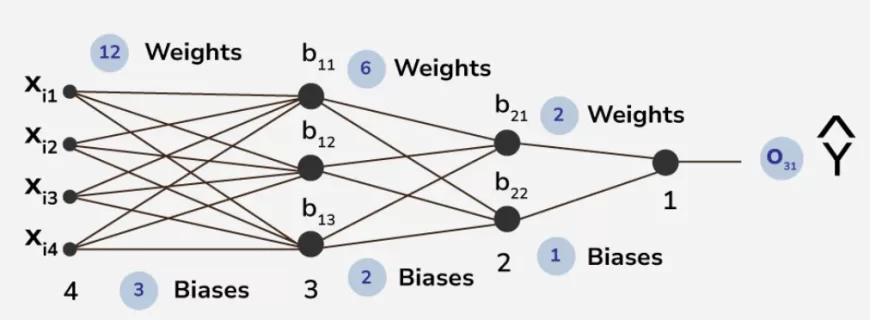
Understanding how neural networks work becomes easy when we break it down into steps.
1. Input Layer
The input layer receives raw data.
Examples:
-
Image pixels
-
Text data
-
Numbers such as age, income, or temperature
Each input is passed to the next layer for processing.
2. Hidden Layers
Hidden layers are where the actual learning happens.
Each hidden layer contains neurons that:
-
Multiply inputs by weights
-
Add bias
-
Apply an activation function
-
Pass the result forward
A neural network can have one or many hidden layers, depending on complexity.
3. Output Layer
The output layer produces the final result, such as:
-
Yes or No
-
Category (spam or not spam)
-
Predicted value (price, score, probability)
4. Learning From Mistakes
Neural networks learn by comparing predictions with actual results:
-
If the prediction is wrong, the error is calculated
-
Weights are adjusted to reduce the error
-
This process repeats until accuracy improves
This learning process is called training.
Key Components of a Neural Network
Let’s look at the core building blocks that make neural networks work.
Neurons (Nodes)
Neurons are the basic processing units. They receive inputs, perform calculations, and pass outputs forward.
Layers
Neural networks are structured in layers:
-
Input layer
-
One or more hidden layers
-
Output layer
Weights
Weights determine how important each input is. Higher weights mean greater influence on the output.
Bias
Bias helps shift the output and improves model flexibility.
Activation Functions
Activation functions decide whether a neuron should activate or not. They introduce non-linearity, allowing neural networks to learn complex patterns.
Types of Neural Networks in Machine Learning
Different problems require different neural network architectures.
1. Artificial Neural Networks (ANN)
-
Basic neural network structure
-
Used for simple classification and prediction tasks
-
Common in structured data problems
2. Convolutional Neural Networks (CNN)
-
Designed for image and visual data
-
Excellent at detecting patterns like edges and shapes
-
Widely used in face recognition and medical imaging
3. Recurrent Neural Networks (RNN)
-
Designed for sequential data
-
Can remember past information
-
Used in speech recognition, language translation, and time-series analysis
4. Deep Neural Networks (DNN)
-
Neural networks with multiple hidden layers
-
Capable of learning very complex patterns
-
Foundation of deep learning systems
Neural Network vs Traditional Machine Learning
|
Aspect |
Traditional Machine Learning |
Neural Networks |
|
Feature Engineering |
Manual |
Automatic |
|
Data Type |
Structured data |
Structured & unstructured |
|
Accuracy |
Moderate |
High |
|
Scalability |
Limited |
Highly scalable |
|
Human Effort |
High |
Lower after setup |
Traditional machine learning relies heavily on human-designed features, while neural networks automatically learn features from raw data.
Real-World Applications of Neural Networks

Neural networks are everywhere, often without us realizing it.
-
Face unlock on smartphones
-
Object detection in photos
-
Medical image analysis
Speech Recognition
-
Voice assistants
-
Speech-to-text applications
-
Call center automation
Natural Language Processing
-
Chatbots
-
Language translation
-
Text summarization
Recommendation Systems
-
Movies and music suggestions
-
Product recommendations
-
Personalized content feeds
Finance and Healthcare
-
Fraud detection
-
Credit scoring
-
Disease diagnosis
Advantages of Neural Networks in Machine Learning
Neural networks offer several powerful benefits:
-
Ability to learn complex patterns
-
High accuracy with large datasets
-
Automatic feature extraction
-
Continuous improvement with more data
-
Versatility across industries
These strengths make neural networks a preferred choice for advanced machine learning tasks.
Limitations and Challenges of Neural Networks
Despite their power, neural networks have limitations:
-
Require large amounts of data
-
High computational cost
-
Long training times
-
Difficult to interpret (black box problem)
-
Risk of overfitting
Understanding these challenges helps set realistic expectations.
Neural Networks, Deep Learning, and AI: How They Connect
Neural networks are the foundation of deep learning, which uses multiple layers to learn complex representations of data. Deep learning itself is a subset of machine learning, which belongs to the broader field of AI.
In short:
AI → Machine Learning → Deep Learning → Neural Networks
Why Neural Networks Are Important for the Future
Neural networks are shaping the future of technology:
-
Powering autonomous systems
-
Driving automation and smart decision-making
-
Creating new career opportunities
-
Advancing healthcare, finance, and education
As data continues to grow, neural networks will become even more critical.
A neural network in machine learning is a powerful technique that enables computers to learn from data in a way similar to the human brain. By understanding how neural networks work, their components, types, and applications, you gain a strong foundation in modern AI.
Whether you are a student, professional, or curious learner, learning neural networks opens the door to exciting opportunities in the world of artificial intelligence. As technology evolves, neural networks will continue to play a central role in shaping intelligent systems of the future.