


























































What Are Artificial Neural Networks?
Artificial Neural Networks explained with clear examples. Learn how ANNs work, where they’re used, and why they power today’s leading AI systems.

The Technology That Finally Learned to Think
If you’re reading this, there’s a good chance you’ve already felt the shift.
AI isn’t futuristic anymore.
It’s everywhere in your phone, your job, your feeds, your recommendations, your search results. AI went from “interesting” to “inevitable,” and behind almost all of this transformation sits one quiet hero:
Artificial Neural Networks (ANNs).
They are the reason:
-
Cars can drive themselves
-
Phones can recognize faces
-
Cameras can detect intruders
-
Chatbots understand language
-
Hospitals predict diseases
-
Apps recommend what you want before you know you want it
But here’s the truth, most explanations of neural networks are painful to read.
Too mathematical.
Too abstract.
Too robotic.
Too disconnected from real-world work.
So this guide fixes that.
You’re about to understand exactly what Artificial Neural Networks are,
how they work,
Why they matter,
and what role they play in the AI world of 2026 all in simple, human language, built with clarity, visuals, analogies, and real examples.
Let’s start with the simplest question.
What Is an Artificial Neural Network (ANN)?
Imagine trying to teach a computer something you yourself don’t know how to explain.
How do you explain what a “cat” is?
You can list features: whiskers, ears, tail… but none of these rules define every cat.
Yet a 5-year-old can instantly recognize a cat.
Why?
Because humans don’t “learn by rules” we learn by examples.
Artificial Neural Networks are the same.
Simple Definition:
An Artificial Neural Network is a computer system designed to learn patterns from data just like the human brain learns from experience.
You don’t give it rules.
You give it examples.
It figures out the rules on its own.
That’s why ANNs are the foundation of Deep Learning and modern AI.
How Artificial Neural Networks Work
Let’s break ANN into tiny, clear pieces.
1. Neurons (The Basic Unit)
A neuron in ANN is just:
-
Takes input: A neuron receives numerical values from the previous layer as its input.
-
Does a small calculation: It multiplies the inputs by weights, adds bias, and applies an activation function.
-
Sends output forward: The neuron passes its final value to the next neuron or next layer in the network.
That’s it.

Biological Neuron vs Artificial Neuron
|
Biological Neuron |
Artificial Neuron |
|
Found in the human brain |
Found in AI models |
|
Gets signals from dendrites |
Gets inputs (numbers) |
|
Processes signals electrically |
Processes inputs with math |
|
Sends output through axon |
Sends output to next neuron |
|
Learns by changing synapses |
Learns by changing weights |
|
Uses chemical signals |
Uses numerical values |
|
Natural and organic |
Man-made and digital |
2. Weights (The Learning Power)
-
Every neuron has weights numbers the model adjusts during training.
Think of weights like volume knobs that the neural network keeps tuning until the pattern becomes clear.
-
If the weight is high → the neuron “cares” about that feature.
A high weight means the network is saying, “This detail matters a lot pay attention!”
-
If the weight is low → it “ignores” it.
A low weight means, “This detail isn’t important you can mostly skip it.”
-
Weights are the memory of the neural network.
Everything the network learns every pattern, every rule, every insight is stored inside these weights, not in text or code.
3. Activation Function (The Decision Maker)
Activation functions decide:
“Should this neuron fire or stay quiet?”
Like how your brain decides what’s important.
Common ones:
-
ReLU: ReLU outputs only positive values, helping the network learn faster.
-
Sigmoid: Sigmoid squeezes numbers between 0 and 1, useful for yes/no predictions.
-
Tanh: Tanh outputs values between 1 and 1, giving smoother, centered results.
4. Layers (Where the Magic Happens)
An ANN has:
Input Layer → Hidden Layers → Output Layer
Think of it like stages:
-
Input layer: reads raw data
-
Hidden layers: extract patterns
-
Output layer: gives final prediction
The more hidden layers you have, the deeper the network welcome to Deep Learning.
5. The Learning Process (Very Simple Explanation)
ANN learns in two steps:
Step A: Forward Pass
Data goes through the layers, and ANN makes a prediction.
Step B: Backpropagation
ANN compares its prediction with the actual answer.
If wrong → it adjusts its weights.
If right → it strengthens correct connections.
Over thousands of iterations, ANN becomes smart.
It’s the digital version of learning from mistakes.
Types of Artificial Neural Networks (You’ll See These Everywhere)
Each type of ANN has a different job.
Let’s make it simple:
1. Feedforward Neural Network (FNN)
The simplest ANN where data moves from input to output in one direction. Used for basic tasks like classification, regression, and prediction.
2. Convolutional Neural Network (CNN)
A neural network made for images. It detects edges, shapes, and objects, powering face recognition, medical scans, and AI camera features.
3. Recurrent Neural Network (RNN)
A network that remembers past information, making it ideal for text, speech, and time-series tasks like transcription and trend prediction.
4. LSTM & GRU Networks
Smarter versions of RNNs that can remember longer sequences. Used in chatbots, translations, voice assistants, and long text or audio analysis.
5. Radial Basis Function Networks (RBFN)
Networks that make very precise decisions. Commonly used in anomaly detection, industrial monitoring, and control systems.
6. Hybrid Neural Models
Models that combine multiple ANN types (like CNN + RNN + Transformers) to solve complex problems such as autonomous driving, robotics, NLP, and recommender systems.
Real-World Applications of ANN (2026 Edition)
Let’s go industry by industry with USA + India relevance.
1. Healthcare
-
Disease prediction: ANNs analyze patient history and medical patterns to predict the likelihood of future diseases early.
-
Tumor detection using medical imaging: Neural networks scan CT/MRI images to detect tumors with high accuracy and speed.
-
Reading X-rays and MRIs: ANNs automatically identify fractures, infections, or abnormalities in X-ray and MRI scans.
-
Identifying genetic risk: Neural models study DNA data to detect inherited disease risks and genetic patterns.
USA: Mayo Clinic, Stanford Health AI systems
India: Apollo Hospitals, Narayana Health, using ANN models
2. Finance
-
Fraud detection: ANNs detect unusual transaction patterns to identify and block fraudulent activities in real time.
-
Stock market forecasting: Neural networks analyze historical trends and live market data to predict future price movements.
-
Credit scoring: ANNs evaluate customer data to determine creditworthiness more accurately than traditional rule-based systems.
-
Algorithmic trading: High-speed ANN models execute trades based on market signals, price patterns, and predictive insights.
Banks rely heavily on ANN now.
3. Retail & E-Commerce
-
Product recommendation: ANNs analyze user preferences and browsing patterns to recommend products customers are most likely to purchase.
-
Search ranking: Neural networks rank products in search results based on relevance, user behavior, and real-time interaction data.
-
Dynamic pricing: ANNs adjust product prices automatically by analyzing demand, competition, trends, and customer intent.
-
Customer behaviour prediction: Neural models study past actions and patterns to predict what customers will do next, from purchases to churn.
Every major e-commerce platform runs ANN in the background.
Autonomous Vehicles
-
Lanes: ANNs detect lane boundaries in real time to keep vehicles centered and prevent drift.
-
Pedestrians: Neural networks recognize pedestrians and predict their movement to avoid collisions.
-
Obstacles: ANNs identify nearby objects—vehicles, barriers, animals—to support safe navigation.
-
Road signs: Neural models detect and interpret traffic signs instantly for decision-making on the road.
Tesla, Waymo, and Tata Motors use ANN-heavy perception systems
Leading auto companies rely on ANN-powered vision systems to enable safe autonomous driving.
NLP & Speech
-
Chatbots: ANNs help chatbots understand user queries and generate context-aware responses.
-
Translation: Neural networks convert text or speech from one language to another with high accuracy.
-
Voice recognition: ANNs interpret speech patterns to accurately convert voice input into text or commands.
-
Summarization: Neural models condense long text into short, meaningful summaries without losing key information.
Modern AI assistants depend on hybrid ANN+Transformer systems.
Cybersecurity
-
Intrusion detection: ANNs monitor network activity to spot unauthorized access attempts instantly.
-
Malware detection: Neural models identify harmful software by analyzing behavior patterns and code signatures.
-
Anomaly detection: ANNs find unusual patterns that indicate cyber threats, fraud, or system breaches.
ANN models have replaced rule-based security.
ANN vs Traditional Machine Learning Models
|
Feature |
ANN |
Traditional ML |
|
Learns features automatically |
✔ Yes |
❌ No |
|
Works with images, audio, and text |
✔ Yes |
❌ Limited |
|
Needs lots of data |
✔ Yes |
✔ Yes |
|
More accurate for complex tasks |
✔ Yes |
❌ No |
|
Easy to interpret |
❌ Hard |
✔ Easy |
How ANN Architecture Looks (Visualized in Words)
Think of ANN as a factory:
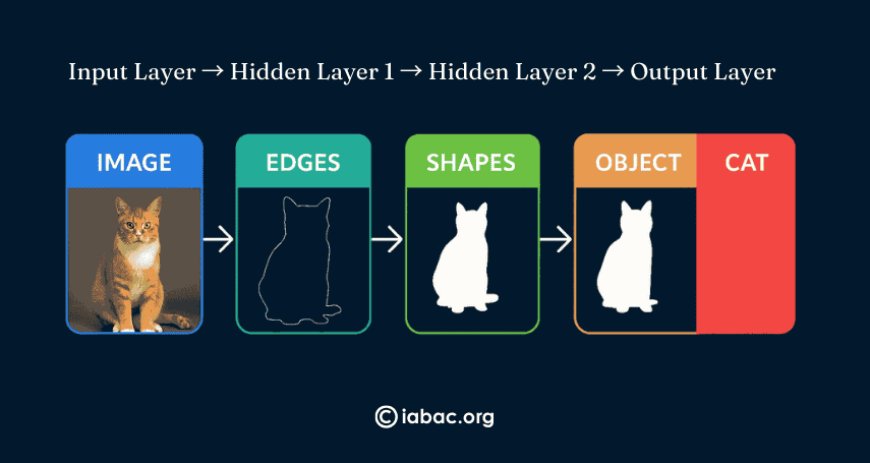
Input Layer → Hidden Layer 1 → Hidden Layer 2 → Output Layer
Each layer transforms data from raw → meaningful → answer.
Example:
Image → edges → shapes → object → “Cat”
The network learns these “steps” automatically.
Training an ANN (Step-by-Step Beginner Friendly)
Step 1: Collect Data
This is where everything begins. The model needs examples images, text, audio, sensor readings, or numbers so it can learn patterns from real-world information.
Step 2: Preprocess Data
Before training, the raw data must be cleaned.
This includes removing errors, normalizing values, converting formats, and splitting the data into training and testing sets so the model learns properly and is evaluated fairly.
Step 3: Build the Model
Here, you design the structure of the neural network how many layers it will have, how many neurons, what activation functions to use, and what shape the input and output should be.
Step 4: Forward Propagation
You feed the data into the model and let it make a prediction.
The output might be right or wrong, but this step shows how good or bad the model currently is.
Step 5: Calculate Loss
Loss measures how far the model’s prediction is from the correct answer.
The higher the loss, the more mistakes the model is making.
Step 6: Backpropagation
Now the model learns.
It sends the loss backward through the network and adjusts each weight slightly, correcting the mistakes from the previous prediction.
Step 7: Optimization
Optimizers like Adam, SGD, and RMSProp help the model update weights efficiently so it learns faster and more accurately.
Think of them as smart coaches guiding the learning process.
Step 8: Evaluate
After training, the model is tested using unseen data to check how well it performs.
Metrics like accuracy, precision, and recall show whether the model has truly learned or still needs improvement.
Simple ANN Code Example (Keras)
from tensorflow.keras.models import Sequential
from tensorflow.keras.layers import Dense
model = Sequential([
Dense(16, activation='relu', input_shape=(4,)),
Dense(8, activation='relu'),
Dense(1, activation='sigmoid')
])
model.compile(optimizer='adam', loss='binary_crossentropy', metrics=['accuracy'])
model.fit(X_train, y_train, epochs=20)
Just 10–12 lines to build an ANN.
Advantages of ANN
-
Learns complex patterns: ANNs can understand relationships in data that traditional models often miss, even when the patterns are highly nonlinear.
-
Works on images, text, audio: They can handle multiple data types, making them useful in everything from computer vision and speech to language processing.
-
Highly accurate: With enough data and proper training, neural networks achieve high accuracy in classification, prediction, and recognition tasks.
-
Adapts over time: ANNs can continue improving as new data is added, allowing them to stay relevant and effective in changing environments.
-
Automates feature extraction: Neural networks automatically learn which features matter most, eliminating the need for manual feature engineering.
Disadvantages of ANN
-
Needs lots of data: Neural networks perform best only when trained on large amounts of high-quality data, which can be hard or expensive to collect.
-
Slower training: ANNs require many training cycles and heavy computation, making the learning process slower compared to simpler ML models.
-
Hard to interpret: It’s difficult to understand why a neural network makes a certain decision, which reduces transparency and trust in sensitive fields.
-
Computationally expensive: Training and running ANN models often need powerful GPUs or cloud resources, increasing hardware and operational costs.
Common Mistakes Beginners Make
-
Too many layers: Beginners often add unnecessary layers, making the model overly complex and harder to train without improving accuracy.
-
Wrong learning rate: A learning rate that’s too high causes unstable training, while one that’s too low makes learning extremely slow.
-
Not enough data: Training with limited data leads to weak patterns and poor accuracy because the model doesn’t have enough examples to learn from.
-
Overfitting: The model memorizes the training data instead of learning general patterns, resulting in poor performance on new data.
-
No regularization: Skipping techniques like dropout, L2 regularization, or batch normalization makes the model prone to overfitting.
-
Poor preprocessing: Incorrect scaling, missing value handling, or messy input data confuses the network and leads to inaccurate predictions.
Future of Artificial Neural Networks (2025–2030)
ANNs will drive:
-
Fully autonomous vehicles
-
AI doctors
-
AI-powered robots
-
Real-time translation without errors
-
Intelligent tutoring systems
-
Hyper-personalized AI assistants
ANN is not fading. It’s evolving.
Transformers didn’t replace ANN; they are advanced ANNs.
Every big AI model you see in 2026 still uses neural networks at the core.
ANN Is the Heart of Modern AI
Artificial Neural Networks started as a research idea.
Today, they shape industries, jobs, opportunities, and the way we interact with technology.
If AI is the future, ANN is the engine.
And now you understand it clearly, deeply, confidently.
Frequently Asked Questions
Q1: What is ANN in simple words?
A computer model that learns patterns from data like a human brain.
Q2: Where is ANN used?
Healthcare, finance, vehicles, NLP, robotics, cybersecurity.
Q3: ANN vs CNN vs RNN?
-
ANN → general pattern learning
-
CNN → images
-
RNN → sequences
Q4: Is ANN a part of AI or ML?
It is part of Machine Learning and the foundation of Deep Learning.
Q5: Why is ANN important today?
Because all modern AI systems rely on it.