



























































Module 5: Recurrent Neural Networks
Master Recurrent Neural Networks in Module 5. Learn RNNs, LSTMs, and Bidirectional models to help AI understand sequences, speech, and time-based data.


When Patterns Start Telling Stories
Up until now, your AI has learned how to recognize images, detect objects, and understand its visual world.
But intelligence isn’t just about vision.
It’s also about time, memory, and context.
Think about it.
When you listen to a song, you don’t process every note separately; you understand the flow.
When someone speaks, you don’t interpret words in isolation; you connect them to form meaning.
Humans rely heavily on sequences.
So does real intelligence.
This module is where your AI begins to understand sequences and patterns that unfold over time.
And the tools that make this possible are Recurrent Neural Networks (RNNs) and their powerful variants like LSTMs and Bidirectional RNNs.
If convolutional neural networks taught your AI to see, RNNs teach it to think in time.
Welcome to one of the most important steps in becoming an Artificial Intelligence Expert.
What Are Recurrent Neural Networks (RNNs)?
A Recurrent Neural Network is designed to handle sequential data where order matters.
Examples include:
-
Speech
-
Text
-
Stock market data
-
Weather patterns
-
Heartbeat signals
-
Music
-
Video frames
Unlike traditional neural networks, which assume every input is independent, RNNs have memory.
They remember information from previous steps and use it to influence the next output.
If a regular neural network is a calculator, an RNN is a storyteller it understands how one moment connects to the next.
How RNNs Work: The Secret Is Memory
RNNs repeat the same operation at each time step, while carrying a hidden state, a form of memory.
Imagine reading a sentence:
“The cat sat on the…”
Before you even see the last word, your brain predicts it:
-
“mat”
-
“sofa”
-
“floor”
Why?
Because your memory of earlier words shapes your expectation.
RNNs work exactly the same way.
Each step:
-
Takes an input
-
Processes it
-
Remembers something
-
Passes that memory forward
This gives your AI a “sense of context” something basic neural networks simply can’t achieve.
The Problem: Vanishing Gradients
Early RNNs struggled to remember long-term patterns.
During backpropagation, gradients became extremely small making the network forget information from earlier steps.
This made tasks like language translation or long-sentence predictions nearly impossible.
But then came the breakthrough.
LSTMs Long Short-Term Memory Networks
Introduced in 1997, LSTMs solved the vanishing gradient problem and completely transformed sequential AI.
Here’s why LSTMs matter:
-
They can store information for long periods
-
They decide what to remember and what to forget
-
They work great for language, sound, and time-series data
LSTMs use three “gates”:
-
Forget gate: What information to throw away
-
Input gate: What new information to store
-
Output gate: What to output at this time step
It’s like giving your AI a highly organized filing system instead of remembering everything, it remembers what matters.
Bidirectional RNNs Understanding Context in Both Directions
Sometimes, understanding doesn’t come from the past alone, the future matters too.
For example:
“I went to the bank to deposit money.”
“I sat by the bank of the river.”
The meaning of the word “bank” depends on words after it.
Bidirectional RNNs solve this by reading sequences forward and backward, creating a richer understanding of context.
These networks are widely used in:
-
Speech recognition
-
Language translation
-
Named entity recognition
-
Sentiment analysis
This is where your AI begins to understand not just sequences but meaning.
Building RNN Models in Keras
Let’s look at a simple example using TensorFlow and Keras.
Here’s the skeleton of a basic RNN model:
from tensorflow.keras.models import Sequential
from tensorflow.keras.layers import SimpleRNN, Dense, Embedding
model = Sequential([
Embedding(input_dim=5000, output_dim=64),
SimpleRNN(128, activation='tanh'),
Dense(1, activation='sigmoid')
])
An LSTM version:
from tensorflow.keras.layers import LSTM
model = Sequential([
Embedding(5000, 64),
LSTM(128),
Dense(1, activation='sigmoid')
])
And for advanced performance, Bidirectional LSTM:
from tensorflow. keras.layers import Bidirectional
model = Sequential([
Embedding(5000, 64),
Bidirectional(LSTM(128)),
Dense(1, activation='sigmoid')
])
With this, you can build:
-
Sentiment analysis models
-
Language classifiers
-
Speech-to-text architectures
-
Time-series prediction systems
You’re no longer just detecting patterns, you're predicting them.
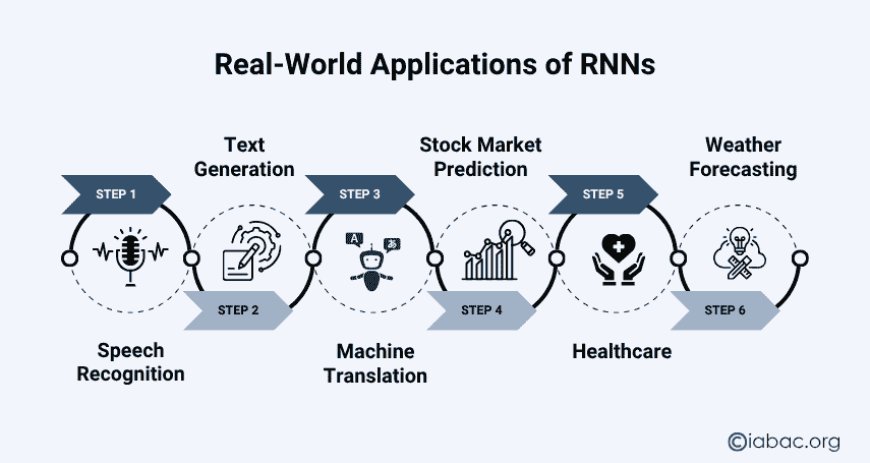
Real-World Applications of RNNs
RNNs power some of the world’s most advanced AI systems:
Speech Recognition
Systems like Siri, Google Assistant, and Alexa use RNNs to interpret spoken language.
Text Generation
Writing poetry, generating scripts, completing sentences all powered by sequence learning.
Machine Translation
Google Translate uses combinations of LSTMs and Transformers.
Stock Market Prediction
RNNs analyze time-based data for trend forecasting.
Healthcare
Predicting patient vitals, analyzing ECG signals, or detecting irregular heartbeats.
Weather Forecasting
Understanding patterns over time to predict temperature, rainfall, and storms.
Wherever there is time, there is a need for RNNs.
Common Challenges (and How Experts Handle Them)
Overfitting
RNNs tend to memorize patterns.
Solution: Dropout, regularization, and larger datasets.
Long Training Times
RNNs process data step-by-step, which can be slow.
Solution: Use LSTMs, GRUs, and GPU acceleration.
Difficulty Understanding Dependencies
Long sentences can be challenging.
Solution: Use Bidirectional RNNs or Transform your architecture in Module 6.
Data Preprocessing
Text requires tokenization, embedding, and cleaning.
Solution: Apply NLP preprocessing techniques (coming in the next module).
Why Learning RNNs Makes You a Better AI Expert
Understanding sequences is a milestone not just technically, but conceptually.
It teaches you:
-
How AI handles context
-
How memory influences prediction
-
How patterns evolve through time
These skills are essential for becoming an Artificial Intelligence Expert, especially in fields like NLP, finance, healthcare, and voice technology.
Mastering RNNs gives you the intuition to build models that don’t just see the world, they interpret it.
Learning from the Past
By completing this module, you now understand:
-
What RNNs are and why they matter
-
How LSTMs solve memory limitations
-
How Bidirectional networks capture left–right context
-
How to build RNN, LSTM, and Bi-LSTM models in Keras
-
Real-world applications across speech, text, finance, and healthcare
You’ve given your AI something incredibly human the ability to learn from the past to understand the present.
What’s Next?
Now that your AI can understand sequences, it’s time to teach it something even more powerful language.
Next up:
Module 6: Natural Language Processing (NLP) Teaching AI to Understand Humans
This is where your AI begins to read, analyze, interpret, and generate text from chatbots to sentiment analysis to Transformers and the foundations of GPT.
Your journey as an Artificial Intelligence Expert is about to become even more exciting.