


















































AI Machine Learning and Its Impact
Understand how AI and machine learning shape our world, from daily life improvements to business innovations. Discover their real-life benefits and changes.


AI Machine Learning is changing the world in incredible ways. It's not just a technology of the future; it’s already here, making a real difference in our daily lives. From big advancements in healthcare to more personalized customer service, AI is helping industries work better and faster. With years of experience and hands-on work in this field, I’ve seen how much AI Machine Learning can achieve, along with some of the challenges it brings. Understanding both the benefits and ethical questions around AI is key to seeing how it’s impacting businesses and society worldwide. By balancing these aspects, we can appreciate the powerful influence AI Machine Learning is having across different fields.
What is AI Machine Learning?
AI (Artificial Intelligence) refers to machines or software systems designed to simulate human intelligence. This means that AI systems can "learn" and "think" to some extent, adapting to new inputs, identifying patterns, and making decisions based on data. Machine Learning (ML) is a subset of AI that focuses on the concept that systems can automatically learn and improve from experience without being explicitly programmed.
In simpler terms:
- Artificial Intelligence aims to create systems capable of performing tasks that usually require human intelligence, such as understanding natural language, recognizing objects, and making decisions.
- Machine Learning is a method that enables computers to learn from data patterns to improve their performance over time on specific tasks.
Machine Learning has become the core of AI because of its ability to handle vast amounts of data. By analyzing this data, ML algorithms can identify patterns and develop insights without requiring human intervention. These algorithms fall into various categories, such as supervised, unsupervised, semi-supervised, and reinforcement learning, each used for different types of problems and data structures.
The Importance and Impact of AI Machine Learning Across Industries
AI Machine Learning has revolutionized nearly every industry by improving efficiencies, reducing operational costs, and enabling predictive insights that would otherwise be impossible. Here’s a look at some of the most significant impacts AI ML has had:
1. Healthcare and Medicine
- Predictive Diagnostics: AI can analyze large datasets, such as medical images or patient history, to detect patterns, helping doctors diagnose conditions early.
- Personalized Treatment: Machine Learning algorithms can analyze data on how patients respond to treatments, allowing for more personalized and effective healthcare plans.
- Drug Discovery: AI accelerates drug discovery by simulating how different chemical compounds interact with biological systems.
2. Finance and Banking
- Fraud Detection: Machine Learning models can identify suspicious transactions and potential fraud in real-time, providing banks with a powerful tool against financial crime.
- Risk Assessment: AI helps assess risks by analyzing historical data, which is invaluable for making decisions on loans, investments, and credit scoring.
- Customer Service: Chatbots powered by AI provide instant customer support and streamline operations.
3. Retail and E-commerce
- Personalized Recommendations: Machine Learning algorithms analyze browsing behavior to suggest products, enhancing the customer shopping experience.
- Inventory Management: AI optimizes stock levels and supply chain logistics, reducing costs and preventing stockouts.
- Dynamic Pricing: Based on demand, competitors’ prices, and other factors, AI models can adjust prices in real time.
4. Manufacturing and Logistics
- Predictive Maintenance: By analyzing equipment data, Machine Learning can predict maintenance needs, minimizing downtime and reducing costs.
- Quality Control: AI systems analyze product images to detect defects, ensuring higher quality and reducing waste.
- Supply Chain Optimization: AI improves forecasting accuracy, ensuring timely delivery and better resource allocation.
5. Education and E-Learning
- Personalized Learning Paths: AI tailors educational content based on a student’s learning pace and style, helping students learn more effectively.
- Automated Grading and Assessment: Machine Learning algorithms can assess assignments and exams, providing feedback and reducing the workload on educators.
Each of these examples demonstrates how AI Machine Learning can reshape industries, creating more efficient and personalized experiences. As AI continues to advance, we can expect even more profound transformations in our daily lives and the way businesses operate.
Key Technologies in AI Machine Learning
To better understand AI Machine Learning, let’s explore a few key technologies often used in developing these solutions:

- Neural Networks: Modeled after the human brain, neural networks are used in deep learning to process complex patterns in data.
- Natural Language Processing (NLP): This technology allows computers to understand and generate human language, a fundamental capability in applications like chatbots, sentiment analysis, and language translation.
- Computer Vision: This enables machines to interpret and understand visual information from the world, critical for applications in fields such as healthcare, automotive (self-driving cars), and security.
- Reinforcement Learning: A type of Machine Learning where agents learn by interacting with an environment and receiving feedback based on their actions, widely used in robotics and gaming.
Getting Started with AI Machine Learning Certification
Starting a career in AI Machine Learning often requires foundational knowledge in areas such as mathematics, statistics, programming (e.g., Python), and understanding of ML algorithms. While there is no one-size-fits-all certification, getting certified in AI Machine Learning can validate your skills and help open doors in this competitive field.
Why Pursue an AI Machine Learning Certification
- Structured Learning Path: Certifications provide a structured approach to learning, ensuring you cover all essential areas.
- Career Advancement: Certified professionals often find better job prospects and higher salaries.
- Hands-On Experience: Many certification programs include practical projects and exercises to apply your knowledge.
Best AI Machine Learning Certification for Beginners: IABAC
If you’re new to AI and Machine Learning, the International Association of Business Analytics Certification (IABAC) offers a well-recognized program for beginners and professionals alike. The IABAC certifications are designed to validate practical skills in AI and data science, combining theoretical understanding with real-world applications.
Key IABAC Certifications in AI Machine Learning:
- Certified AI Professional (CAIP): Aimed at beginners, this certification covers the fundamentals of AI, ML, and data science, providing a comprehensive overview of the field.
- Certified Machine Learning Professional (CMLP): This certification goes deeper into Machine Learning, covering core algorithms, neural networks, and applications.
- Certified Data Science Professional (CDSP): For those looking to expand their knowledge in data science, this certification combines AI, Machine Learning, and analytics to provide a broad skill set for industry applications.
Each IABAC certification is structured to include both theoretical concepts and practical applications, ensuring that learners can confidently apply their knowledge in real-world situations. Additionally, these certifications offer international recognition, which can be valuable for global career opportunities.
Steps to Begin Your AI Machine Learning Journey
- Learn the Basics: Start by understanding core concepts in AI, Machine Learning, and data science. Basic knowledge of programming (Python is widely used) is helpful.
- Explore Free Resources: Many online platforms provide free resources, tutorials, and introductory courses to help you get started.
- Get Hands-On Experience: Practice with small projects, using libraries like Scikit-Learn, TensorFlow, and PyTorch to build simple ML models.
- Earn a Certification: Consider an IABAC certification to validate your skills and gain credibility as you pursue a career in AI Machine Learning.
- Stay Updated: AI and ML are evolving fields, so keep learning by following industry news, research papers, and engaging with the community.
How AI Machine Learning is Changing Learning and More
AI Machine Learning is transforming fields like healthcare, finance, and especially education. From making processes quicker to offering new ways to learn, AI is changing how we work, learn, and interact with technology. Here’s a look at how AI Machine Learning is shaping learning and the broader world.
Big Changes with AI and Machine Learning
1. Boosting Productivity: AI-powered tools handle repetitive tasks, freeing up time and speeding up decision-making by analyzing large amounts of data.
2. Smarter Predictions: AI helps businesses spot trends, improve customer experiences, and use resources more efficiently by finding patterns in data.
3. Healthcare Improvements: In healthcare, AI supports doctors with diagnostics, patient monitoring, and customized treatments, helping speed up medical research and improve patient care.
How AI Machine Learning Impacts Education
Education is one of the areas where AI Machine Learning has the biggest impact, making learning more accessible, engaging, and customized.
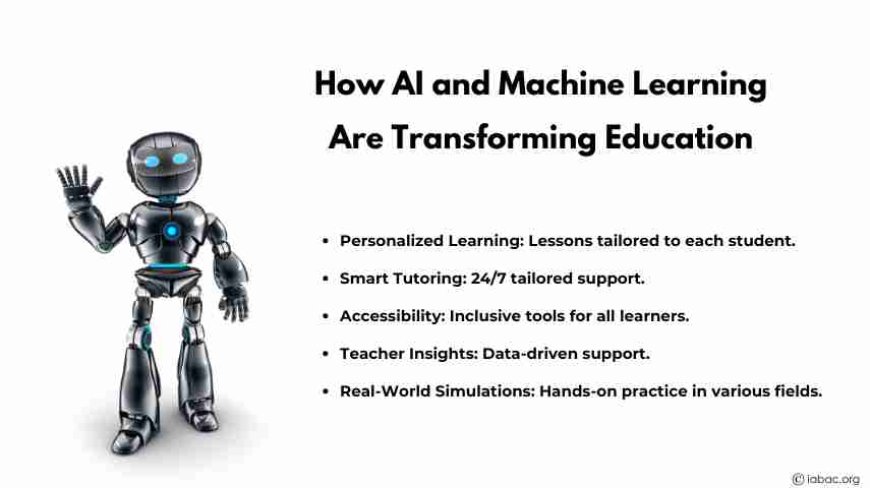
1. Tailored Learning: AI-powered tools adjust lessons to a student’s pace, interests, and strengths, creating a more personalized experience that helps students stay motivated and remember what they learn.
2. Smart Tutoring: Virtual tutors are available anytime, offering support that adapts to students’ needs and giving personalized feedback to reinforce understanding.
3. Better Accessibility: AI tools like text-to-speech and translation software help students with disabilities and break down language barriers, making learning more inclusive for everyone.
4. Insights for Teachers: AI tracks how students are doing, helping teachers spot areas where students might need extra help and find ways to improve learning outcomes.
5. Hands-On Learning with Simulations: AI-powered simulations in fields like medicine and engineering let students safely practice skills, connecting classroom learning with real-world applications.
Challenges and the Future of AI-Driven Learning
While AI has many benefits, it also brings challenges, like concerns about data privacy and potential bias in algorithms. As AI becomes more involved in education, balancing these tools with human guidance will be essential for meaningful learning.
AI Machine Learning is changing how we learn, making education more personalized, accessible, and flexible. Although there are challenges, AI’s potential to create engaging, data-informed, and inclusive learning experiences is clear. With thoughtful use, AI can help create a future where education is customized to each person’s needs, better-preparing students for the world ahead.