


















































What Are Generative AI Fundamentals?
Learn generative AI fundamentals in simple terms. Understand how it works, key models, real examples, benefits, and career skills for beginners.

The terms "generative AI" or "gen-AI" have become popular phrases in the field of artificial intelligence. However, many students and professionals wonder: what exactly does it mean? What are the fundamental ideas, models, applications, constraints, and morals that one should understand?
I'll provide a clear, understandable, and systematic overview of the principles of generative AI so that you, whether a beginner, an AI expert, or someone interested in the area, may create a solid foundation.
What Is Generative AI?
At its simplest, generative AI refers to a class of artificial intelligence systems that generate new content, text, images, music, code, video, etc. Not simply by classifying or predicting from existing data, but by creating novel outputs. For example, a generative model can write a paragraph that didn’t previously exist, or produce an image from a text description.
Here are a few key points to anchor the concept:
-
It is a subset of machine learning and deep learning: It uses learning from large datasets, identifying patterns, and then generating new content that follows those patterns.
-
Its purpose is creative, or generative, rather than simply discriminative (i.e., rather than simply “this is cat vs dog”, it produces something new).
-
It often uses very large models trained on vast amounts of data (for example, language, images, code).
Thus, when one speaks of this, we refer to this capability of creation, powered by sophisticated models and data.
Why Is Generative AI Important?
Understanding the “why” helps you see the value and relevance of this across industries and for learners.
-
New Content at Scale
It enables the creation of content (text, images, music, code) at a speed and scale that would be difficult manually. For example, businesses can generate marketing copy, and designers can generate mock-ups from text descriptions.
-
Creative & Assistive Usage
Rather than replacing the human entirely, it can assist human creativity, suggesting ideas, drafting content, and generating prototypes. This makes it valuable for writers, designers, developers, and educators.
-
Enabling New Interfaces and Experiences
With generative AI, users can “converse with data” or “describe what you want and get it”. For instance, you give a description and get an image, or ask a model to generate code from a prompt.
-
Business Transformation
Many companies treat this as a strategic lever for innovation: automating content creation, enhancing customer service, enabling personalization, and accelerating research and development.
Hence, this is important because it expands what’s possible, not just automating existing work but enabling new kinds of work.
Core Concepts and Technical Foundations
To understand this, a few core concepts and technical foundations are essential. Below are the key ones.
Training Data and Patterns
Generative models require large amounts of data. They learn patterns, structures, and relationships in that data (text, images, code, etc.). Then they generate new instances that resemble the learned distribution.
Model Architectures
Some of the main architectures used include:
-
Generative Adversarial Networks (GANs): Two networks, a generator and a discriminator, compete, which helps produce realistic outputs (especially images).
-
Variational Autoencoders (VAEs): Encode data into latent representations, then decode to generate new outputs.
-
Transformer-based Models / Large Language Models (LLMs): Especially for text generation (and multimodal tasks), models like GPT use transformer architectures.
Foundation Models
This term refers to large pretrained models that can be adapted to many tasks. These models are the backbone of many applications. For example, a large language model trained on millions of documents can then be fine-tuned or prompted for specific generation tasks.
Prompting and Instructions
In many generative AI systems, one interacts with the model via prompts (input text or other instructions) that guide the generation. The quality and design of prompts strongly affect the output.
Output and Creative Space
Because generative models are probabilistic, they may produce multiple possible outputs for the same prompt. They are not deterministic in the human sense. This means there is creative variability (which is powerful) but also unpredictability (which must be managed).
Evaluation & Quality
Assessing generative outputs involves both objective metrics (e.g., reconstruction error, perplexity) and subjective judgment (does the output “make sense”, is it useful, is it creative?). Users and builders must understand that models can generate plausible but wrong or biased outputs.
Limitations and Hazards
Fundamentally, it is important to know that generative AI has limitations: hallucinations (outputs that are plausible but false), biases inherited from training data, resource constraints (compute, energy), and potential misuse (for deepfakes, misinformation).
Types of Generative AI Outputs and Use-Cases
This is not one single use case; it spans many types of outputs. Understanding the types helps learners see where the fundamentals apply.
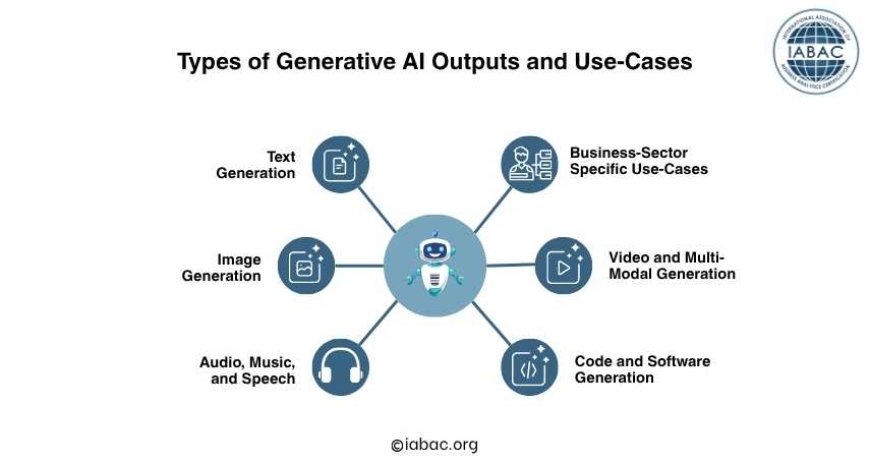
Text Generation
Models generate articles, stories, summaries, code, and conversations. Example: large language models can produce coherent paragraphs or code from prompts.
Image Generation
From textual descriptions (“a sunset over mountains in cubist style”) to fully new images. GANs and diffusion models are heavily used here.
Audio, Music, and Speech
Generative models can synthesize speech, music compositions, or other audio forms. This less-visible area is rapidly growing.
Code and Software Generation
Some models accept programming prompts and generate code, templates, or software components. This is increasingly relevant for developers.
Video and Multi-Modal Generation
Emerging systems combine modalities: video, text, audio, or even sensor data. While still more complex, they illustrate how these fundamentals scale.
Business-Sector Specific Use-Cases
-
Marketing: Generating copy, images, campaign ideas.
-
Customer service: Chatbots that generate responses.
-
Design: Generating product prototypes, UX drafts.
-
Healthcare & science: Generating molecular structures, images for diagnostic training, and synthetic datasets.
When you understand the fundamentals, you can assess which use-cases are realistic, beneficial, and feasible.
How to Get Started with Generative AI: For Learners
If you are learning these fundamentals (as this blog is aimed to help you), here is a practical roadmap:
-
Foundation: Understand basic AI/ML concepts
You should be comfortable with machine learning (supervised, unsupervised), neural networks, and representation of data. Without this base, it may feel opaque.
-
Learn about model architectures
Study how GANs work, how transformer models work, and what autoencoders are. These are the building blocks.
-
Explore tools and platforms
Many frameworks, libraries, and tutorials exist. Try simple generative tasks: text generation with open source LLMs, image generation with GAN/diffusion models.
-
Experiment with prompts and instruction design
Practice giving clear prompts and evaluating outputs. See how changing the prompt changes the output.
-
Evaluate outputs and understand limitations
Check for correctness, coherence, bias, and ethical issues. Learn to question the results, “Is this too good to be true? Is it biased?”.
-
Work on real-world use-cases
Pick a domain you care about (education, marketing, design, science) and try to craft a small experiment.
-
Stay aware of ethics, regulations and responsible use
Consider data privacy, copyright, bias, hallucination risk, and energy usage. These are essential for professional use of it.
By following this roadmap, your understanding becomes practical and not just theoretical.
Where Generative AI Is Heading, Trends and Future Outlook
Looking ahead, a few trends bear mentioning for learners who want to stay ahead.
-
Multi-modal generation: Models that accept and generate across different media (text + image + audio + video) are gaining traction.
-
Smaller, specialised models: While large foundation models dominate today, there will be more efficient, domain-specific generative models.
-
Improved controllability and alignment: Ensuring that generated content aligns with user intent, values, and ethics is an active research area.
-
Hybrid human-AI workflows: It will become more integrated into human workflows (design, writing, coding) as a partner rather than a replacement.
-
Regulation, accountability, watermarking: Due to concerns about misuse (deepfakes, misinformation), expect more governance around these outputs.
-
Education and literacy: As it becomes widespread, individuals across fields will need literacy in prompt design, ethics, and evaluation.
For learners, grasping these future-focused directions helps in shaping one’s skills and mindset for what lies ahead.
The field of generative AI is full of possibilities, but those opportunities come with responsibility. If you take the time to understand the foundations — how generative models learn, how they create, what prompts they do, what the constraints and risks are, you will be in a good position to use it successfully and ethically.
If you want to strengthen your knowledge or obtain certification in generative AI basics, consider pursuing the Generative AI Certification, which is a recognized certificate that validates your skills.